
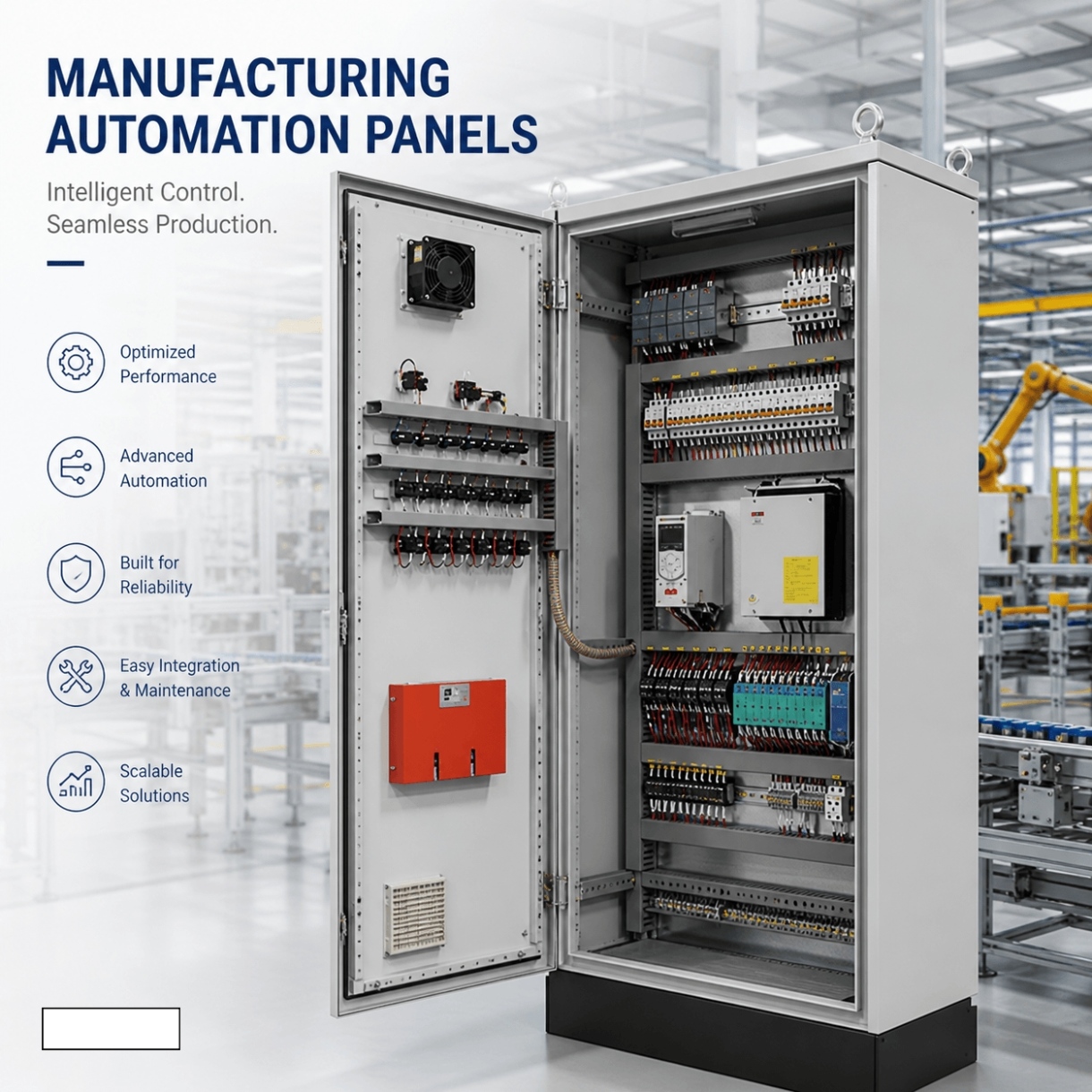
Process Control Panels
Manufacturing Automation Panel Supplier
Manufacturing automation panels for OEM machinery and production lines — PLC, I/O, drives and enclosures integrated by Foshan suppliers with short lead times.
Specifications
- Application
- Custom Industrial Automation
- Control Method
- PLC / Relay Based
- Voltage
- 220V / 380V / 480V Available
- Protection Rating
- IP54 / IP65 Optional
- CCommunication Protocol
- Modbus / Profinet / Ethernet/IP
- Testing
- FAT Before Shipment
- Customization
- Available
Quick Answer
Manufacturing automation panels coordinate PLC, VFD, HMI and safety across your production line - continuous, batch or hybrid processes. UniRegal designs or builds to print using multi-brand components, with UL 508A construction available. Lead time ~15 days; send your process description and I/O list for a quotation.
Machinery Control Panels Built Around the Complete Machine Cycle
UniRegal supplies custom machinery control panels for OEM equipment, packaging machinery, conveying systems, processing equipment, and automated production machines.
Each panel is developed around how the machine must power up, enter manual or automatic operation, coordinate motors and actuators, respond to sensors, handle faults, protect operators, communicate with adjacent equipment, and recover after an interruption.
For machine builders, the objective is not simply to install a PLC, HMI, and drives inside an enclosure. The objective is to create a documented control system that can be tested with the machine, reproduced for future builds, installed at the customer’s site, and maintained throughout the equipment lifecycle.
Is a Machinery Control Panel the Right Product for Your Project?
Project Requirement | Recommended Direction |
|---|---|
A new OEM machine requires power, logic, HMI, motion, safety, and field wiring | Machinery Control Panel |
An approved machine design must be reproduced for multiple units | Repeat-Build OEM Machinery Control Panel |
An existing machine needs obsolete controls replaced | Retrofit Machinery Control Panel |
A machine must exchange operating signals with an existing production line | Line-Integrated Machinery Control Panel |
The project mainly requires PLC hardware and software without full machine electrical integration | PLC Control Panel |
The project mainly requires starting and protecting one or several motors | Motor Control Panel |
The project requires centralized power distribution for multiple independent motor feeders | MCC Panel |
A machinery control panel is the correct choice when the control system must be designed around the behavior and delivery requirements of a specific machine.
Machinery Control Panel Capability Overview
Parameter | Available Project Options |
|---|---|
Project Route | Build-to-Print or Design-and-Build |
Machine Stage | Concept, Prototype, Production Build, Repeat Build, or Retrofit |
Control Architecture | Relay, PLC, HMI, VFD, Servo, Remote I/O, or Hybrid |
Operator Interface | Push Buttons, Selector Switches, Local Stations, or HMI |
Motion Control | Contactors, VFDs, Servo Drives, or Project-Specified Controllers |
Safety Control | Safety Relay or Safety Controller Based on Approved Safety Requirements |
Panel Construction | Wall-Mounted, Machine-Mounted, or Floor-Standing |
Enclosure Material | Carbon Steel or Stainless Steel |
Protection Rating | Selected According to the Installation Environment |
Communication | Hardwired Signals or Project-Specified Industrial Networks |
Documentation | Schematics, BOM, Layout, Terminal Plan, I/O List, Program Backup, and Test Records |
Production Quantity | Prototype, Project Batch, or Repeat OEM Production |
Testing | Panel Inspection, I/O Simulation, Functional FAT, or Machine-Connected FAT |
Standards | Confirmed According to Machine Type, Destination Market, and Contractual Scope |
Final ratings, component brands, safety requirements, software scope, standards, and FAT responsibilities are confirmed during the technical review.
A Machinery Control Panel Begins With the Machine Cycle
The machine cycle should be defined before the electrical architecture and software are finalized.
Depending on the equipment, a cycle may include loading, detection, positioning, clamping, movement, processing, inspection, rejection, unloading, and reset. The actual sequence must be supplied or approved by the machine builder because it determines the required sensors, actuators, I/O points, interlocks, motion devices, alarms, and recovery logic.
A useful sequence description should explain:
- What permits the machine to start
- Which devices must be in their home positions
- Which actions may occur simultaneously
- Which sensor confirms each movement
- What happens when confirmation is not received
- How the operator pauses or stops the machine
- Which faults require manual intervention
- What conditions permit a reset
- Whether the machine resumes or restarts after interruption
- How the machine communicates with upstream and downstream equipment
Without these decisions, the panel build may proceed, but complete machine behavior cannot be reliably verified.
Machine Operating States and Modes
Operating states should be understandable to operators, commissioning engineers, and maintenance personnel.
A project may include states such as power-up, stopped, ready, starting, running, holding, stopping, faulted, and resetting. Modes may include setup, manual, jog, automatic, maintenance, local, or remote operation.
The required states and modes must be defined for the actual machine. For equipment manufacturers that require standardized behavior across several machine platforms, ISA-88 or PackML-based state models can be considered where applicable.
Important questions include:
- Which controls are available in setup mode?
- Can individual devices be jogged with guards open?
- Which permissions are required for maintenance functions?
- What happens to material inside the machine after a stop?
- Does clearing a fault permit an automatic restart?
- Which state is reported to the production line?
- How is a blocked or starved condition handled?
These decisions affect the PLC program, HMI navigation, safety design, operator training, and final acceptance test.
Information Required Before Engineering
Required Information | Why It Matters |
|---|---|
Machine Description | Establishes the intended operation and control boundary |
Mechanical Layout | Shows equipment positions, panel location, cable routes, and operator access |
Operating Sequence | Defines machine states, transitions, interlocks, timers, and fault responses |
Motor and Drive List | Defines switching, protection, VFD, servo, and power requirements |
Actuator List | Identifies pneumatic, hydraulic, and electrically operated devices |
I/O List | Determines PLC, remote I/O, terminal, and spare-capacity requirements |
Sensor List | Defines signal types, supply requirements, and expected feedback |
Operator Workflow | Determines push buttons, HMI screens, access levels, and manual controls |
Safety Assessment | Defines required safety functions and their required performance |
Pneumatic or Hydraulic Diagram | Clarifies valve operation, stored energy, and actuator behavior |
Line Interface List | Defines signals exchanged with upstream and downstream equipment |
Supply Voltage and Frequency | Determines the electrical ratings of panel components |
Installation Environment | Determines enclosure material, sealing, cooling, and installation method |
Destination Country | Helps identify applicable electrical, marking, and documentation requirements |
FAT Requirements | Defines what must be demonstrated before shipment |
Production Quantity | Distinguishes a prototype from a controlled repeat-build program |
If some documents are unavailable, send the machine layout, operating description, motor list, available drawings, and target market first. Missing engineering inputs can then be identified before quotation.
Power, Logic, Motion, and Field Devices
A machinery control panel may combine several control disciplines, but each should have a clearly defined responsibility.
Control Area | Typical Scope |
|---|---|
Incoming Power | Main isolation, branch protection, control power, and distribution |
Machine Logic | Operating modes, sequences, timers, counters, permissives, and interlocks |
Motor Control | Direct starting, reversing, soft starting, or variable-speed operation |
Servo Motion | Homing, positioning, indexing, synchronization, and motion status |
Pneumatic or Hydraulic Control | Solenoid operation, position confirmation, pressure permissives, and timeouts |
Operator Control | Start, stop, reset, mode selection, parameter entry, and status display |
Field Devices | Sensors, switches, valves, actuators, motors, instruments, and local stations |
Diagnostics | Alarm identification, first-out indication, device status, and recovery guidance |
Communication | Drive, remote I/O, machine-to-machine, SCADA, or production-line interfaces |
Motor, drive, and servo sizing should be confirmed by the machine designer or motion engineer. The panel design can implement approved equipment selections, but it should not assume mechanical load, inertia, acceleration, or braking requirements from a general machine description.
Servo, VFD, and Pneumatic Coordination
Many industrial machines require several forms of movement to operate as one cycle.
A conveyor may use a VFD, an indexing mechanism may use a servo axis, and a clamp may use a pneumatic cylinder. Their control logic must define when each movement is permitted, how completion is confirmed, and what happens if a device does not reach its expected state.
The engineering review should confirm:
- Servo axis quantity and approved drive models
- Homing method and home-position sensors
- Travel limits and mechanical limit switches
- VFD speed references and acceleration requirements
- Motor brake control where applicable
- Pneumatic valve and cylinder feedback
- Pressure or vacuum permissives
- Motion and actuator timeout values
- Conditions that stop one device or the complete machine
- Recovery after product jams or incomplete movement
This coordination is one of the main differences between a machinery control panel and a general PLC cabinet.
Operator-Focused HMI and Machine Diagnostics
The HMI should help the operator run and recover the machine, not simply display PLC tags.
A machinery HMI may include:
- Machine overview and current operating state
- Setup, manual, and automatic operation
- Individual device status
- Recipe or product parameter management
- Production counters
- Alarm history
- First-out fault indication
- Interlock or permissive status
- Maintenance screens
- Drive and servo status
- I/O diagnostic pages
- User access levels
- Upstream and downstream machine status
Alarm messages should identify the affected device, explain the condition preventing operation, and indicate the next approved operator action where possible. Messages such as “Machine Fault” provide little value during production or remote troubleshooting.
Parameter limits, password ownership, user access levels, languages, software licenses, and delivery of PLC and HMI source files should be agreed before programming begins.
Machine Safety Functions and Responsibility Boundaries
Machine safety begins with the machine-level hazard and risk assessment. The panel does not determine the required safety performance simply because a safety relay or safety PLC is installed.
The machine builder or responsible safety engineer should define:
- Identified machine hazards
- Required safety functions
- Emergency-stop zones
- Guard-door behavior
- Light-curtain, scanner, or safety-mat functions
- Safe stopping method
- Drive safe-torque-off requirements
- Reset location and reset conditions
- Required performance level or safety integrity level
- Validation and test requirements
UniRegal can implement approved safety requirements within the agreed panel and software scope. The final safety architecture, required performance, complete-machine validation, and regulatory responsibility must be confirmed for each project.
Safety Relay or Safety Controller?
A safety relay may be suitable for a machine with a limited number of straightforward safety functions.
A programmable safety controller may be considered when the machine has several guard zones, multiple operating modes, coordinated motion, distributed safety devices, detailed diagnostics, or connections to other machines.
The selection should follow the approved safety requirements. A programmable safety controller is not automatically required for every machine, and a standard PLC interlock should not be treated as a safety function unless the approved architecture permits it.
Upstream and Downstream Machine Integration
A machine installed within a production line must exchange more than a general start or stop command.
The interface may need to define:
- Machine ready
- Machine running
- Fault present
- Product available
- Product accepted
- Upstream blocked
- Downstream blocked
- Machine starved
- Speed reference
- Product or recipe selection
- Line hold
- Controlled stop request
- Emergency-stop zone status
- Local or line-control authority
Each signal should have a defined source, destination, active state, timeout response, and recovery condition. The project should also state whether the interface uses hardwired signals, an industrial communication network, or both.
Interface ownership must be agreed before commissioning so that the machine supplier, line integrator, and end user do not develop conflicting logic.
From Prototype to Repeat OEM Production
A prototype machine often changes during assembly and testing. For future machines to behave consistently, those changes must be converted into controlled production documents.
A repeat-build package should establish:
- Approved electrical schematics
- Approved panel layout
- Controlled bill of materials
- Accepted component alternatives
- PLC and HMI software versions
- Drive and servo parameter files
- Labeling conventions
- Terminal and cable schedules
- FAT procedure and acceptance criteria
- Revision history
- Serial-number or panel-identification rules
- As-built document release process
When a prototype is approved, its design can become the baseline for future production runs.uild-to-print sourcing is suitable when Any later component, wiring, or software change should be recorded against that baseline.
This approach helps OEMs avoid receiving panels that look similar but contain undocumented hardware or software differences.
Build-to-Print or Design-and-Build?
Build-to-Print Machinery Control Panels
B the electrical design, panel layout, BOM, software, and test procedure have already been approved.
UniRegal reviews the supplied documents for buildability, component availability, drawing conflicts, terminal allocation, and production requirements before assembly.
This route allows the machine builder to retain control of the original design while outsourcing the panel build.
Design-and-Build Machinery Control Panels
Design-and-build support is suitable when the machine function is known but the complete electrical build package has not yet been prepared.
The available mechanical layout, operating sequence, motor list, I/O list, safety requirements, line interfaces, and destination-market information are reviewed before an electrical architecture is proposed.
Design approval points should be established before production begins, especially for the control sequence, component brands, safety architecture, HMI functions, software ownership, and FAT criteria.
Factory Acceptance Testing for Machinery Control Panels
The FAT scope should reflect whether the panel is tested independently or connected to the actual machine.
Test Stage | What Can Be Verified |
|---|---|
Panel-Only FAT | Components, wiring, labels, grounding, control voltage, simulated I/O, HMI functions, communications, alarms, and logic responses |
Machine-Connected FAT | Motor direction, actuator sequence, sensor feedback, homing, motion, safety devices, jam recovery, and complete operating cycles |
Site Acceptance Test | Site supply, final field wiring, utilities, line interfaces, actual product, production conditions, and end-user operation |
A panel-only FAT cannot prove actual machine throughput, product quality, servo tuning under mechanical load, sensor position, or complete cycle performance. These items require the real machine, suitable test equipment, or final site conditions.
Available FAT Checks
Depending on the agreed scope, testing may include:
- Component and nameplate verification
- Enclosure and mechanical assembly inspection
- Wire continuity and terminal verification
- Protective bonding and grounding inspection
- Control-voltage verification
- Power-on testing
- Digital and analog I/O simulation
- PLC and remote I/O communication
- HMI screen and alarm checks
- VFD communication and parameter review
- Servo communication and status checks
- Operating-state and mode simulation
- Interlock and permissive checks
- Approved safety-circuit functional checks
- Power interruption response
- Communication-loss response
- Drawing and label consistency review
Witness testing, video records, test reports, simulated field devices, and machine-connected testing should be requested before quotation if required.
Documentation for Installation and Long-Term Service
The final documentation package can be defined according to the project scope and may include:
- General arrangement drawing
- Electrical schematics
- Panel layout
- Bill of materials
- Terminal plan
- I/O list
- Cable or field-connection schedule
- PLC hardware configuration
- HMI screen list
- Drive and servo parameter files
- PLC and HMI program backups
- Safety requirement or function reference supplied by the customer
- Approved FAT procedure
- FAT or inspection report
- Component datasheets
- Nameplate and label list
- As-built drawings
- Packing list
Required file formats, drawing standards, software versions, languages, password ownership, licenses, and source-code handover must be confirmed in the quotation.
Machinery Control Panels for Export Equipment
For machinery delivered to another country, the panel should be reviewed against the final installation market before components are ordered.
Important information includes:
- Supply voltage and frequency
- Earthing system
- Available short-circuit current or required SCCR
- Main disconnect requirements
- Control voltage
- Enclosure rating and installation environment
- Local component availability
- Cable and field-wiring requirements
- Label and document language
- Applicable machine and electrical standards
- Required inspection, certification, or marking
- Final installation authority requirements
For North American machinery, UL 508A panel construction and NFPA 79 machine-electrical requirements may form different parts of the project. An industrial control panel certification does not by itself certify the complete machine.
If an official UL mark is required, the certification route, manufacturing location, component selection, SCCR, labeling, and inspection scope must be confirmed before order placement.
Retrofit Machinery Control Panels
A machinery retrofit should preserve the required machine function without automatically copying obsolete or undocumented electrical practices.
Useful retrofit information includes:
- Existing panel photographs
- Machine and component nameplates
- Available electrical drawings
- Existing PLC and HMI program backups
- Motor and drive information
- Field-device and terminal list
- Description or video of the current machine cycle
- Known faults or unavailable components
- Required new functions
- Available shutdown period
- Existing safety assessment and safety devices
- Space available for the replacement panel
When drawings are missing, an on-site electrical survey or verified field-wire schedule may be required. The quotation should clearly state which information is assumed and which items must be confirmed before production.
Typical Applications
Machinery control panels can be developed for:
- Packaging machinery
- Conveying systems
- Material-handling equipment
- Processing equipment
- Food and beverage machinery
- Plastic and rubber machinery
- Textile machinery
- Automated manufacturing systems
- Custom OEM equipment
- Production-line machines
- Machine retrofit and modernization projects
The panel architecture is selected according to the actual machine, not only the industry name.
What Affects Price and Lead Time?
The price of a machinery control panel is influenced by more than enclosure size and component quantity.
Important factors include:
- Completeness of the machine sequence
- Number and type of I/O points
- Number of motors, VFDs, and servo axes
- Required safety functions
- HMI screen and diagnostic requirements
- Industrial communication interfaces
- Software development and testing scope
- Component brands and availability
- Enclosure material and environmental protection
- Documentation requirements
- Panel-only or machine-connected FAT
- Site commissioning responsibility
- Prototype or repeat-production quantity
- Destination-market requirements
Two quotations may use similar PLC and drive brands but include very different engineering, programming, documentation, testing, and commissioning responsibilities. These scope differences should be compared before selecting a supplier.
How to Compare Machinery Control Panel Quotations
Before comparing prices, confirm whether each quotation includes:
Scope Item | Question to Ask |
|---|---|
Electrical Design | Are schematics, panel layout, and BOM included? |
PLC Programming | Is the complete machine sequence included? |
HMI Development | Which screens, alarms, recipes, and languages are included? |
Safety Functions | Who defines, implements, and validates them? |
Motion Control | Are servo programming and machine tuning included? |
Software Ownership | Will source files, passwords, and licenses be provided? |
Field Wiring | Are cables, junction boxes, sensors, and machine wiring included? |
Line Integration | Who programs and tests the upstream and downstream handshake? |
FAT | Is it panel-only, simulated, or connected to the machine? |
Documentation | Are approved and as-built documents included? |
Commissioning | Is remote or on-site support included? |
Repeat Builds | How are revisions and component alternatives controlled? |
Certification | Is only design consideration included, or an official mark and inspection? |
A quotation that clearly defines these boundaries is more useful than a low cabinet price with an undefined engineering scope.
Frequently Asked Questions
What is the difference between a machinery control panel and a PLC control panel?
A PLC control panel focuses on programmable logic, I/O, HMI, and communication architecture. A machinery control panel covers the broader electrical system of a specific machine, including power, motors, motion, operator controls, field wiring, approved safety functions, operating states, FAT, and machine-delivery documentation.
What information is needed to quote a machinery control panel?
Send the machine description, mechanical layout, operating sequence, motor and drive list, I/O list, safety requirements, supply voltage, enclosure environment, destination country, quantity, and expected FAT scope. Available drawings or machine videos can also help identify missing information.
Can you quote a panel while the machine is still being designed?
Yes, but the quotation should identify assumptions and engineering hold points. The control sequence, motor data, I/O, safety requirements, panel location, and machine interfaces must be approved before the corresponding parts of the design are released for manufacturing.
Can the control panel be built before the machine is complete?
Yes, if the electrical design and interface information are sufficiently mature. However, changes to sensors, actuators, motor sizes, mechanical timing, or safety devices after panel production may require wiring, hardware, drawing, or software revisions.
How can you test the panel without the actual machine?
Inputs and outputs can be simulated to check PLC logic, HMI screens, alarms, interlocks, communications, and state transitions. Actual motion, sensor placement, mechanical load, complete safety-device behavior, throughput, and product handling require machine-connected or site testing.
Who is responsible for the machine risk assessment?
The machine builder, responsible designer, or designated safety authority should complete and approve the machine-level risk assessment. The panel supplier can implement approved safety functions within its agreed scope but should not independently assume the required performance level or safety integrity level.
Should the machine use a safety relay or a safety PLC?
The decision depends on the number of safety functions, guard zones, operating modes, motion requirements, diagnostics, and required safety performance. A safety relay may suit a straightforward machine, while a programmable safety controller may suit a more complex architecture.
Can PLC, HMI, and drive source files be supplied?
They can be included when specified in the quotation. File formats, software versions, passwords, licenses, editable source files, parameter backups, and ownership rights should be confirmed before programming begins rather than after the machine has been delivered.
How do you maintain consistency across repeat OEM machine builds?
Consistency requires an approved design baseline containing controlled drawings, BOM, software versions, parameter files, labels, FAT procedures, and accepted component alternatives. Changes should be recorded by revision so future panels do not contain undocumented differences.
Can the panel communicate with an existing production line?
Yes, provided the interface is clearly defined. The project should specify exchanged signals, protocol, data ownership, active states, timeout responses, control authority, emergency-stop zone boundaries, and responsibility for testing the machine-to-line handshake.
Can the panel be designed for UL 508A or NFPA 79 requirements?
These requirements can be reviewed when specified before quotation. The final scope depends on the machine, destination, SCCR, components, drawings, labeling, manufacturing location, and whether formal certification or marking is required. Panel compliance does not automatically establish complete-machine compliance.
Can you replace a machinery panel when the original drawings are missing?
A replacement may still be possible, but field information must be verified. Existing panel photos, terminal records, machine-cycle videos, component models, PLC backups, motor data, sensor lists, and an on-site wiring survey may be required before the replacement design can be finalized.
Is on-site commissioning always required?
Not always. A well-documented panel with tested interfaces may be commissioned by the machine builder with remote support. On-site commissioning is more likely to be required when mechanical motion, servo tuning, safety validation, existing field wiring, or production-line interfaces cannot be tested before shipment.
What usually causes machinery control panel projects to be delayed?
Common causes include an unfinished machine sequence, changing motor or sensor selections, missing safety requirements, incomplete I/O information, undefined line interfaces, late component-brand changes, and FAT expectations that were not agreed before production.
Request a Machinery Control Panel Quotation
Send the following information for technical review:
- Machine type and operating description
- Mechanical layout
- Machine sequence
- Motor, VFD, and servo list
- I/O and field-device list
- Approved safety requirements
- Supply voltage and frequency
- PLC, HMI, and component preferences
- Panel installation environment
- Upstream and downstream interfaces
- Required documentation
- FAT and commissioning sRelated solutions & guides
- Building manufacturing automation? We integrate PLC, I/O and drives into panels built by Foshan suppliers to your line's spec — single point of accountability. Talk to our team about your project.cope
- Quantity and destination country
UniRegal will review the information and identify the electrical, automation, interface, documentation, and testing scope required for the machine.