
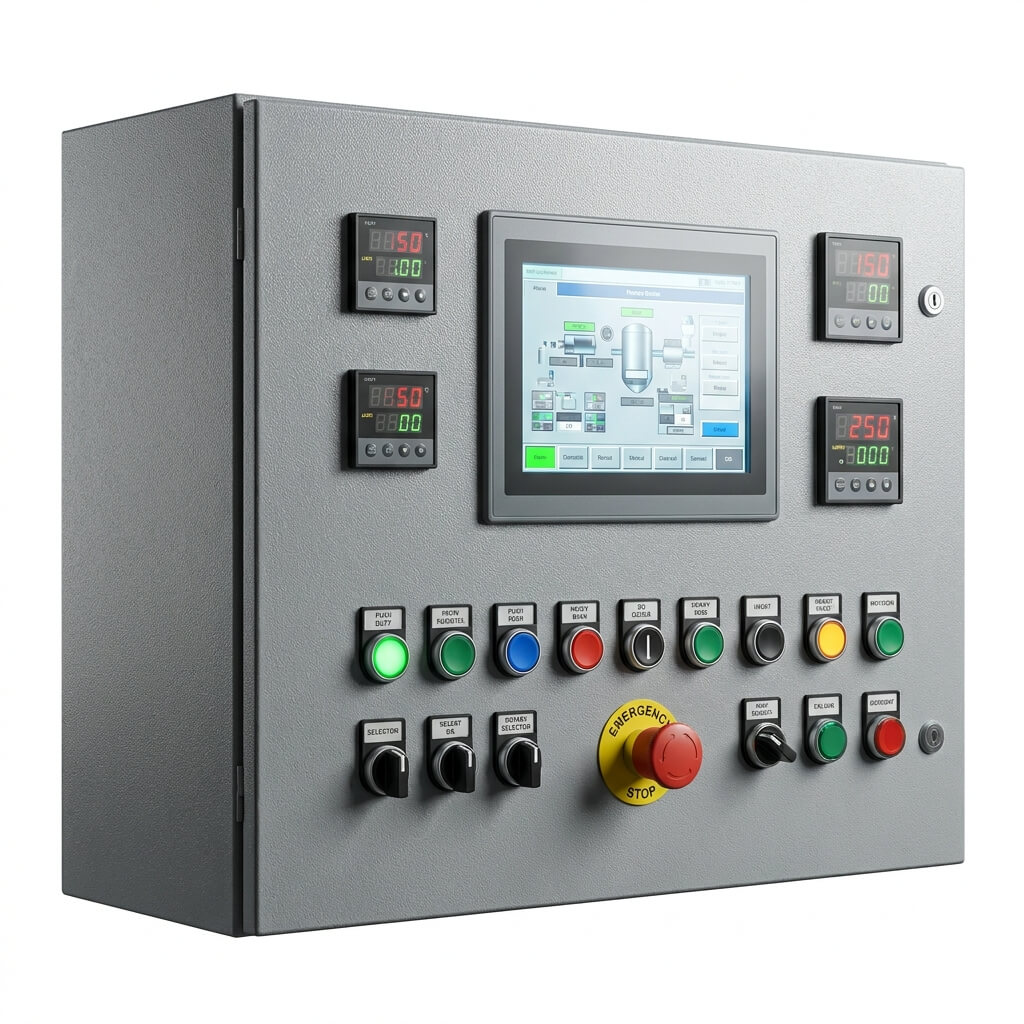
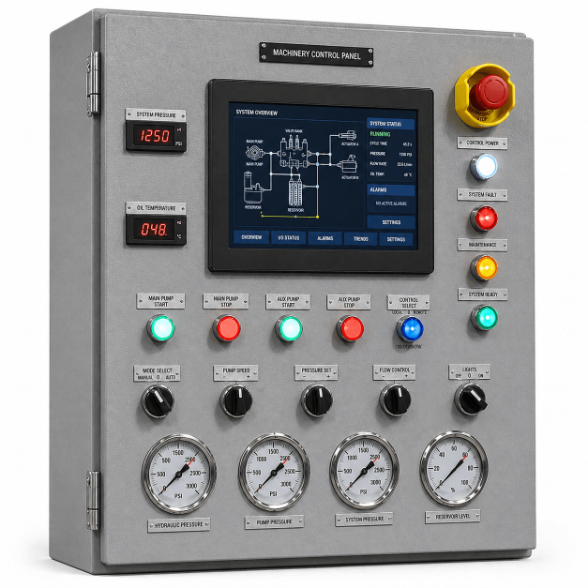
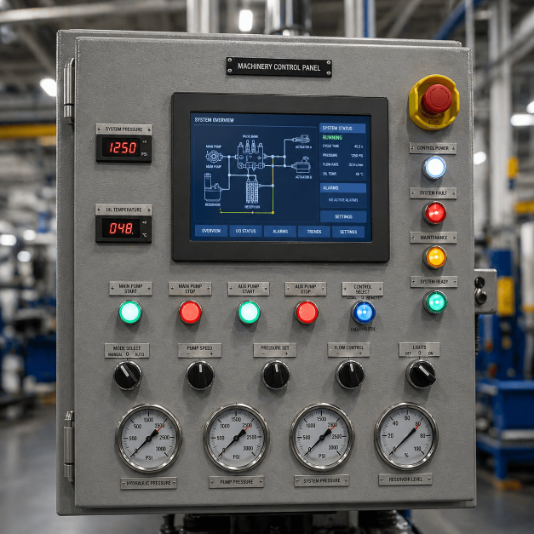
Machinery Control Panels
Machinery Control Panel Supplier
Custom machinery control panels for OEM equipment, automated production machines and retrofit projects. Send sequence, voltage, I/O list and safety functions.
Specifications
- Application
- Customizable
- Voltage
- Customizable
- Protection Rating
- Customizable
- Communication Protocol
- Customizable
- Testing
- FAT Available
- Customization
- Available
Quick Answer
A machinery control panel runs your OEM equipment - conveyors, packaging, sealing, labeling - with motor control, VFD speed regulation, sensors, safety interlocks and HMI. UniRegal builds to your machine electrical drawing using approved brands; ~15-day lead time, UL 508A available. MOQ from 5 units.
Custom Machinery Control Panels for OEM Equipment, Production Lines, and Industrial Automation
Uniregal supplies custom machinery control panels for industrial machines, OEM equipment, production lines, packaging machines, conveying systems, processing equipment, pumps, motors, and automated manufacturing systems.
Each control panel can be designed according to the machine function, motor load, PLC logic, HMI operation, VFD requirement, sensor signals, safety interlocks, installation environment, and project documentation needs.
For buyers, a machinery control panel is not just an electrical cabinet. It is the part of the machine that connects power, control logic, operator interface, sensors, actuators, alarms, and safety functions into one workable system.
Typical Applications
Application | Control Scope |
|---|---|
Packaging Machinery | Conveyor control, sealing, labeling, sensors, alarms, HMI operation |
Conveying Systems | Motor control, VFD speed control, start/stop stations, safety interlocks |
Processing Equipment | Temperature, pressure, level, flow, motor and valve control |
Pump and Motor Systems | Starter control, VFD control, overload protection, duty/standby logic |
Food and Beverage Machinery | Machine sequence, sensors, operator control, alarm monitoring |
Plastic and Rubber Machinery | Motor drives, heating zones, cooling control, safety circuits |
Textile Machinery | Motor synchronization, speed control, sensor signals, production monitoring |
Water Treatment Equipment | Pump control, dosing control, valve operation, instrument signal wiring |
OEM Equipment | Custom control panels built around the machine builder’s design |
Retrofit Projects | Replacement of old panels, discontinued controls, wiring cleanup, upgrade support |
What the Panel Can Include
Component | Function |
|---|---|
Main Disconnect Switch | Isolates incoming power for maintenance and service |
Circuit Breakers / Fuses | Protects power and control circuits |
Contactors | Starts and stops motors or other electrical loads |
Overload Relays | Protects motors from overload conditions |
PLC | Runs machine logic based on inputs, outputs, timers, and sequences |
HMI | Allows operators to view status, set parameters, and respond to alarms |
VFD | Controls motor speed for conveyors, pumps, fans, and process equipment |
Servo Drive | Supports precise motion control where required |
Safety Relay / Safety Controller | Handles emergency stop, guard door, and safety interlock signals |
Power Supply | Provides control voltage for PLC, sensors, relays, and instruments |
Terminal Blocks | Connects field devices, sensors, actuators, motors, and external wiring |
Indicator Lights / Push Buttons | Supports local operation and machine status indication |
Wire Labels and Nameplates | Helps installation, troubleshooting, and future maintenance |
Common Machinery Control Panel Types
Panel Type | Suitable For |
|---|---|
PLC Control Panel | Machines requiring automatic logic control and I/O signal processing |
HMI Control Panel | Machines requiring operator display, parameter setting, and alarm visibility |
VFD Control Panel | Machines using variable-speed motors, conveyors, pumps, or fans |
Motor Starter Panel | Machines requiring direct-on-line, star-delta, or soft starter motor control |
Servo Control Panel | Machines requiring accurate positioning, motion control, or speed synchronization |
Relay Control Panel | Simple machine logic, interlocks, and auxiliary control circuits |
Machine Safety Control Panel | Emergency stop, guard door, safety relay, and interlock circuits |
OEM Machine Control Panel | Custom panels designed according to the machine builder’s drawings and sequence |
Retrofit Machine Control Panel | Replacement panels for old machines, damaged cabinets, or discontinued controls |
Why Machinery Control Panel Specification Matters
Many machinery control panel problems appear during startup, not during quotation.
A panel can look complete on paper but still create delays if the machine sequence is unclear, the I/O list is incomplete, the motor load is not confirmed, or the operator controls do not match how the machine is actually used.
For OEMs and project buyers, the cost of a poorly specified control panel is rarely limited to the panel itself. It can delay machine testing, create repeated wiring changes, confuse operators, and make troubleshooting difficult after delivery.
That is why the panel should be reviewed together with the machine function, not only as a cabinet with components.
What Should Be Confirmed Before Ordering?
Information Needed | Example |
|---|---|
Machine Type | Packaging machine, conveyor, pump skid, processing equipment |
Power Supply | 220V, 380V, 400V, 415V, 480V, 600V |
Motor List | Motor quantity, power, voltage, starting method, VFD requirement |
Control Sequence | Start/stop logic, manual/auto mode, interlocks, alarms |
I/O List | Sensors, switches, valves, actuators, indicators, external signals |
Operator Interface | Push buttons, selector switches, HMI, local/remote operation |
Safety Requirement | Emergency stop, guard door, safety relay, safety controller |
Communication | Ethernet, Modbus, Profinet, Profibus, EtherNet/IP, hardwired signals |
Installation Environment | Indoor, outdoor, dusty area, wet area, high-temperature area |
Enclosure Type | Wall-mounted, floor-standing, stainless steel, IP-rated cabinet |
Component Preference | Siemens, Schneider, ABB, Omron, Mitsubishi, Allen-Bradley, Delta |
Drawing Availability | Electrical schematic, machine layout, old panel photos, wiring diagram |
Machine Control Logic
The control logic should match the actual machine operation.
Before production, the machine sequence should define how the equipment starts, stops, resets, alarms, and responds to abnormal conditions. If the machine has multiple motors, conveyors, sensors, or operating modes, the logic should also clarify the relationship between each device.
Typical logic items include:
- Power-on sequence
- Manual and automatic mode
- Start and stop conditions
- Motor interlocks
- Sensor feedback
- Alarm handling
- Emergency stop response
- Reset conditions
- Fault display
- Local and remote operation
- Communication with other equipment
- Production line interlock signals
PLC, HMI, and VFD Options
Machinery control panels can be built with PLC, HMI, and VFD functions according to the machine requirement.
Function | Typical Use |
|---|---|
PLC Control | Machine sequence, I/O logic, interlocks, timers, counters |
HMI Operation | Parameter setting, alarm display, manual control, status monitoring |
VFD Control | Motor speed adjustment, soft start, energy saving, process control |
Servo Control | Positioning, indexing, synchronized motion, precise speed control |
Remote I/O | Distributed machine signals and larger equipment layouts |
Communication Module | Integration with another machine, SCADA, or production line control system |
Safety and Interlock Design
Machine safety should be discussed before panel design, especially when the machine includes moving parts, conveyors, cutters, heaters, presses, rotating equipment, or operator access points.
The panel can be designed to support emergency stop circuits, guard door switches, safety relays, safety controllers, overload protection, fault alarms, and interlock signals according to the confirmed machine requirement.
For machinery exported to markets with specific electrical safety requirements, the relationship between the control panel, machine wiring, and applicable standards should be reviewed early in the project.
UL 508A and NFPA 79 Considerations
For North American machinery projects, UL 508A and NFPA 79 are often discussed together.
UL 508A focuses on the construction of industrial control panels, including component selection, wiring, spacing, marking, and short-circuit current rating considerations. NFPA 79 is commonly associated with electrical equipment of industrial machinery.
If your machine project requires UL 508A-based panel construction, specific component brands, SCCR review, nameplate markings, or documentation, these requirements should be confirmed before quotation and production.
Engineering Documents
Available documents may include:
- General arrangement drawing
- Electrical schematic
- Wiring diagram
- I/O list
- Terminal list
- Bill of materials
- PLC hardware configuration
- HMI screen list if required
- Nameplate and label list
- Test report
- Packing list
- Compliance-related documents if required
Panel Testing Before Shipment
Each machinery control panel can be inspected according to the confirmed drawings and project requirements before shipment.
Typical inspection items include the following:
- Component model verification
- Wiring continuity check
- Terminal and label inspection
- Grounding check
- Control voltage check
- Power-on test when applicable
- Manual operation check when applicable
- PLC I/O signal check when applicable
- HMI screen check when applicable
- VFD parameter and basic function check when applicable
- Alarm and interlock check according to agreed logic
- Visual inspection before packing
The purpose of testing is to reduce startup problems before the panel reaches the customer site.
Machinery Control Panel for OEM Projects
For OEM machine builders, the control panel should match the machine structure, installation space, operator workflow, and final customer requirements.
Uniregal can build panels according to your electrical drawings, component brand preference, machine sequence, and export market requirement. If the project is still in the design stage, we can also review the panel configuration and help identify missing information before production.
Machinery Control Panel for Retrofit Projects
Many machinery control panel inquiries come from old machines that still work mechanically but have outdated electrical systems.
The old panel may contain discontinued PLCs, damaged contactors, unclear wiring, aged terminals, obsolete HMIs, or drives that are difficult to replace locally.
For retrofit projects, you can send existing panel photos, component lists, nameplate information, wiring drawings, and machine operation videos if available. We can review the information and propose a practical replacement or upgrade solution.
FAQ
What is a machinery control panel?
A machinery control panel is an electrical control cabinet used to operate, protect, and monitor industrial machines. It usually includes power protection, motor control, PLC logic, HMI operation, relays, terminals, wiring, safety circuits, and field device connections.
What does a machine control panel do?
It controls how the machine starts, stops, runs, alarms, and responds to sensors or operator commands. It can also control motors, VFDs, valves, actuators, heaters, conveyors, and other machine devices.
What is the difference between a machinery control panel and an industrial control panel?
An industrial control panel is a broad term for electrical control assemblies used in industrial applications. A machinery control panel is specifically designed around the operation of a machine, including machine sequence, safety interlocks, operator controls, motors, sensors, and actuators.
What components are used in a machinery control panel?
Common components include circuit breakers, fuses, contactors, overload relays, PLCs, HMIs, VFDs, servo drives, safety relays, power supplies, terminals, push buttons, selector switches, indicator lights, and wire labels.
Can you build custom machinery control panels?
Yes. The panel can be customized according to the machine type, control sequence, motor list, I/O list, PLC and HMI requirement, VFD requirement, enclosure type, component brand, and documentation scope.
Can you build PLC control panels for machinery?
Yes. PLC control panels can be built for machine automation, production lines, conveying systems, pump systems, processing equipment, packaging machinery, and OEM equipment.
Can you build VFD control panels for machinery?
Yes. VFD control panels can be used for machines that require motor speed control, soft starting, energy saving, conveyor speed adjustment, pump control, fan control, or process speed regulation.
What information is needed for a quotation?
Please send the machine type, power supply, motor list, control sequence, I/O list, operator interface requirement, safety requirement, communication requirement, component brand preference, and drawings or photos if available.
Can you build a replacement panel for an old machine?
Yes. For replacement projects, please send old panel photos, component models, wiring drawings, machine nameplate information, and a description of how the machine operates. We can review the information and suggest a practical replacement configuration.
Do you provide wiring diagrams?
Yes. Wiring diagrams can be provided according to the confirmed order scope. For custom panels, drawings should be reviewed before production to confirm wiring, terminals, I/O, power circuits, and field connections.
Can the panel be designed for UL 508A requirements?
UL 508A-based panel design can be discussed before production. The final scope depends on the project requirement, component selection, SCCR review, labeling, documentation, and whether official certification or marking is required.
How do you test the control panel before shipment?
Testing may include component verification, wiring continuity check, terminal inspection, grounding check, power-on test, PLC I/O check, HMI check, VFD basic function check, alarm check, and visual inspection before packing.
Request a Quotation
Send us your machine type, motor list, control sequence, I/O list, voltage, enclosure requirement, and preferred component brands.
Our team will review the machinery control panel configuration before quotation, so you receive a practical proposal based on the machine requirement, not only a cabinet price.
Contact Us
Looking for a reliable machinery control panel supplier for your industrial project?
Contact UniRegal Automation today.
- Email: info@uniregal.com
- Website: https://www.uniregal.com
For OEM machines, the cost drivers are worth understanding before the design is frozen — see OEM machine control panel cost drivers and custom control panels .