
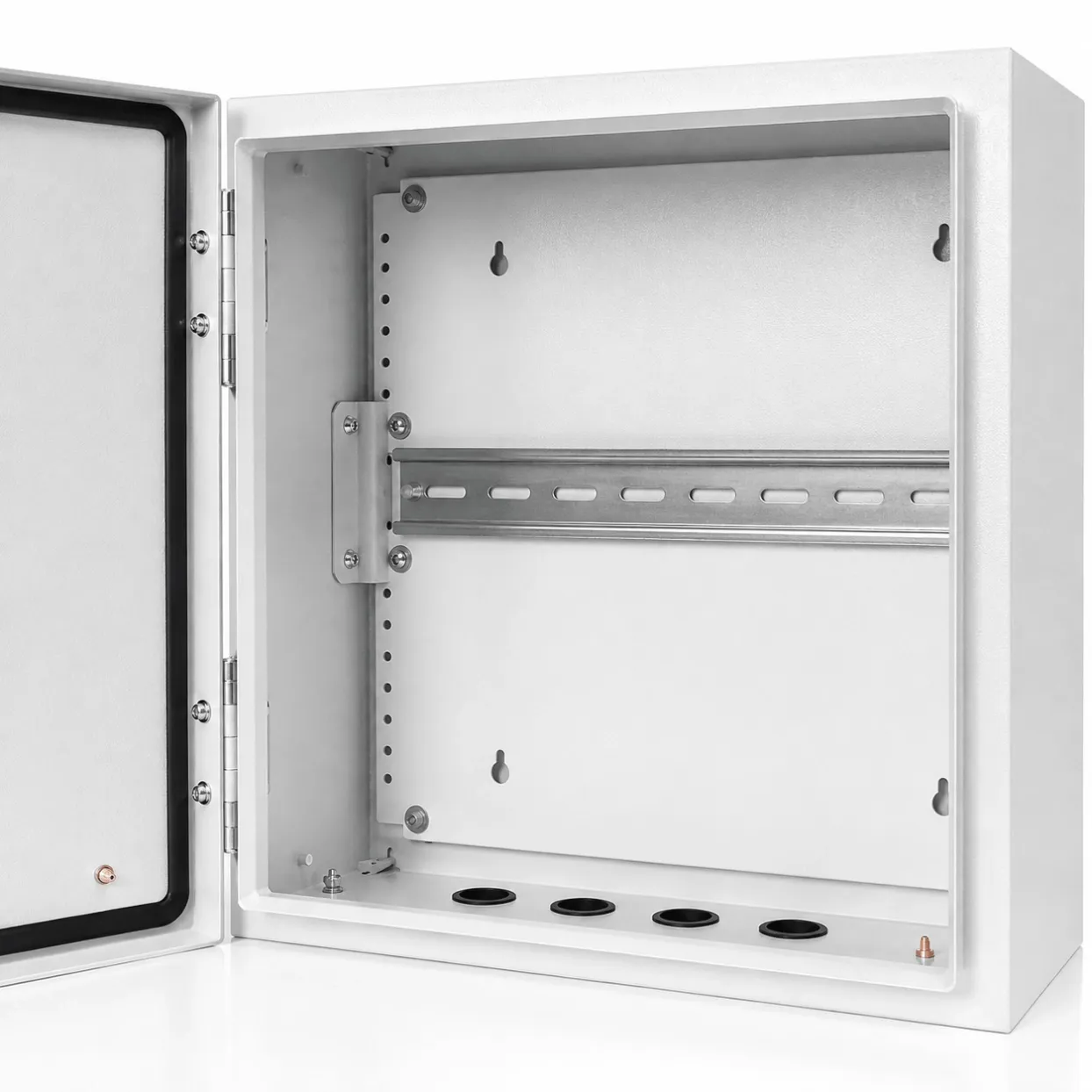
Outdoor Cabinets (IP65/IP66)
Wall Mounted Electrical Enclosure Supplier finalfix 1786519071199
Wall-mounted electrical enclosures for PLC control, automation, network and industrial equipment. Configure size, material, IP rating, cable entry, cooling and mounting. finalfix 1786519071199
Specifications
- Title
- Wall-Mounted Enclosures | Electrical, Rack & Fiber Enclosures
- Size:
- 2U、4U、6U、12U、18U、24U、19-inch
- Material
- fiber optic、splice、patch、LGX、termination
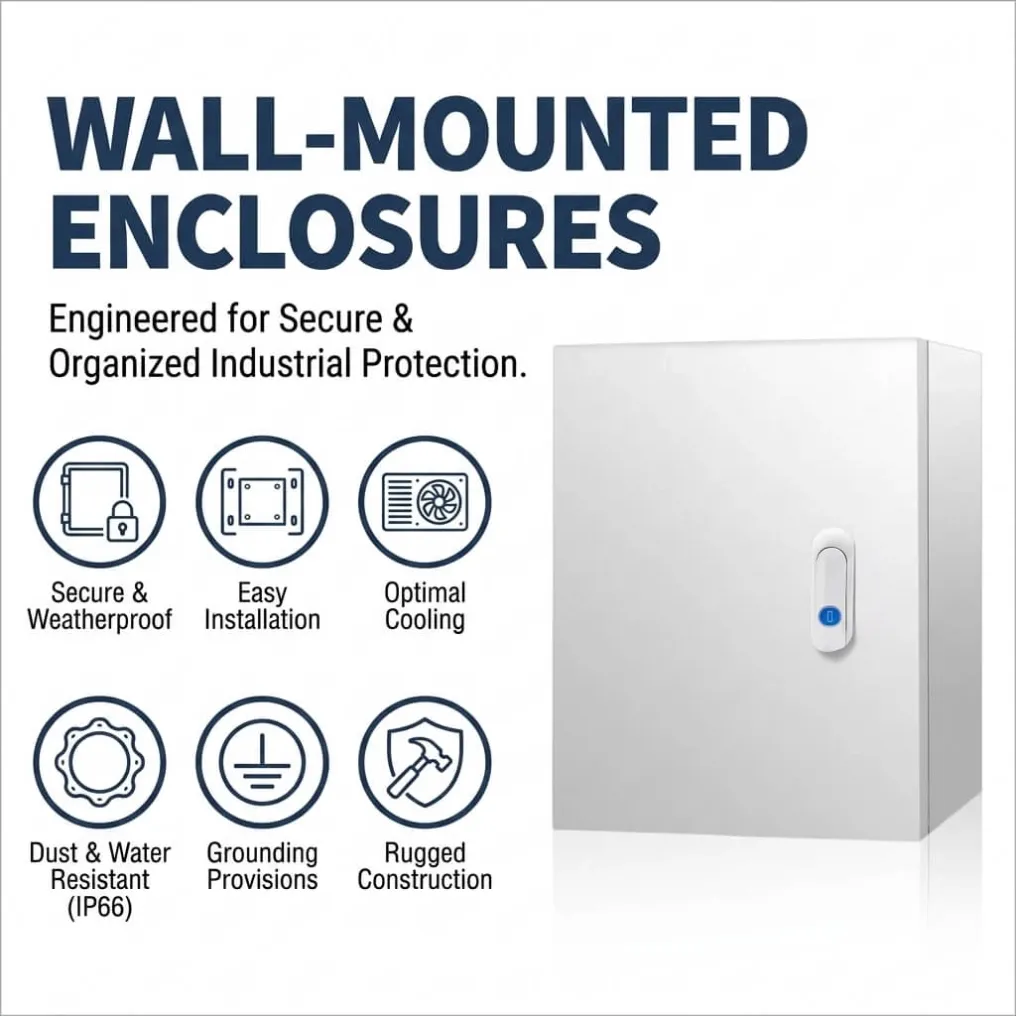
Wall-Mounted Enclosures for Electrical Control, Network Equipment and Fiber Distribution
A wall-mounted enclosure saves floor space, but the installation is only successful when the cabinet, wall structure, equipment depth, cable routing, heat dissipation and maintenance access are designed together.
UniRegal supplies wall-mounted electrical enclosures, wall-mount rack enclosures, industrial plastic wall-mounted enclosures and application-specific wall boxes for PLC and HMI systems, network equipment, fiber distribution, instrumentation, HVAC controls, pump stations and industrial automation.
The enclosure can be supplied as an empty housing, a configured mounting cabinet or a complete wall-mounted control and communication assembly.
Quick Facts
Item | Specification |
|---|---|
Product | Wall-Mounted Enclosures |
Main applications | Electrical control, PLC, HMI, network, server, fiber distribution, instrumentation and local machine control |
Mounting | Wall-mounted, panel-mounted, pole-mounted or custom support frame |
Enclosure types | Electrical enclosure, rack enclosure, fiber enclosure, plastic enclosure, control box or custom cabinet |
Protection options | IP54, IP55, IP65, IP66, NEMA Type 3R, NEMA 4 or NEMA 4X when specified |
Rack options | 2U, 4U, 6U, 9U, 12U, 18U, 24U and custom rack heights |
Equipment | PLC, HMI, VFD, switches, routers, patch panels, splice trays, terminals and instrumentation |
Material options | Powder-coated steel, stainless steel, aluminum, polycarbonate, ABS or GRP depending on application |
Door options | Solid door, transparent door, perforated door, drop-down door, swing-out door or inner door |
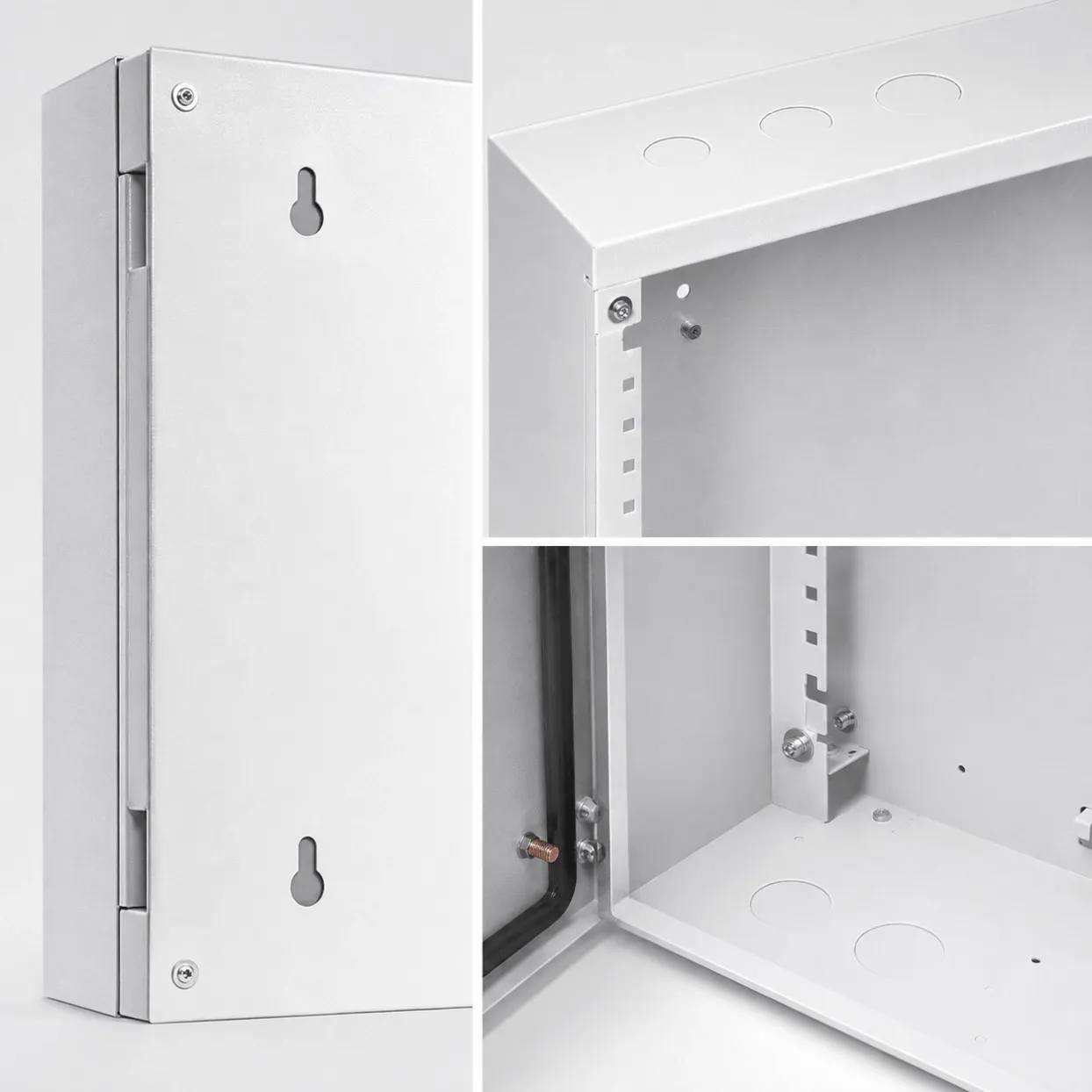
Cable entry | Top, bottom, rear, side, gland plate, brush panel or fiber-specific entry |
Thermal options | Natural ventilation, filter fan, thermostat, heat exchanger, air conditioner or heater |
Integration scope | Empty enclosure, mounting plate, DIN rail assembly, rack installation or complete control-panel wiring |
Documentation | GA drawing, BOM, wiring diagram, rack layout, cable schedule and FAT documents when required |
The First Question: What Type of Wall-Mounted Enclosure Do You Need?
The phrase “wall-mounted enclosure” can describe several different products. Selecting the wrong type usually creates problems with equipment depth, cable access, ventilation or maintenance.
Wall-Mounted Electrical Enclosure
A wall-mounted electrical enclosure is used for PLCs, HMIs, circuit breakers, relays, terminals, power supplies, VFDs and local control equipment.
It is normally selected when the buyer needs:
- A mounting plate for electrical components
- Front access for operators or maintenance staff
- Cable entry from the top, bottom or rear
- Protection against dust, water or accidental contact
- A compact alternative to a floor-standing control cabinet
- Integration with an existing machine or process skid
Wall-Mount Rack Enclosure
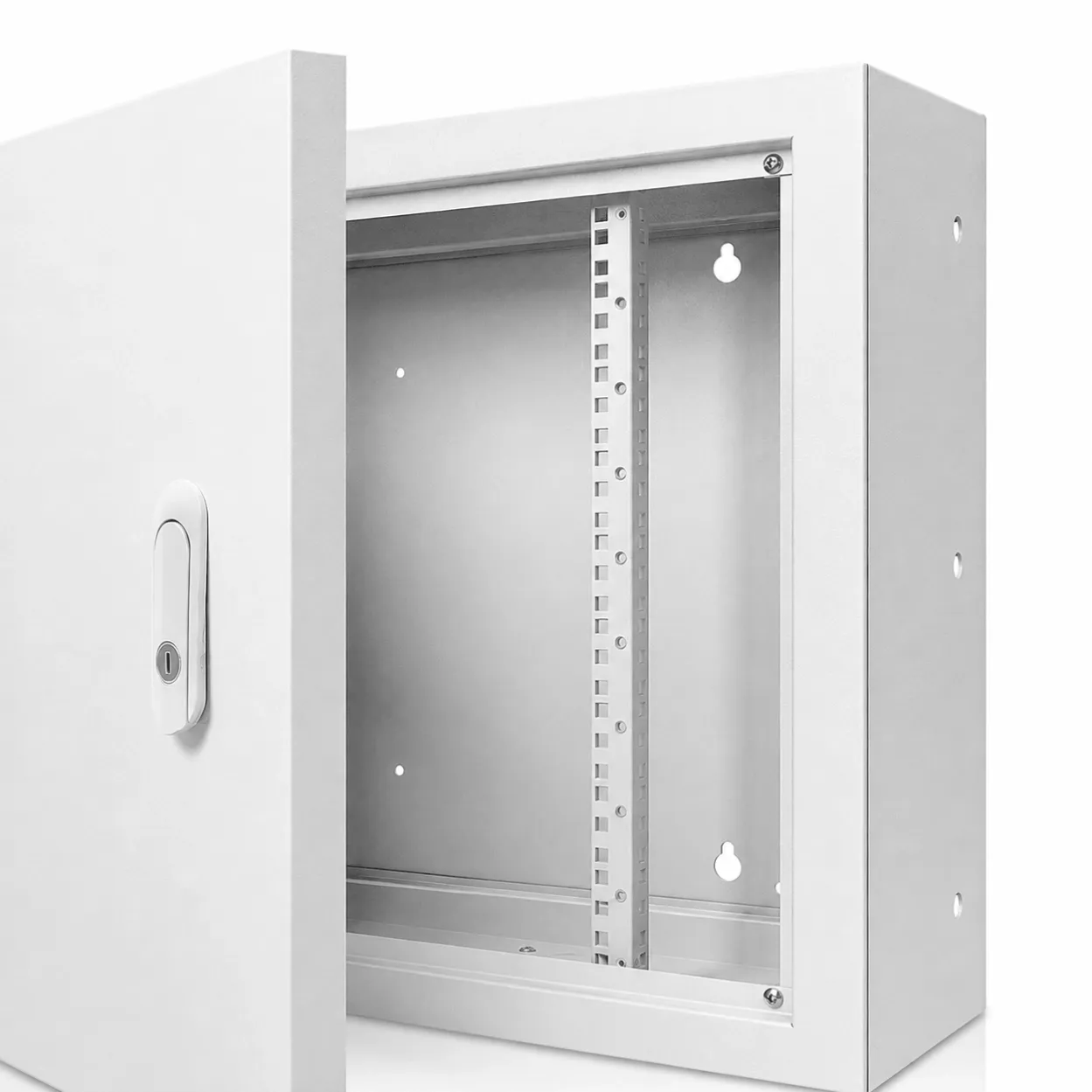
A wall-mount rack enclosure is designed for 19-inch or other specified rack equipment such as network switches, patch panels, routers, firewalls, edge computers and communication devices.
The buyer should confirm:
- Rack width
- Rack height in U
- Usable internal depth
- Equipment depth including connectors
- Front and rear access
- Door opening clearance
- Cooling and ventilation
- Maximum wall load
- Cable bending radius
- Future spare rack space
Wall-Mount Fiber Optic Enclosure
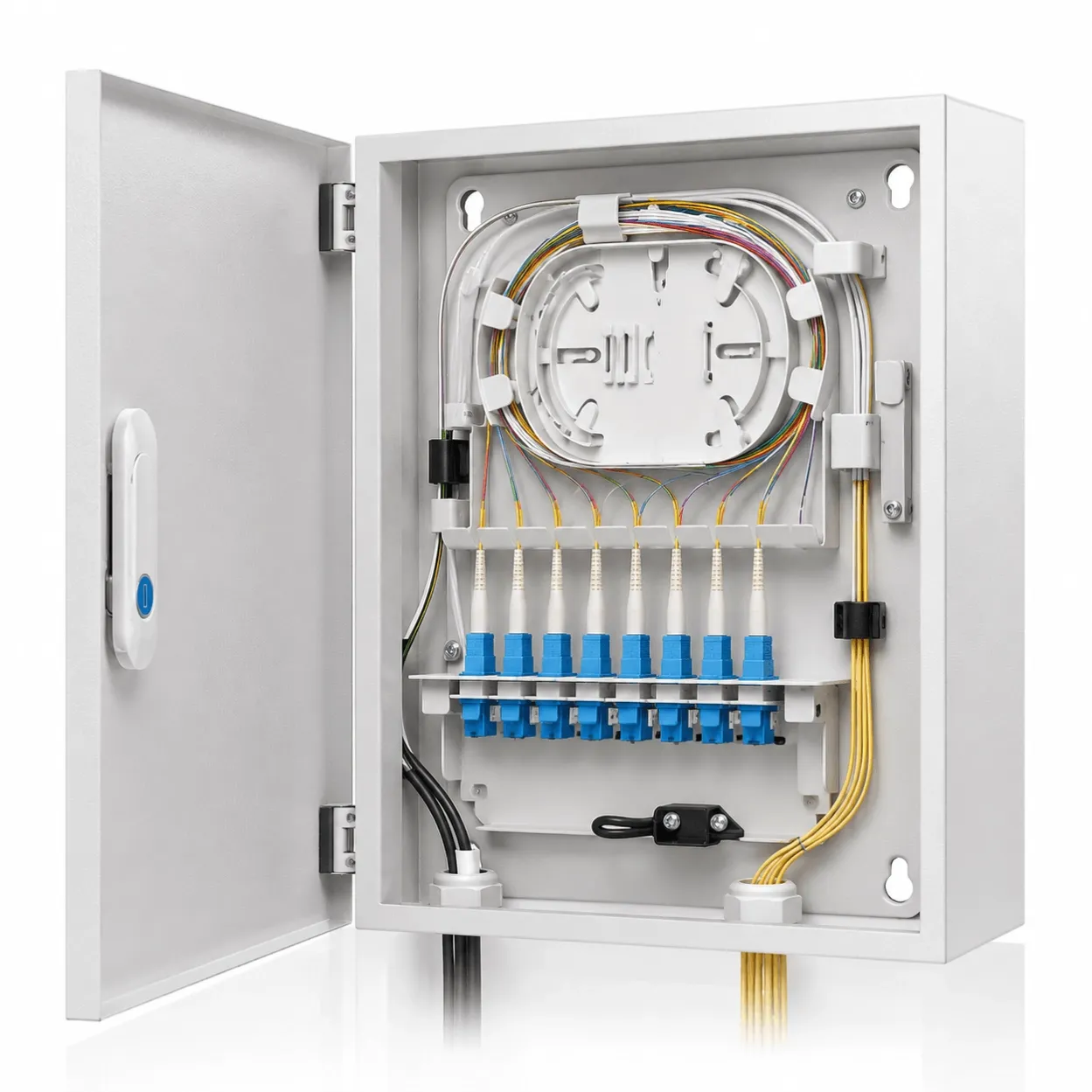
A wall-mount fiber enclosure is used for fiber patching, splicing, termination and distribution where a full equipment rack is not available.
The design may include:
- Adapter panels
- LGX-compatible modules
- Splice trays
- Pigtails
- Fiber storage
- Cable entry glands
- Bend-radius protection
- Lockable patching or splice compartments
- Port labels and identification areas
Fiber enclosures should be selected by connector type, fiber count, splice method, cable construction and future expansion—not only by external dimensions.
Heavy-Duty Plastic Wall-Mounted Enclosure
A heavy-duty plastic or non-metallic wall-mounted enclosure may be considered where low weight, electrical insulation, corrosion resistance or chemical compatibility is important.
Potential applications include:
- Sensors and instrumentation
- Small control units
- Communication devices
- Junction boxes
- Metering equipment
- Outdoor low-voltage electronics
- Corrosive environments where metal is unsuitable
The buyer should confirm UV exposure, impact resistance, flame performance, temperature, mounting strength and required IP rating before selecting a plastic enclosure.
Why Wall-Mounted Enclosures Fail After Installation
The wall cannot support the real load
The empty enclosure may be light, but switches, power supplies, batteries, patch panels, transformers and cables can add significant weight.
The mounting design should consider:
- Wall material
- Anchor type
- Bracket spacing
- Cabinet weight
- Internal equipment weight
- Cable weight
- Vibration
- Seismic or transport requirements
- Service loads when the door is open
For plasterboard, sandwich panels or lightweight partitions, the cabinet may require a structural backing frame instead of direct fixing.
The cabinet is too shallow for the equipment
A wall mount server enclosure may fit the equipment body but fail when power connectors, fiber bend radius, patch cords and cable glands are added.
The usable depth should be calculated as:
Equipment depth + connector clearance + cable bend radius + rear ventilation space + maintenance allowance
Do not quote a wall-mount rack enclosure only by external depth.
The door cannot open in the installed location
A cabinet may fit the wall but become unusable when installed beside another panel, pipe, machine guard or doorway.
Before confirming the design, check:
- Left or right door opening
- Door swing radius
- Front service clearance
- Removable-door requirement
- Operator viewing angle
- Access to cable glands
- Adjacent equipment and wall obstructions
Cooling is added too late
Network switches, industrial PCs, power supplies and VFDs generate heat. A sealed cabinet may protect the equipment from dust and water while trapping the heat inside.
Thermal design should be completed before the cutouts are finalized. Depending on the equipment and environment, the enclosure may use natural ventilation, a filter fan, thermostat, heat exchanger, air conditioner or heater.
Cable routing compromises the protection rating
A wall-mounted enclosure is often modified on site. Unplanned drilling, oversized cable holes and unsuitable glands can reduce the original IP or NEMA protection level.
The design should identify:
- Cable entry location
- Cable quantity
- Cable diameter
- Gland size
- Conduit direction
- Fiber bend radius
- Drainage requirement
- Grounding and bonding
- Service loop
The enclosure is difficult to maintain
A cabinet that cannot be opened, isolated or serviced safely will create higher operating cost even if the initial purchase price is low.
Maintenance should be considered during the layout stage, including:
- Removable mounting plate
- Swing frame
- Pull-out shelf
- Label area
- Spare terminals
- Spare rack units
- Separate power and communication zones
- Accessible grounding points
- Clear cable identification
Wall-Mount Rack Enclosure Selection
Rack Height
Common rack-related search terms include 2U, 4U, 6U, 9U, 12U, 18U and 24U wall-mount enclosures.
The required rack height should include:
- Current equipment
- Patch panels
- Cable-management panels
- Power distribution unit
- Ventilation space
- Future expansion
- Maintenance access
A 6U wall-mount rack enclosure may be suitable for a small switch and patch panel. A 12U or 18U cabinet may be more appropriate when the installation includes multiple switches, power units, fiber modules and cable-management accessories.
Equipment Depth
Rack equipment does not occupy only the depth of the chassis. Rear connectors, power cables, fiber patch cords and ventilation must also be considered.
The RFQ should include:
- Equipment model
- Overall equipment depth
- Connector position
- Required front and rear access
- Cable exit direction
- Minimum bend radius
- Required service clearance
Door and Access Options
A wall-mount rack enclosure may use:
- Solid steel door
- Perforated door
- Transparent acrylic or polycarbonate door
- Single-hinged door
- Removable door
- Swing-out frame
- Lockable front door
- Rear access panel
A transparent door may help operators inspect indicators without opening the cabinet, while a perforated door can improve airflow. The final selection should be based on security, protection and thermal requirements.
Wall-Mount Fiber Enclosure Selection
Fiber wall-mount enclosures are normally selected by connection capacity and service method.
The buyer should specify:
- Fiber count
- LC, SC, ST, MPO or other connector type
- Adapter panel type
- Splice tray capacity
- Patching-only or patch-and-splice configuration
- Single-door or dual-compartment arrangement
- Incoming and outgoing cable diameter
- Required storage length
- Port labeling
- Locking requirement
- Indoor or outdoor location
Current fiber enclosure products in the market commonly separate patching and splicing areas, use cable-management features and provide scalable adapter or splice capacity.
Electrical Wall-Mounted Enclosure Configuration
A wall-mounted electrical enclosure can be configured with:
- Mounting plate
- DIN rails
- Wiring ducts
- Terminal blocks
- Circuit breakers
- PLC and I/O modules
- HMI cutout
- VFD compartment
- Relay and contactor section
- 24 VDC power supply
- Industrial Ethernet switch
- Surge protection
- Grounding bar
- Cable glands
- Door-mounted push buttons
- Emergency stop
- Pilot lights
- Nameplates
- Internal LED service light
For PLC and VFD applications, cable routing and grounding should be designed together. Separating power cables, motor cables, analog signals and communication cables helps reduce electromagnetic interference and commissioning problems.
Wall-Mounted Enclosure Thermal Management
Natural Ventilation
Natural ventilation may be suitable for low-heat equipment in a controlled indoor environment. It should not be used without considering dust, humidity, insects and the required protection rating.
Filter Fan
A filter fan can remove internal heat when the surrounding air is clean enough and the enclosure design can maintain the required protection level.
The RFQ should confirm:
- Heat load
- Airflow requirement
- Filter replacement access
- Ambient dust
- Temperature range
- Fan alarm
- Thermostat
- IP or NEMA requirement
Heat Exchanger
A heat exchanger can transfer internal heat while keeping the control compartment separated from contaminated ambient air. It may be useful for industrial rooms with dust, oil mist or corrosive air.
Air Conditioner
A wall-mounted enclosure air conditioner may be required when:
- Internal heat generation is high
- Ambient temperature is high
- The cabinet must remain sealed
- Network or control equipment has a narrow temperature range
- Solar or process heat affects the enclosure
- The cabinet is installed in a plant room without reliable HVAC
Heater and Condensation Control
A heater or humidity-control device may be needed when the enclosure is exposed to rapid temperature changes or high humidity. Condensation can affect terminals, PCBs, fiber connectors, network equipment and metal surfaces.
UniRegal can review the cabinet heat load, fan arrangement, thermostat settings, heater requirement and airflow path as part of the enclosure design.
IP and NEMA Protection
Typical wall-mounted electrical enclosure requirements include:
- IP54 for controlled indoor environments
- IP55 for dust and water protection
- IP65 for dust-tight and water-jet protection
- IP66 for stronger water-jet protection
- NEMA 3R for selected outdoor rain applications
- NEMA 4 for gasketed water protection
- NEMA 4X for corrosion-resistant applications
The protection rating applies to the complete enclosure configuration. Doors, hinges, cable glands, ventilation openings, rack fans, air conditioners and field modifications must be included in the review.
A wall-mount rack enclosure with large ventilation openings should not be described as IP66 unless the complete ventilation and sealing design supports that rating.
Wall-Mounted Enclosures for Industrial Automation
UniRegal can configure wall-mounted enclosures for:
- Machinery control
- Pump control
- HVAC and BMS
- Water-treatment instrumentation
- MCC or small motor-control sections
- PLC and HMI systems
- Industrial Ethernet
- Remote I/O
- Utility metering
- OEM equipment
- Process instrumentation
- Fiber and communication distribution
The scope may include enclosure modification, component mounting, field-wiring checks, PLC/HMI integration, parameter verification, operator diagnostics and commissioning support.
Technical Specifications
Specification | Configurable options |
|---|---|
Enclosure category | Electrical, rack, server, fiber, plastic, control or custom wall box |
Mounting | Wall, panel, pole bracket, DIN rail or custom support frame |
Material | Powder-coated steel, stainless steel 304/316, aluminum, polycarbonate, ABS or GRP |
Protection | IP54, IP55, IP65, IP66, NEMA 3R, NEMA 4 or NEMA 4X |
Rack height | 2U, 4U, 6U, 9U, 12U, 18U, 24U or custom |
Rack width | 19-inch, 21-inch, 23-inch or project-specific |
Usable depth | Confirmed from equipment depth, connectors and cable-bend allowance |
Door | Solid, perforated, transparent, drop-down, hinged, removable or swing-out |
Lock | Key lock, quarter-turn lock, padlockable handle or project-specific |
Cable entry | Top, bottom, rear, side, brush panel, gland plate or fiber entry |
Fiber configuration | Adapter panels, splice trays, pigtails, patching, termination or storage |
Electrical configuration | Mounting plate, DIN rail, terminals, PLC, HMI, breakers and relays |
Thermal management | Natural ventilation, filter fan, thermostat, heat exchanger, AC or heater |
EMC provisions | Grounding bar, bonding, screened cable entry and power-signal segregation |
Wall loading | Cabinet weight, equipment weight, cable weight and anchor design to be confirmed |
Surface finish | Powder coating, brushed stainless steel, polished or project finish |
Documentation | GA, BOM, rack layout, wiring diagram, cable schedule and FAT documents |
Wall-Mount Enclosure RFQ Checklist
Please provide:
- Enclosure application
- Electrical, rack, fiber, server or plastic enclosure type
- Equipment list and equipment models
- Rack height and width if applicable
- Required usable depth
- Cabinet external dimensions
- Wall type and mounting method
- Cabinet weight and internal equipment weight
- IP or NEMA target
- Material and surface finish
- Door, lock and access requirements
- Cable entry position and cable diameter
- Heat load and cooling requirement
- Fiber count and adapter or splice requirements
- Required power distribution or control components
- Local standards and certification requirements
- Quantity and repeat-order plan
- Delivery country and target date
For a wall-mounted enclosure quotation, a drawing or equipment model list is usually more useful than a request based only on the words “wall mount cabinet.”
Empty Enclosure or Complete Integrated Panel?
Buyer requirement | Empty wall-mounted enclosure | UniRegal integrated wall-mounted panel |
|---|---|---|
Best for | Buyers with their own panel workshop | OEMs, EPC contractors and industrial facilities |
Scope | Housing, door, mounting plate and accessories | Enclosure, components, wiring, labels and documentation |
Engineering responsibility | Buyer completes layout and wiring | UniRegal reviews equipment fit, cable routing and control integration |
Commissioning | Buyer manages field wiring and testing | FAT, wiring verification and project documentation can be included |
Repeat orders | Depends on buyer drawings | Configuration can be recorded for repeat supply |
Main risk | Incorrect cutouts, heat load or cable access | Lower integration risk through one coordinated review |
Application References
The following case-reference blocks should be published with verified project information before going live.
Wall-Mounted PLC Enclosure for OEM Machinery
A compact wall-mounted control enclosure can place the PLC, HMI, power supply, terminals and communication equipment close to the machine while preserving operator access and reducing floor-space requirements.
Publish with verified details such as machine type, enclosure size, PLC brand, IP rating, wiring scope and FAT evidence.
Wall-Mounted Pump Control Enclosure
A pump-station enclosure may combine local start/stop controls, motor protection, level signals, communication terminals and remote monitoring.
Publish the pump quantity, motor data, enclosure rating, cable-entry design and commissioning documentation.
Wall-Mounted Fiber or Network Enclosure
A fiber or network enclosure may be used in a building entrance, telecom room, equipment room or remote network zone where a full rack is not available.
Publish verified fiber count, adapter-panel type, splice-tray capacity, locking arrangement and cable-management design.
Wall-Mounted HVAC or BMS Enclosure
An HVAC or BMS wall cabinet may house controllers, relays, communication modules, sensors and local operator interfaces.
Publish the controller platform, communication protocol, heat-load review, wiring scope and functional-test evidence.
Wall-Mounted Water-Treatment Instrument Enclosure
Water-treatment installations may require a compact enclosure for sensors, transmitters, PLC I/O, terminals and communication equipment near the process equipment.
Publish the process area, material, rating, cable-entry arrangement and service requirements.
Buyer FAQs
What is a wall-mounted enclosure?
A wall-mounted enclosure is a protective cabinet fixed to a wall or structural support frame to house electrical, control, network, server, fiber or instrumentation equipment.
What is the difference between a wall-mounted electrical enclosure and a wall-mount rack enclosure?
A wall-mounted electrical enclosure is usually designed around a mounting plate, DIN rail or control layout. A wall-mount rack enclosure is designed around rack height, rack width, equipment depth and cable management.
What size wall-mount rack enclosure do I need?
Select the rack height and usable depth from the equipment list, connectors, cable bend radius, ventilation and future expansion. The external cabinet size alone is not sufficient.
Can a wall-mounted enclosure hold a server?
It may hold suitable rack or edge-computing equipment when the cabinet depth, wall load, cooling, power distribution and service clearance are verified. Full-depth servers may require a floor-standing rack instead.
What IP rating is suitable for a wall-mounted electrical enclosure?
The rating depends on the installation environment. IP54, IP55, IP65 or IP66 may be suitable for different conditions, but the door, cable glands, ventilation and field modifications must be considered together.
Can a wall-mounted enclosure be installed outdoors?
Yes, when the material, coating, gasket, protection rating, mounting structure, thermal management and condensation control are designed for outdoor conditions.
How is the wall load calculated?
The design should include the empty cabinet weight, installed equipment, power supplies, batteries, cables, accessories and service loads. The wall material and anchor system must also be checked.
Can you supply a wall-mount fiber optic enclosure?
Yes, the configuration can be based on fiber count, connector type, adapter panels, splice trays, patching requirements, cable diameter and future expansion.
Does a wall-mounted enclosure need a fan or air conditioner?
Not always. The decision depends on internal heat generation, ambient temperature, protection rating, equipment temperature limits and the available airflow path.
Can you integrate PLC, HMI and VFD equipment?
Yes. UniRegal can review the enclosure layout, mount components, complete wiring, verify parameters and prepare documentation for an integrated control-panel project.
What information is required for a quotation?
Provide the application, equipment list, dimensions, rack or fiber requirements, wall type, IP/NEMA target, cable-entry details, thermal requirement, quantity and delivery location.
Request a Wall-Mounted Enclosure Review
Send your equipment list, required dimensions, wall type, protection rating, cable-entry details and installation photos to:
UniRegal can support standalone wall-mounted enclosures, rack and fiber configurations, and complete wall-mounted control-panel integration.
Related Articles: