
Oct 6, 2026Buying Guides
How Should Buyers Choose a Chemical Dosing System for Wastewater Treatment?
Learn how to choose a chemical dosing system for wastewater treatment by evaluating process requirements, control strategy, automation, material compatibility and system integration—not just pump spec
Engineering Question
How should buyers choose a chemical dosing system for pH adjustment, coagulation, flocculation, disinfection, sludge conditioning, or other wastewater treatment processes?
Quick Answer
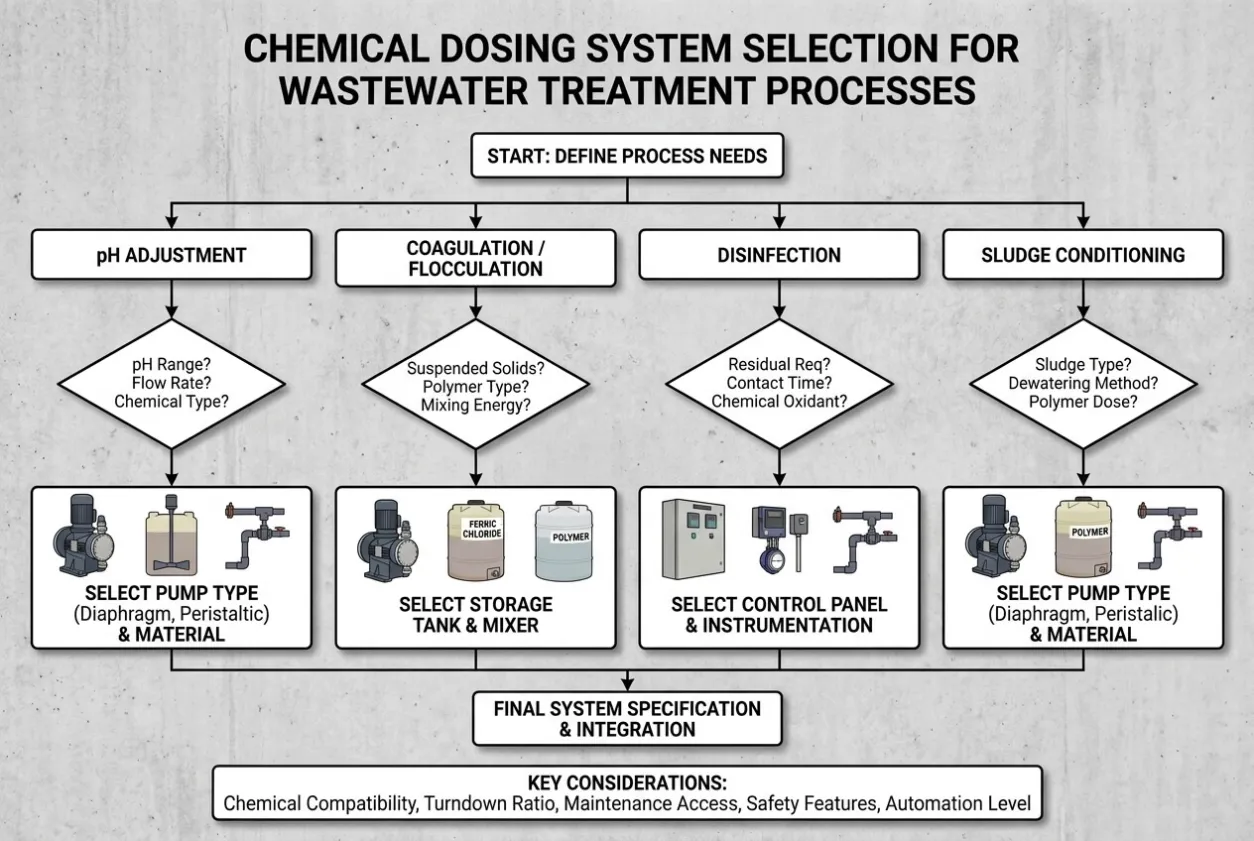
A chemical dosing system should be selected around the treatment process rather than around the pump itself.
Before approving a system, buyers should first understand what the treatment process is expected to achieve and then design the dosing equipment, instrumentation, control strategy, and operator workflow around that objective.
A complete engineering review normally includes the treatment objective, chemical properties, concentration, required dosing range, wastewater flow variation, discharge pressure, wetted-material compatibility, injection location, mixing conditions, process instrumentation, PLC control philosophy, alarm strategy, maintenance access, and operator safety.
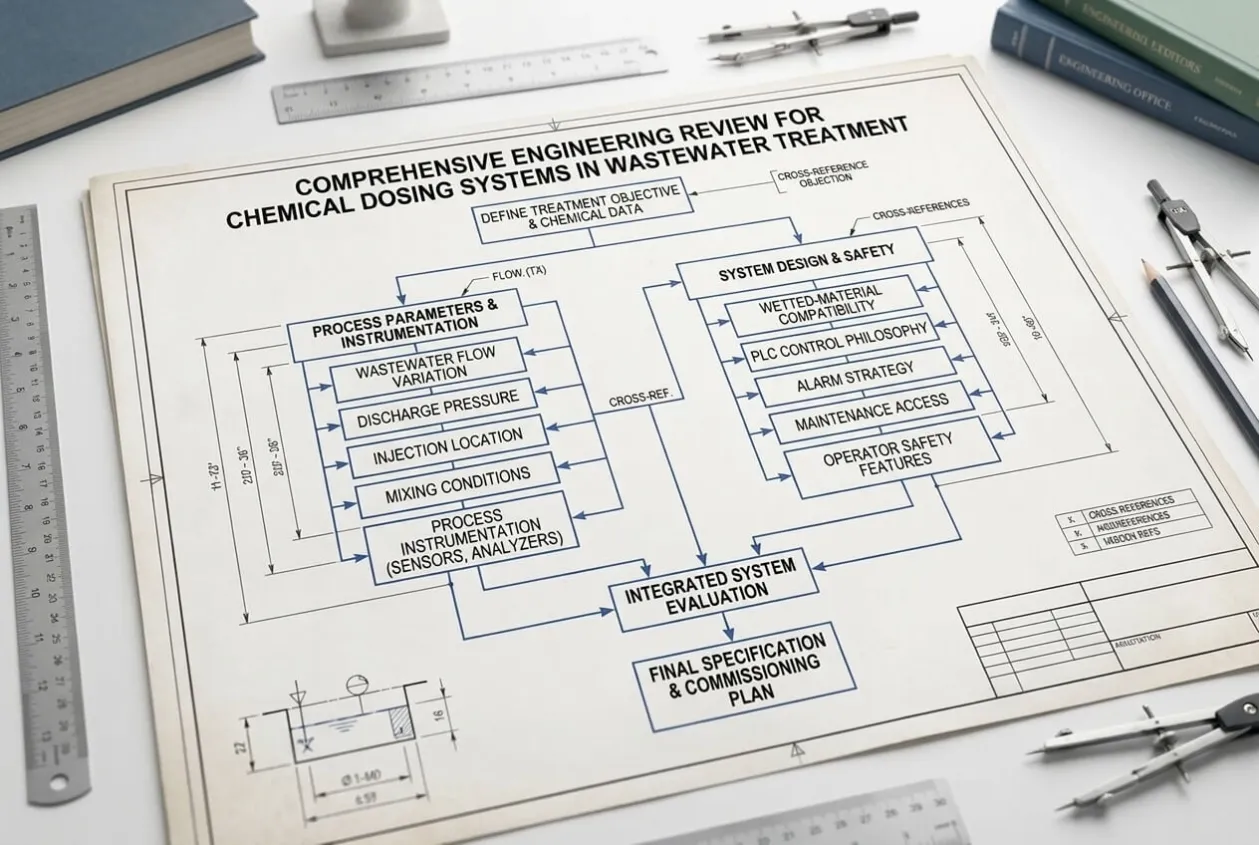
The metering pump is only one part of that system. Stable wastewater treatment depends on how the pump, the process, the instrumentation, and the control panel work together after commissioning.
Many Projects Start With the Wrong Question
When buyers first request a quotation, the discussion usually begins with equipment specifications.
How many litres per hour?
What discharge pressure?
Which pump brand?
These are sensible questions because every dosing system needs a pump that can deliver the required chemical safely and accurately.
They are not, however, the questions that determine whether the treatment process will remain stable six months after startup.
Most commissioning problems do not begin with the pump. They begin much earlier, when the treatment process, instrumentation, and control philosophy are reviewed independently instead of as one system.
By the time operators notice unstable pH, inconsistent coagulation, excessive chemical consumption, or frequent manual adjustments, the pump is often doing exactly what it was designed to do.
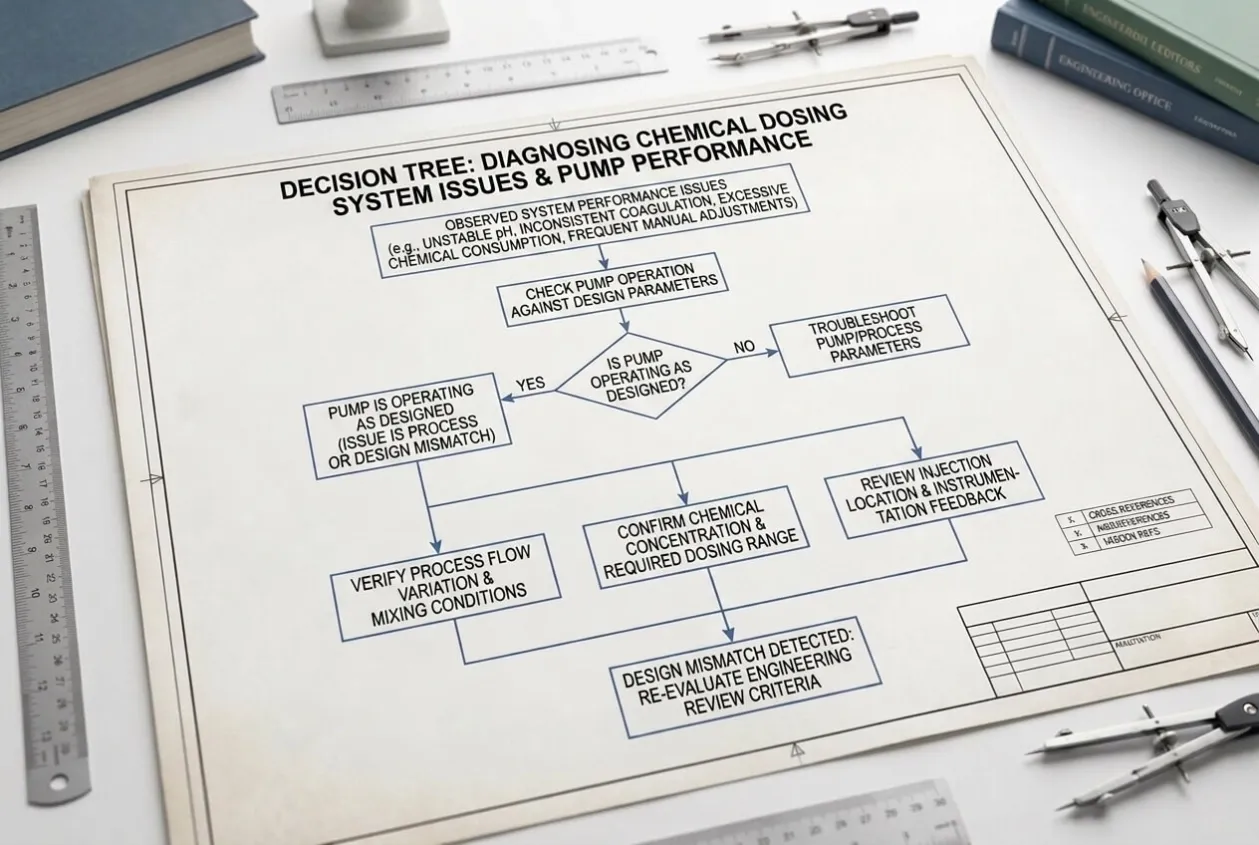
The engineering assumptions around it are not.
That is why experienced system engineers rarely begin a design review with the pump catalogue. They begin by asking a different question.
What is the treatment process expected to achieve?
Once that question has been answered clearly, equipment selection becomes much easier because every engineering decision has a purpose instead of becoming an isolated specification.
The Pump Is Only One Part of the Dosing System
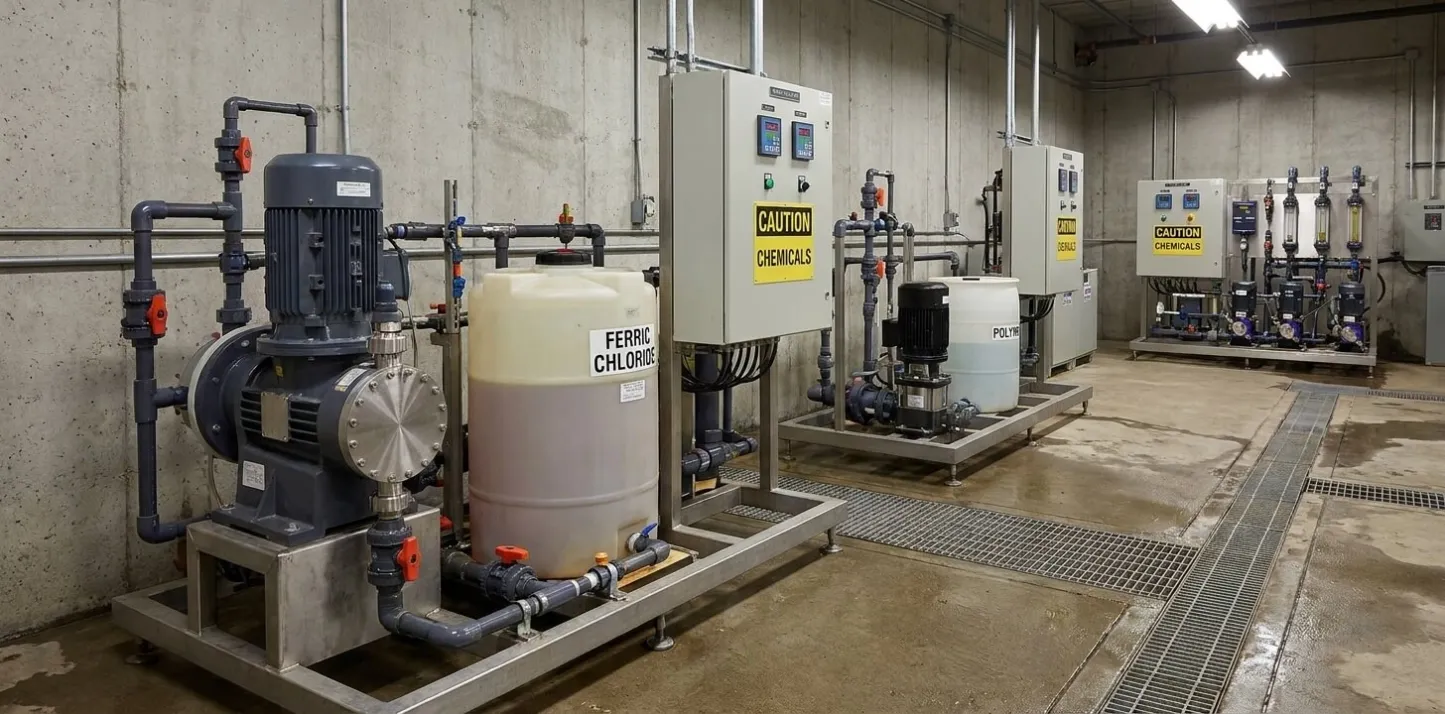
Chemical dosing equipment is often described as a package consisting of a storage tank, agitator, metering pump, calibration column, valves, pipework and a control panel.
Mechanically, that description is correct.
From an engineering perspective, it tells us very little about whether the process will actually work.
A complete dosing system may include chemical storage, preparation tanks, agitators, metering pumps, calibration columns, pulsation dampeners, pressure-relief valves, back-pressure valves, injection quills, analysers, level instruments, PLC control panels, HMI operator interfaces, alarm functions and communication with the wider treatment plant.
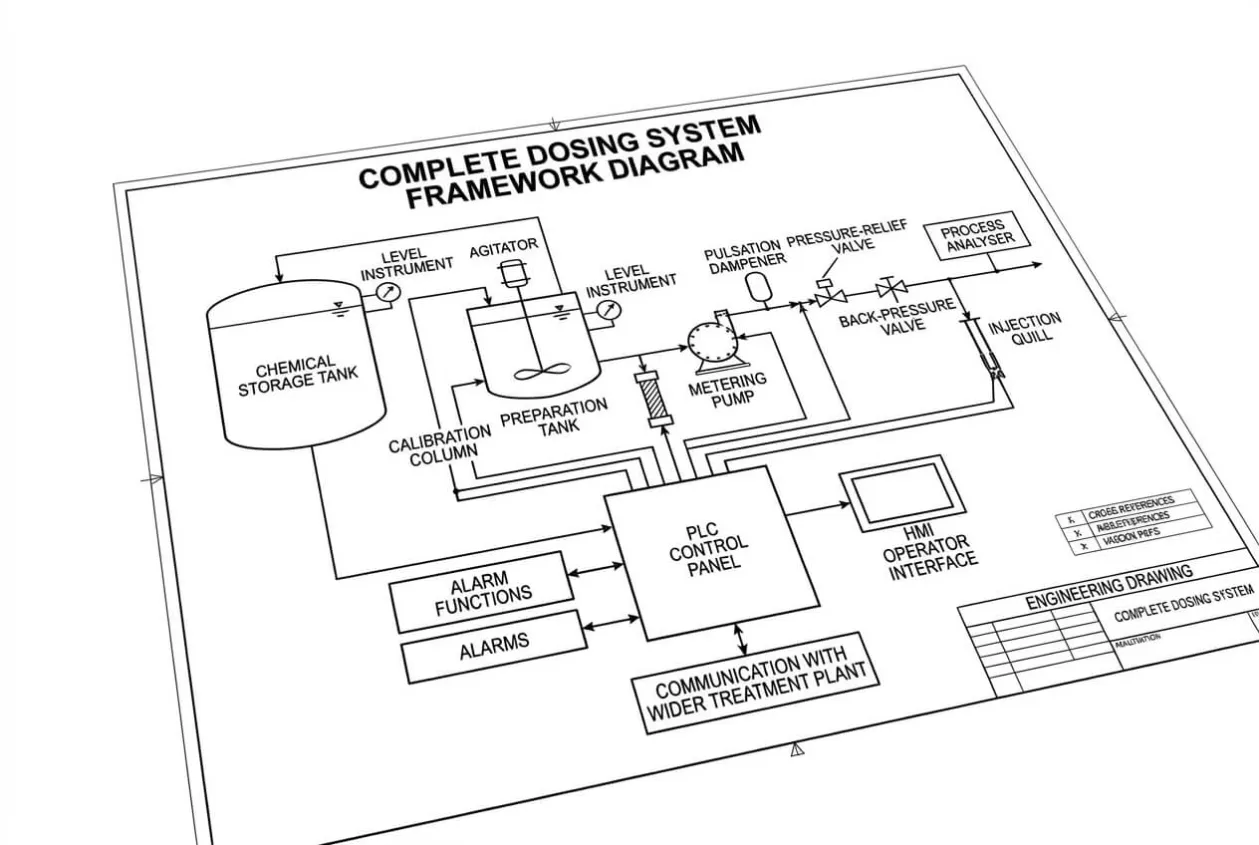
Looking at that equipment list, it is easy to think that a dosing system is simply a collection of mechanical and electrical components assembled onto one skid.
In reality, the equipment is only the visible part of the system.
What determines long-term treatment stability is the relationship between those components after commissioning.
The pump delivers the chemical.
The mixer provides enough energy for the chemical to disperse.
The analyser measures the actual process condition.
The PLC decides when and how much correction should be applied.
The operator supervises the system and responds when operating conditions change.
If each component performs well individually but the overall control loop has not been engineered properly, the treatment process can still become unstable.
For that reason, selecting the correct metering pump is important, but selecting the correct treatment strategy is even more important.
Start With the Treatment Objective
The same dosing skid may be used for pH adjustment, coagulation, flocculation, disinfection, sludge conditioning or chemical precipitation, yet the engineering decisions behind each application are completely different.
A pH control system is designed to maintain a stable chemical balance while avoiding excessive oscillation.
A coagulation system aims to destabilise suspended particles quickly so they can be removed efficiently in the following treatment stages.
Flocculation requires a completely different approach because the objective is no longer rapid mixing but controlled particle growth without breaking the newly formed flocs apart.
Disinfection introduces another set of requirements. Chemical dosage must be sufficient to achieve the required treatment performance while remaining consistent with contact time, wastewater quality and operating conditions.
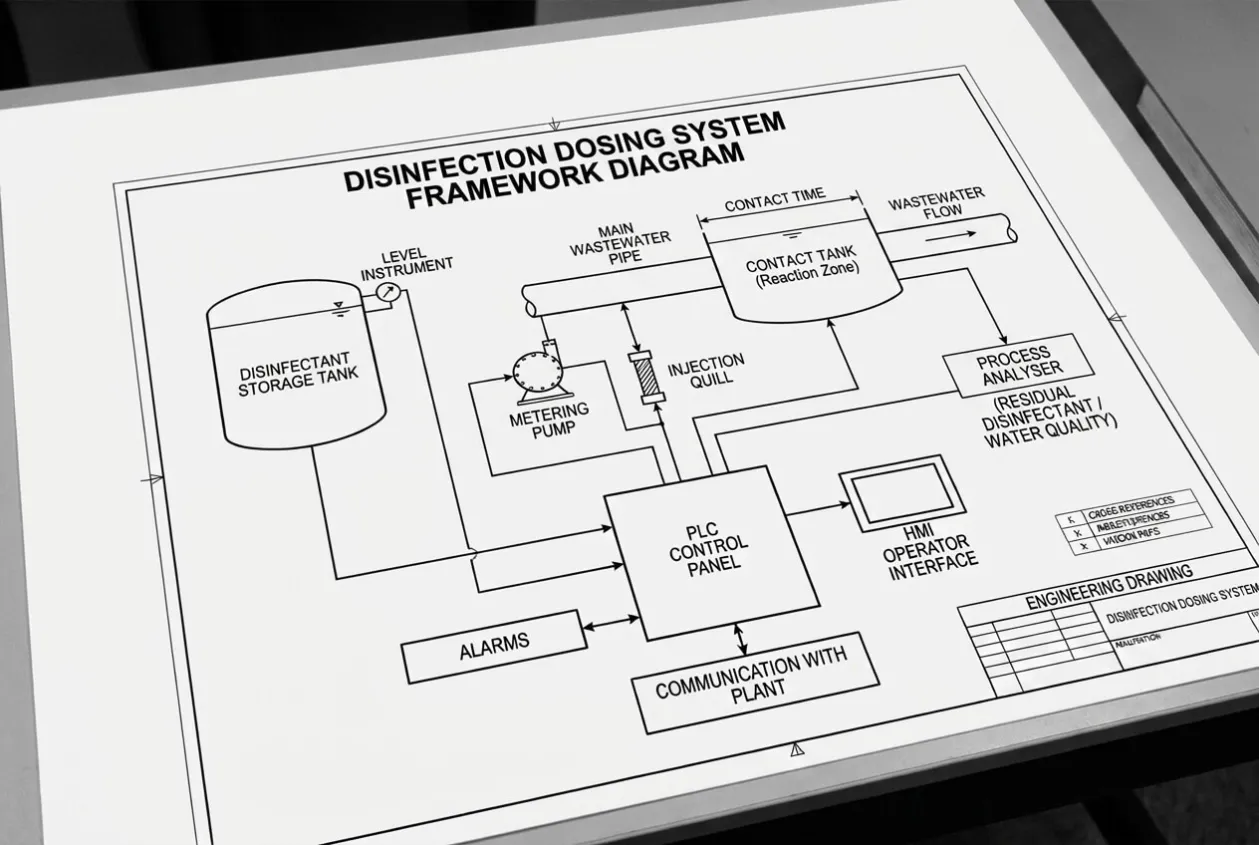
Although the equipment may appear similar from the outside, the treatment objective determines almost every important engineering decision inside the system.
This is why experienced engineers define the process objective before selecting equipment.
Once the process objective has been agreed, questions about pump capacity, instrumentation, control strategy and automation become much easier to answer because they are all supporting the same goal.
The U.S. Environmental Protection Agency also approaches wastewater chemical treatment from this perspective. Its guidance discusses chemical selection, dosage, injection location, mixing conditions and process performance as connected engineering decisions rather than independent equipment choices.
What Information Should a Buyer Define Before Selection?
One of the easiest ways to recognise whether a supplier understands the application is to look at the questions they ask before preparing a quotation.
If the first conversation focuses only on pump capacity and discharge pressure, an important part of the engineering review may already be missing.
A reliable dosing system normally begins with understanding the process itself.
The supplier should know which chemical will be used because different acids, alkalis, oxidising agents, coagulants and polymers require different materials of construction.
Chemical concentration is equally important. Two systems using the same chemical may require different designs simply because the concentration affects viscosity, crystallisation behaviour, corrosion risk and the actual dosing volume.
Operating conditions also deserve careful attention.
The maximum design flow is important, but it should never become the only design point. Most wastewater plants spend the majority of their operating life under normal rather than maximum loading conditions. The selected pump should therefore remain stable and controllable during everyday operation instead of only performing well under exceptional conditions.
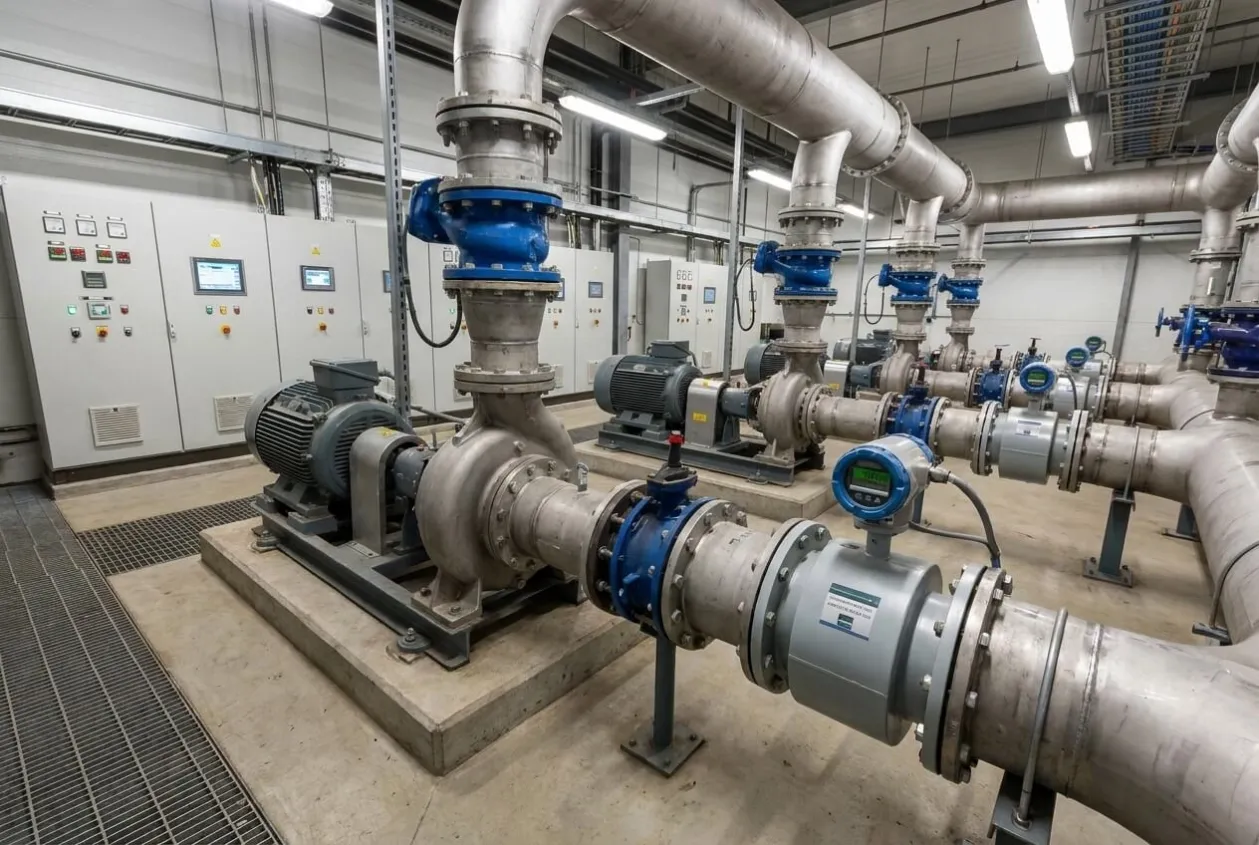
Wastewater flow variation should also be reviewed because it influences the control philosophy. Some plants operate with relatively constant loading while others experience significant variations throughout the day. Those differences affect whether manual adjustment, flow-paced dosing, analyser feedback or combined control will provide the most reliable performance.
The engineering review should also include discharge pressure, pipe losses, injection location, available mixing time, analyser position, maintenance access, alarm philosophy and expected operator involvement.
None of these decisions can be made effectively in isolation because each one influences how the rest of the system behaves.
Good engineering is rarely about optimising one component. It is about ensuring that every component supports the same treatment objective.
Why Oversizing Creates Control Problems
Choosing a larger pump often feels like the safer decision.
The reasoning is understandable.
If the plant expands in the future, additional capacity is already available.
Unfortunately, wastewater treatment systems rarely spend their operating life at maximum design conditions.
Most facilities operate much closer to their normal production rate, which means an oversized pump may spend years working near the bottom of its controllable range.
Under those conditions, relatively small adjustments in stroke length or motor speed can produce disproportionately large changes in chemical delivery.
Operators usually notice the symptoms long before they discover the cause.
The outlet pH begins moving above and below its target.
Chemical consumption gradually increases.
The controller settings are adjusted repeatedly.
The PLC program is questioned.
Eventually someone suggests replacing the pump because it appears unable to maintain stable control.
In many cases, none of those components is actually faulty.
The instability comes from the relationship between pump sizing, process delay, mixing efficiency, analyser location and controller tuning.
Those decisions were made during engineering, but they only become visible after the system begins operating under real process conditions.
Selecting additional capacity is not automatically wrong.
The important question is whether the pump remains accurate and controllable where the plant operates every day rather than where it may operate occasionally.
That distinction often determines whether the commissioning team spends its time optimising the process or trying to correct behaviour that was unintentionally built into the system from the beginning.
A Typical pH-Control Problem
A wastewater treatment plant once reported that its outlet pH could not remain within the specified operating range. The operating team believed the acid dosing pump was undersized because increasing the dosing rate appeared to improve the result for a short period before the pH began drifting again.
Nothing unusual appeared when the equipment was inspected. The metering pump delivered the commanded flow accurately, the PLC executed the control logic correctly, and the pH analyser remained within its calibration tolerance. Every major component seemed to be performing exactly as intended.
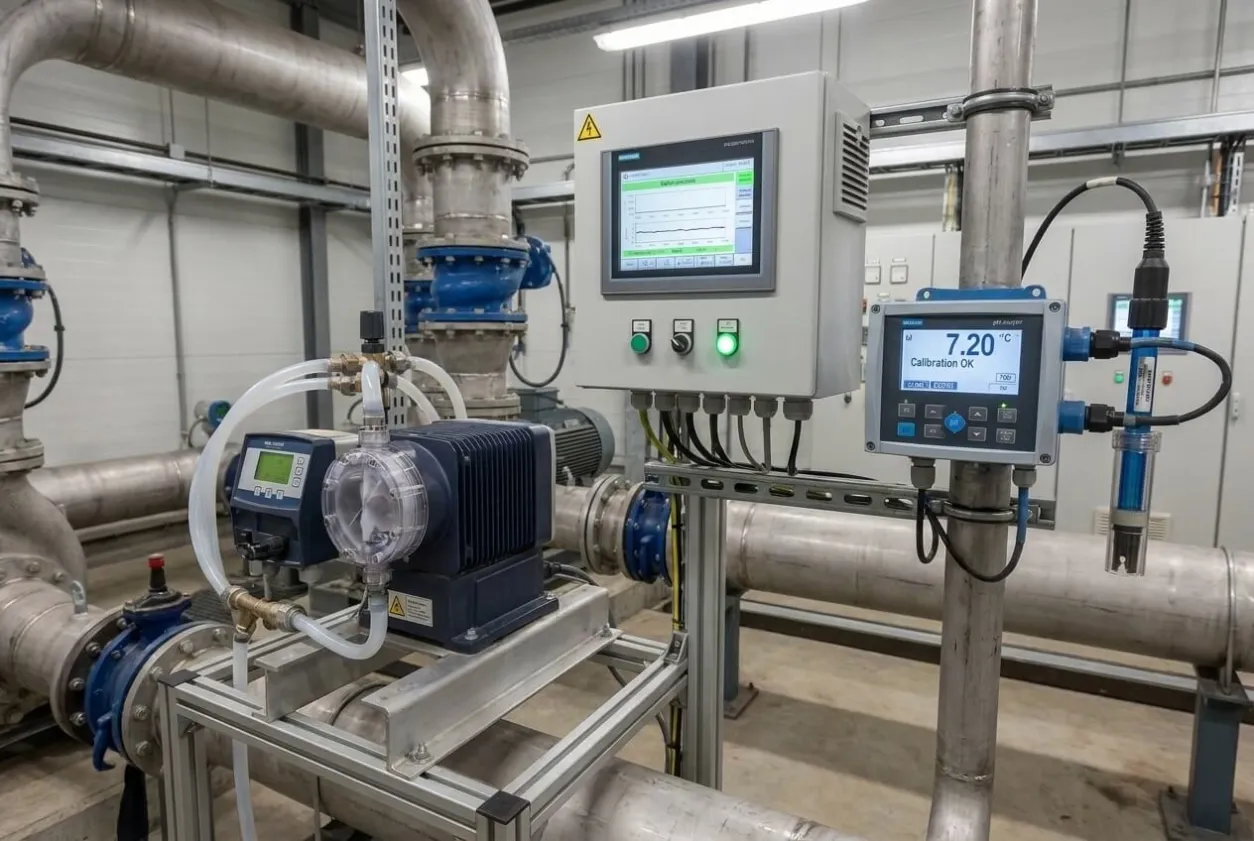
The instability came from the process rather than from the equipment.
The acid was injected into a section where mixing was incomplete, while the pH probe measured the water before the chemical had fully dispersed. The controller was therefore making decisions based on information that no longer represented the actual condition inside the tank.
Each correction arrived too early. Before the previous dose had enough time to mix completely, another correction had already been calculated. The control loop spent its time chasing delayed feedback instead of responding to the process itself.
The engineering review focused on the system rather than on replacing hardware.
The operating range of the dosing pump was matched more closely to the plant's normal chemical demand. The injection point and analyser location were reviewed together instead of independently. Mixing conditions inside the tank were improved, and the controller response was adjusted to reflect the actual process delay.
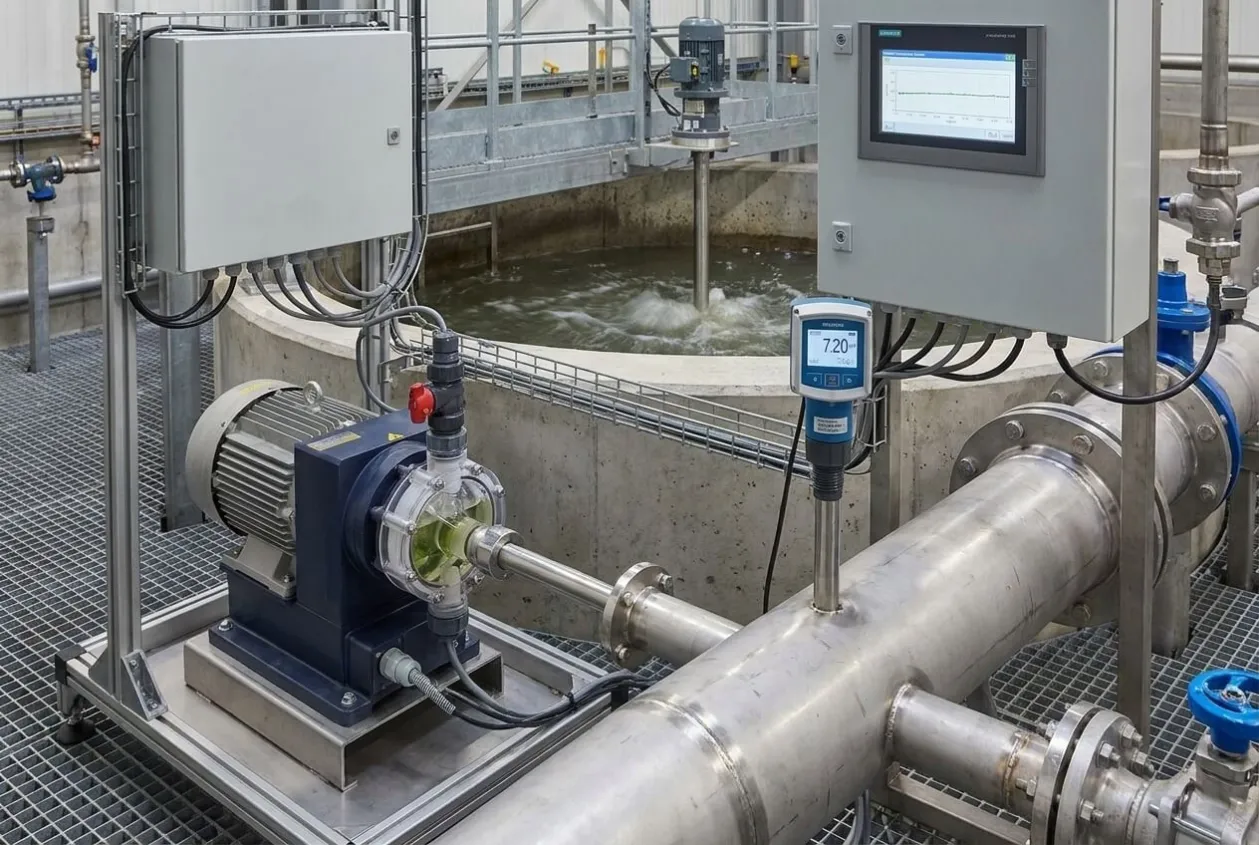
None of these changes required a larger pump.
What they required was a better understanding of how the treatment process behaved as one complete control loop.
This situation is not unusual. Many commissioning problems that appear to be equipment failures are eventually traced back to engineering decisions made long before the first chemical entered the tank.
Choosing the Right Control Strategy
Selecting the correct control philosophy is just as important as selecting the correct pump because even the most accurate dosing equipment cannot compensate for a control strategy that does not reflect the way the treatment process behaves.
Manual dosing is still appropriate for relatively stable applications where wastewater characteristics change very little and operators regularly verify treatment performance. Its greatest advantage is simplicity, but that simplicity also limits its ability to respond automatically when operating conditions begin to change.
Flow-paced dosing automatically adjusts chemical delivery according to the measured wastewater flow. This approach performs well when chemical demand increases and decreases in proportion to flow, although it assumes that pollutant concentration remains reasonably consistent throughout operation.
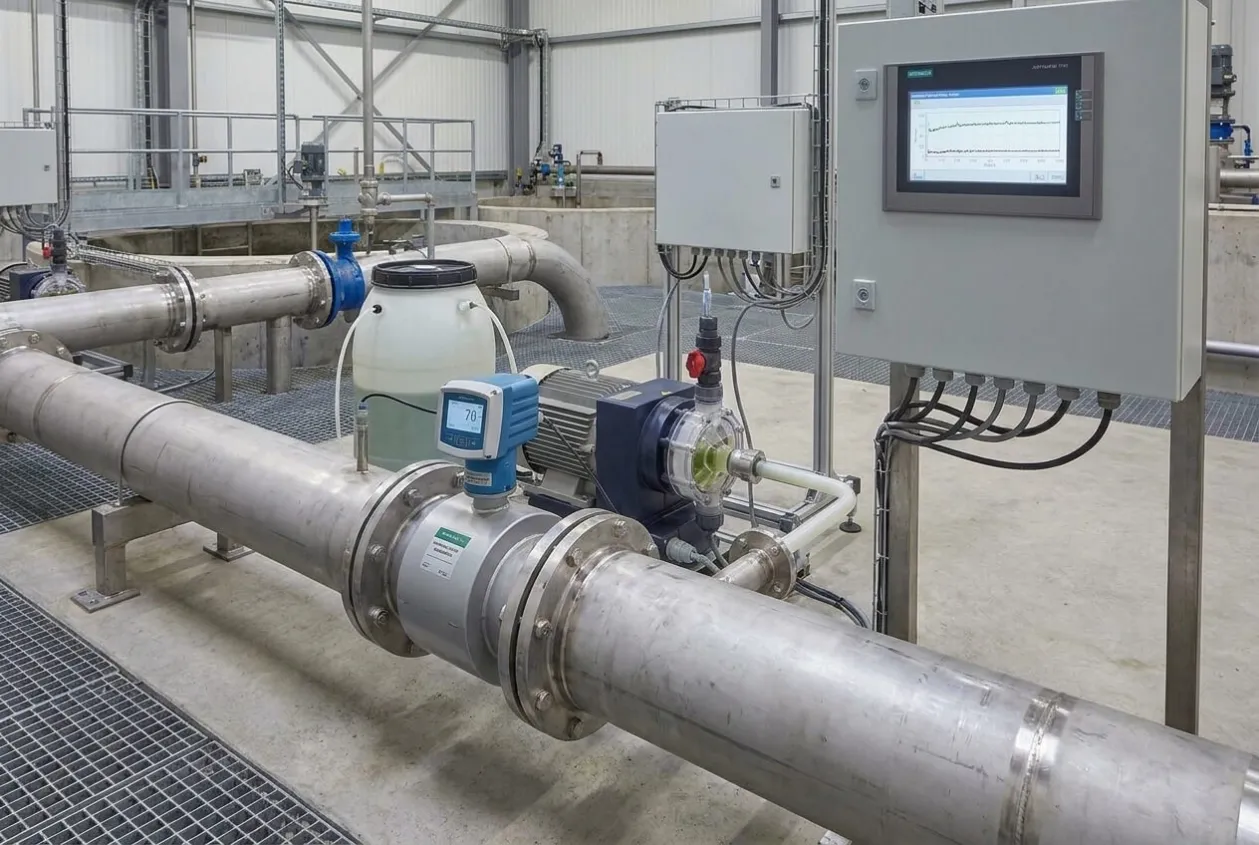
Feedback control uses a measured process value such as pH, ORP, conductivity, turbidity or residual disinfectant to adjust the dosing rate continuously. It offers much greater flexibility when wastewater quality changes, but it also places higher demands on analyser reliability, sampling location, mixing efficiency and controller tuning. Poor instrumentation cannot be corrected simply by writing more sophisticated PLC software.
Many modern wastewater treatment plants combine both approaches. Flow measurement provides the initial dosing command, while analyser feedback makes smaller corrections as process conditions change. This allows the system to respond quickly to changes in hydraulic loading while maintaining stable treatment performance when wastewater quality fluctuates during the day.
Batch treatment systems follow a different philosophy altogether. Instead of continuously adjusting chemical delivery, the PLC executes a predefined sequence that controls dosing volume, mixing time, reaction time and process verification before the next batch begins. The objective is not continuous optimisation but repeatable treatment performance from one batch to the next.
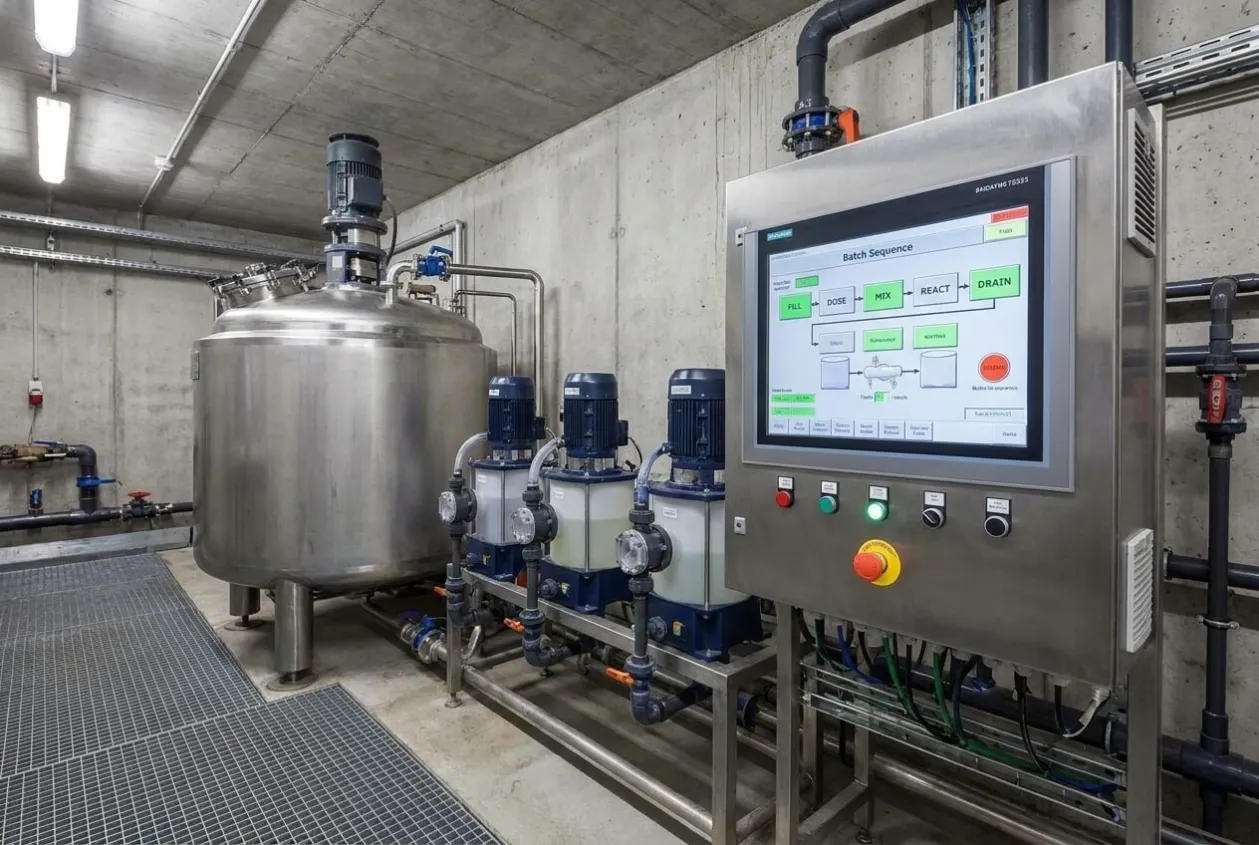
The appropriate control strategy therefore depends on the treatment process rather than on the equipment itself. Selecting the pump before deciding how the process will actually be controlled often leads to unnecessary compromises later in the project.
Chemical Compatibility Extends Beyond the Pump
One of the most common questions during equipment selection is whether the pump is compatible with the chosen chemical.
It is a reasonable question, but it is not a complete one.
The chemical does not come into contact only with the pump head. It also passes through valves, diaphragms, seals, pipework, calibration columns, injection quills, storage tanks and other wetted components throughout the dosing system. Any one of these components can become the weakest point if material compatibility has not been reviewed carefully.
Compatibility also depends on more than the chemical name printed on the container.
Concentration, operating temperature, impurities, pressure and exposure time all influence how materials perform in service. A material that performs well with a diluted solution may deteriorate much faster when exposed to the same chemical at a higher concentration.
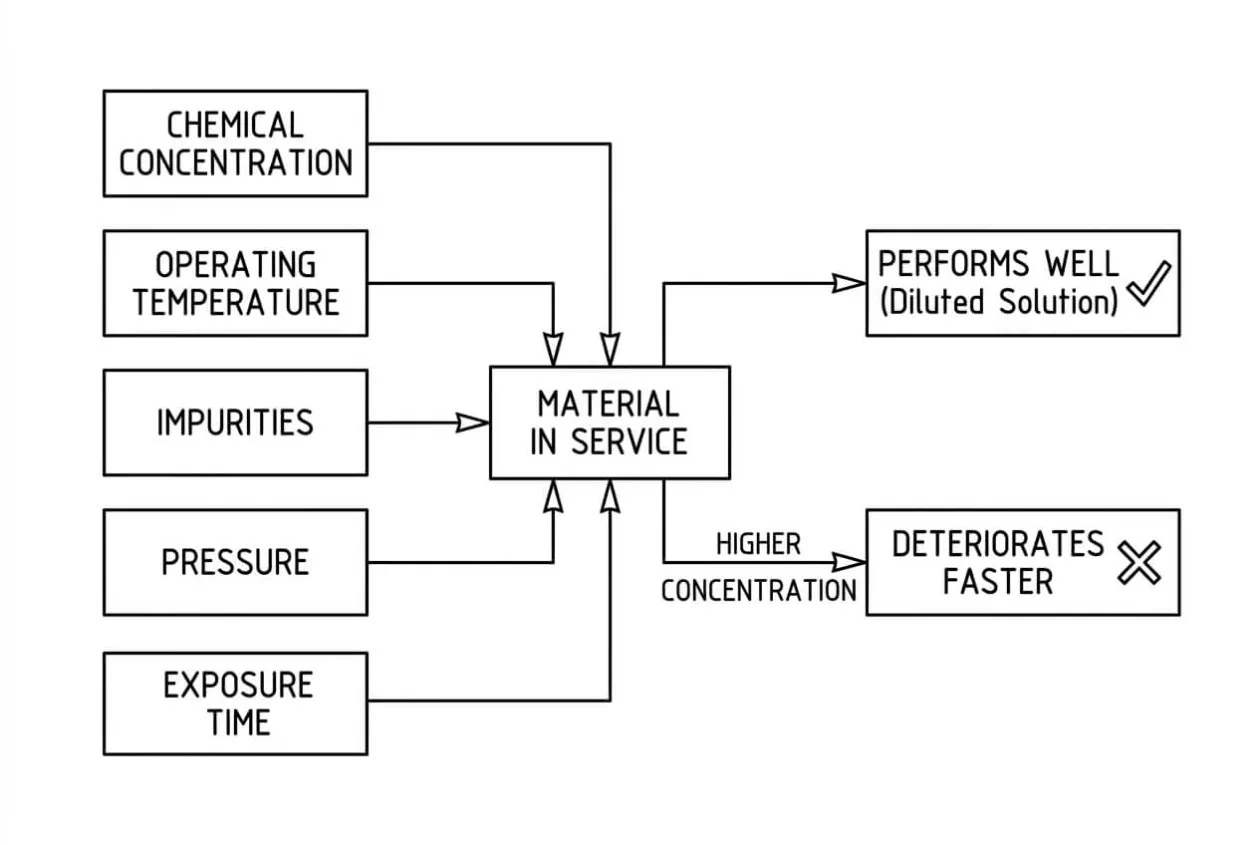
This becomes particularly important when handling concentrated acids, alkalis, sodium hypochlorite, oxidising chemicals or products that have a tendency to crystallise. General material-resistance charts provide a useful starting point during preliminary design, but they should never replace confirmation from the equipment manufacturer for the actual operating conditions.
Material compatibility is rarely the most visible part of a project review, yet it often determines whether the system continues operating reliably several years after commissioning.
Mixing and Instrumentation Should Be Designed Together
A chemical dosing system should never be designed independently from the process it is intended to control.
The injection point determines where the chemical enters the process, but the effectiveness of that decision depends on what happens next. The chemical needs enough mixing energy to disperse properly before reaching the analyser or the following treatment stage. If dispersion is incomplete, the measured value may represent only a local condition rather than the process as a whole.
The position of the analyser is equally important.
A pH probe installed too close to the injection point may measure concentrated chemical before complete mixing has taken place. A probe installed too far downstream introduces additional process delay that can make feedback control less responsive. Neither arrangement is inherently right or wrong. The correct location depends on the hydraulic behaviour of the treatment process and the response time required by the control system.
The same principle applies to coagulation and flocculation.
Coagulants need rapid dispersion so that suspended particles are destabilised quickly. Flocculation requires a gentler mixing environment that allows larger particles to form without being broken apart. Although both stages involve chemical dosing, the mixing requirements are fundamentally different.
These decisions are often treated as civil, mechanical and instrumentation issues handled by different disciplines. During commissioning they become one operational issue because the treatment process does not distinguish between engineering departments.
A reliable control system begins with treating mixing, measurement and automation as one integrated design rather than three independent tasks.
What Should Be Included in the Control Panel?
When buyers evaluate a chemical dosing system, most attention is naturally given to the mechanical equipment. Pump capacity, tank volume and material selection are all easy to compare because they appear clearly on a quotation.
The control panel often receives much less attention, even though it is the part of the system that determines how the equipment behaves once the plant begins operating.
A well-designed control panel does much more than start and stop a metering pump. It coordinates the entire dosing process, monitors operating conditions and ensures that every component responds in a predictable sequence. When something unexpected happens, the objective is not simply to generate an alarm. The objective is to move the process into a safe and understandable operating condition that allows operators to make the right decision quickly.
Depending on the application, the PLC control system may need to manage manual and automatic operating modes, calculate flow-paced dosing rates, switch automatically between duty and standby pumps, monitor tank levels, detect loss of prime, supervise analyser status, record dosing totals, maintain alarm history and communicate with the plant SCADA or distributed control system.
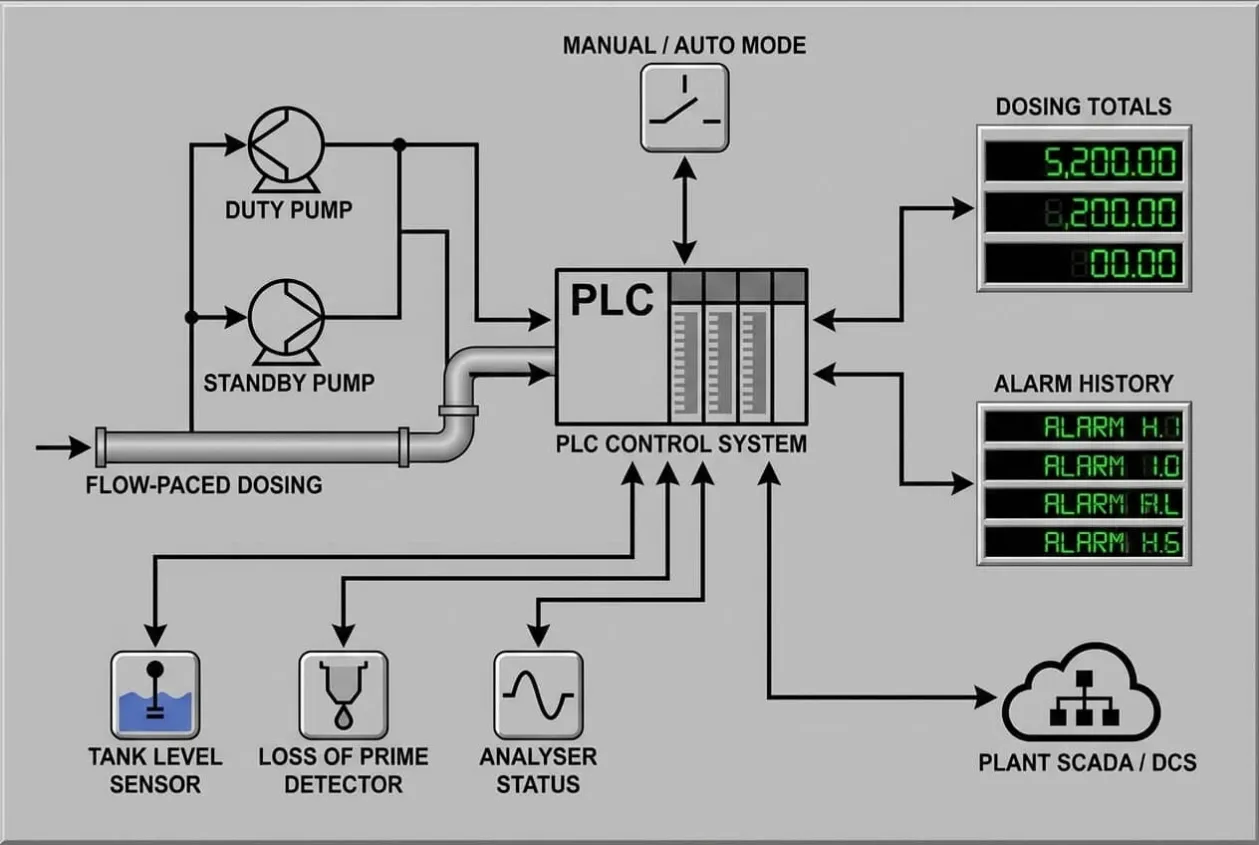
These functions are not included because they make the control panel appear more sophisticated. They are included because wastewater treatment is a continuous process, and small equipment failures should not develop into larger process failures simply because the automation system cannot recognise what has happened.
One example illustrates the difference.
Imagine that a dosing pump continues receiving its normal dosing command after the chemical storage tank has become empty. Mechanically, the pump is still running. From the PLC's perspective, the output signal is still correct. If no level monitoring or permissive logic has been implemented, the control system has no way of recognising that chemical delivery has already stopped. Operators may continue believing the treatment process is functioning normally until laboratory results or discharge measurements reveal that treatment quality has deteriorated.
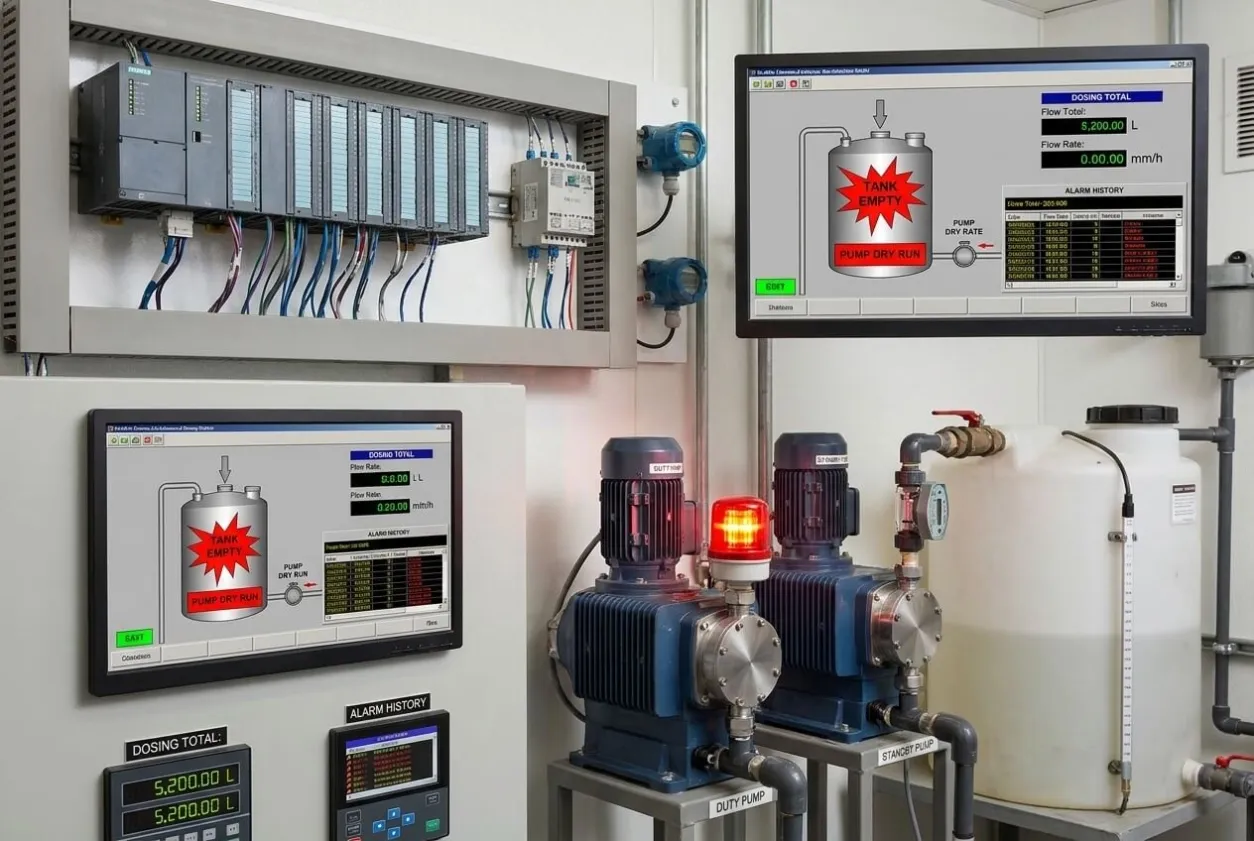
A well-designed control system behaves differently.
Before the pump is allowed to operate, the PLC confirms that sufficient chemical is available, the process flow has been established and all required operating conditions have been satisfied. If one of those conditions disappears during operation, the control logic responds according to a predefined strategy instead of allowing the process to continue blindly.
This is the difference between automation and simple electrical control.
The objective is not merely to operate equipment. The objective is to make the treatment process predictable.
Safety Should Be Designed Into the System, Not Added Afterwards
Safety is sometimes treated as the final item on the project checklist. Once the equipment has been selected and the drawings have been completed, attention turns towards emergency showers, warning labels and personal protective equipment.
In practice, many safety decisions should already have been made long before the mechanical design is finalised.
The chemical itself influences almost every part of the installation. It affects material selection, ventilation requirements, spill containment, maintenance procedures and the physical layout of the equipment. A dosing system handling concentrated sodium hypochlorite will not be engineered in exactly the same way as one handling polymer or dilute alkali because the operating risks are fundamentally different.
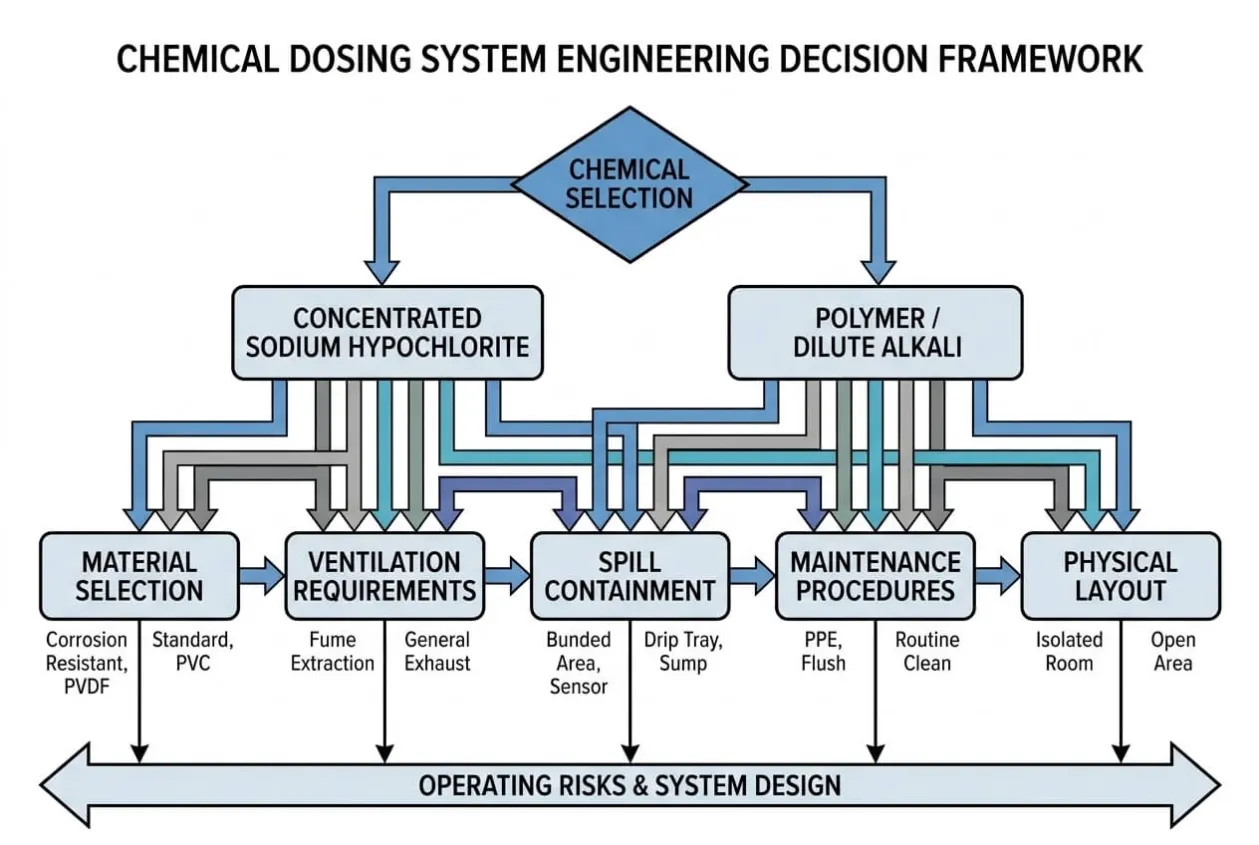
Maintenance should also be considered from the operator's perspective rather than from the equipment layout alone.
Can the calibration column be used safely without standing in an awkward position?
Can the diaphragm be replaced without dismantling half of the pipework?
Can operators isolate the system before maintenance begins?
Is there enough space to refill chemicals without creating unnecessary handling risks?
These questions are rarely visible on a pump datasheet, yet they influence everyday operation far more than many technical specifications.
The chemical supplier's Safety Data Sheet should always form part of the engineering review, together with local environmental, electrical and occupational safety requirements. A dosing package that performs well in one application cannot automatically be considered suitable for another simply because the pump model remains the same.
Reliable engineering is not only about keeping the process under control. It is equally about ensuring that operators can install, maintain and troubleshoot the system safely throughout its operating life.
A Practical Selection Path
Although every wastewater project has its own technical requirements, the engineering review usually follows the same overall sequence.
The process begins by defining the treatment objective rather than the equipment. Once the required treatment result is understood, the chemical can be selected together with its concentration and operating characteristics. Only then does it become possible to establish the minimum, normal and maximum dosing demand that the system must handle.
After the process requirements are clear, the engineering team can review wastewater flow variation, calculate discharge pressure, confirm material compatibility and determine where chemicals should be injected. At that stage, the control philosophy can also be developed because the relationship between process behaviour and instrumentation is now understood.
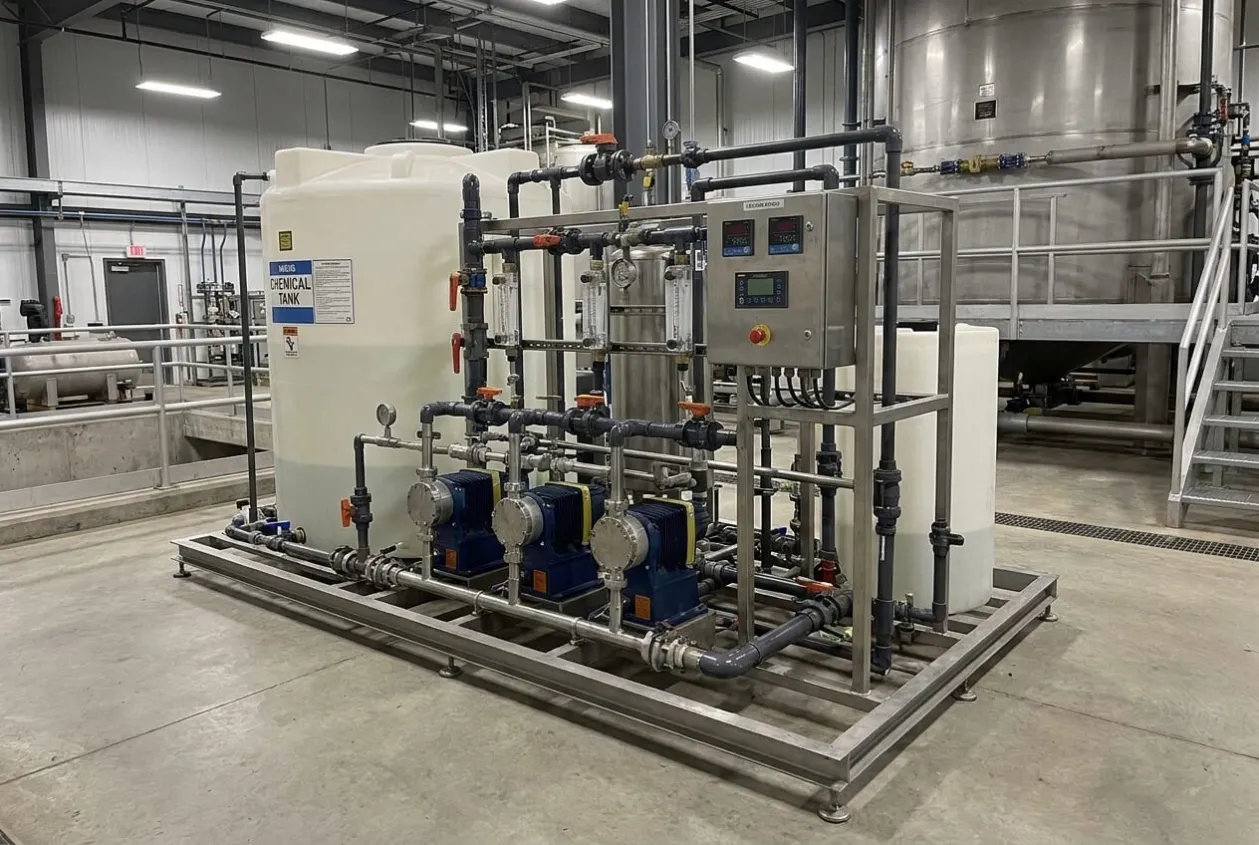
Only after these decisions have been completed does equipment selection become straightforward.
The metering pump can be chosen according to its normal operating range rather than its catalogue maximum. The PLC sequence can be developed around the actual treatment process instead of around assumptions. Instrumentation can be positioned where it provides meaningful process information rather than simply fitting the available pipework.
Commissioning also becomes significantly more predictable because the system has been designed as one integrated process instead of several independent packages assembled on site.
Experienced project teams rarely achieve successful commissioning by solving problems during startup.
More often, they achieve it by preventing those problems during design.
Questions Buyers Should Ask Before Approving a Dosing System
A supplier should be able to explain not only what equipment has been selected, but why it has been selected.
Before approving a chemical dosing system, buyers should expect clear answers to questions such as:
- What operating conditions were used as the basis for pump selection?
- Will the selected pump remain accurate during normal production rather than only at maximum demand?
- How was discharge pressure calculated?
- Have all wetted materials been verified against the actual chemical concentration?
- Why was this injection location selected?
- How much mixing time is available before measurement?
- What happens if the analyser fails or the chemical tank becomes empty?
- Which operating conditions are treated as permissives before dosing begins?
- How will operators verify actual chemical delivery during commissioning?
- What information must be confirmed before the PLC program is finalised?
These questions are valuable because they encourage discussion about the treatment process rather than simply about the equipment specification.
A supplier who explains the engineering decisions behind the system usually provides more long-term value than one who only recommends a larger pump or a different model number.
Need help specifying or sourcing this for your project? Request a quote - we reply within 1-2 working days with a technical review.