Jul 2, 2026Buying Guides
What Materials Are Best for Outdoor Electrical Cabinets?
What Materials Are Best for Outdoor Electrical Cabinets? When buyers evaluate outdoor electrical cabinets, the discussion often starts with material type and price. In real industrial projects, howev
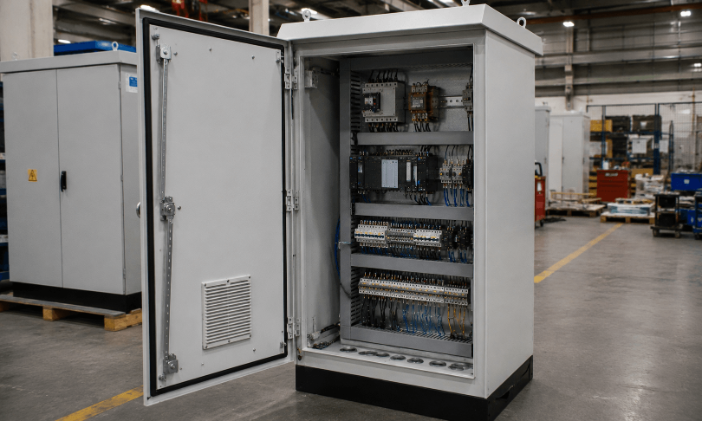
What Materials Are Best for Outdoor Electrical Cabinets?
When buyers evaluate outdoor electrical cabinets, the discussion often starts with material type and price. In real industrial projects, however, the bigger concern usually appears much later, after the cabinet has already been installed outdoors for several months or years.
This is where many enclosure decisions become expensive.
A cabinet that corrodes prematurely, overheats under direct sunlight, leaks during seasonal rain, or requires repeated maintenance visits can create operational costs far beyond the original purchase price. In some environments, enclosure failure does not only damage the cabinet itself. It can interrupt production, damage PLC systems, create electrical safety risks, or shorten the life of sensitive automation equipment installed inside the enclosure.
This is why experienced project teams rarely ask only
“Which material is cheapest?”
Instead, they usually ask:
- Which material survives best in this environment?
- How much maintenance will this cabinet require?
- What happens if corrosion damages the enclosure seal?
- Will this material still perform after years of UV exposure?
- Is the cabinet protecting critical automation equipment or only basic wiring?
- What is the actual lifecycle cost over ten years?
Those questions are much more important because outdoor enclosure selection is really about operational reliability, not only material preference.
According to guidance published by the National Electrical Manufacturers Association (NEMA), enclosure specifications should always consider environmental exposure, corrosion conditions, ingress protection, and long-term operating requirements rather than relying on material cost alone.
This becomes especially important for projects involving:
- Outdoor PLC cabinets
- Industrial automation systems
- Utility infrastructure
- Coastal installations
- Wastewater facilities
- Packaging and process equipment
- Renewable energy systems
In these environments, enclosure failure often becomes a system reliability problem rather than simply a cosmetic issue.
Outdoor Electrical Cabinet Materials Overview
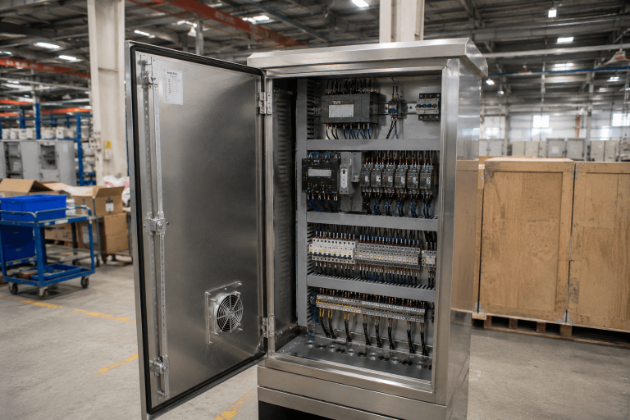
The Main Material Options
Most outdoor electrical cabinets are built from a relatively small group of materials, but each one performs differently once environmental exposure, maintenance expectations, and operational conditions are considered together.
Material | Corrosion Resistance | Strength | Weight | Cost | Best Use Case |
|---|---|---|---|---|---|
Galvanized steel | Good for general outdoor use | High | Medium-heavy | Lower | Standard outdoor installations with moderate exposure |
Stainless steel (304) | Very good | High | Heavy | High | Outdoor cabinets in humid or mildly corrosive environments |
Stainless steel (316) | Excellent | High | Heavy | Higher | Coastal, salt spray, and harsh corrosive environments |
Aluminum | Good to very good | Medium | Light | Medium | Lightweight outdoor enclosures where weight matters |
FRP / Fiberglass | Excellent | Medium | Light-medium | Medium-high | Chemical, coastal, and highly corrosive environments |
Plastic / Polycarbonate | Fair to good | Low-medium | Very light | Low-medium | Small or low-demand outdoor enclosure applications |
Suggested Caption
Choosing the right outdoor electrical cabinet material depends on corrosion risk, maintenance expectations, environmental exposure, and total lifecycle cost rather than purchase price alone.
Why Material Choice Is Not One-Size-Fits-All
One of the most common procurement mistakes is assuming that a cabinet material that worked well in one project will automatically work well everywhere else.
Outdoor conditions vary dramatically between environments.
A galvanized steel cabinet installed in a dry inland factory may operate reliably for years with minimal maintenance. The same enclosure placed near a coastal port or chemical-processing area may begin corroding much faster because airborne salt, humidity, and chemical exposure attack the protective coating continuously.
This is why enclosure selection should begin with environmental risk assessment rather than supplier quotation comparison.
Buyers also need to consider the importance of the equipment inside the cabinet. A low-cost enclosure protecting simple terminal blocks creates very different operational risk compared to an enclosure containing:
- PLC systems
- VFDs
- Communication devices
- Industrial network equipment
- Remote monitoring systems
As automation systems become more integrated, enclosure reliability becomes increasingly tied to overall system uptime. We discussed this broader relationship between enclosure reliability and automation stability in our article about modern control panel solutions and industrial automation reliability, particularly in projects where environmental exposure directly affects long-term system performance.
Best Materials by Environment
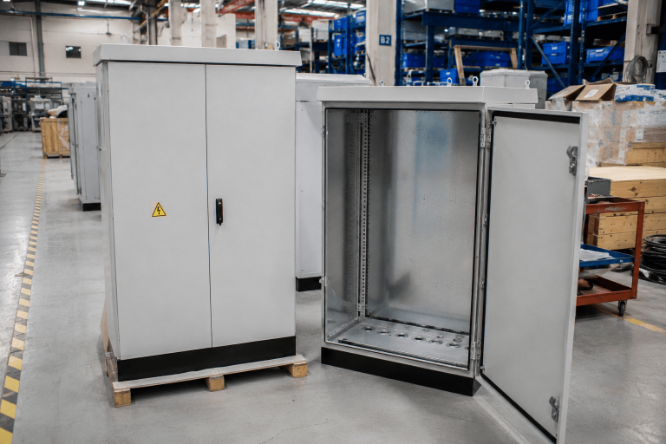
Best Material for General Outdoor Use
For many standard outdoor applications, galvanized steel remains one of the most widely used enclosure materials because it offers a practical balance between cost, structural strength, and acceptable corrosion resistance.
This makes galvanized steel suitable for:
- Outdoor utility installations
- General factory environments
- Infrastructure projects
- Standard automation systems
- Moderate weather exposure
However, buyers should understand that galvanized steel relies heavily on the integrity of its protective zinc coating. Once the coating becomes damaged through scratches, poor fabrication practices, or long-term environmental exposure, corrosion can begin spreading beneath the surface.
This is one reason lower-cost outdoor cabinets sometimes create unexpected maintenance costs several years later.
In many procurement situations, the initial quotation looks attractive because galvanized steel cabinets reduce upfront capital expense. The longer-term maintenance burden is often less visible during purchasing discussions.
According to corrosion engineering guidance published by ASM International, lifecycle performance in outdoor metal systems depends heavily on coating integrity, environmental conditions, and ongoing maintenance exposure.
Best Material for Coastal or Salt Spray Environments
Coastal environments change the enclosure decision significantly because airborne chlorides accelerate corrosion much faster than many buyers initially expect.
Near ports, offshore infrastructure, wastewater plants, and marine facilities, corrosion often becomes the dominant enclosure risk rather than mechanical damage.
This is why stainless steel, especially 316-grade stainless steel, is commonly preferred in harsh outdoor environments involving the following:
- Salt spray exposure
- Continuous humidity
- Chemical contamination
- Coastal wind exposure
The difference between stainless steel 304 and 316 matters here because 316 contains molybdenum, which improves resistance to chloride corrosion.
According to technical guidance from the Nickel Institute, 316 stainless steel generally provides stronger long-term performance in chloride-rich environments than 304.
Buyers sometimes hesitate because stainless steel cabinets carry a higher upfront cost. In practice, many coastal operators eventually discover that corrosion-related maintenance, repainting, and enclosure replacement cost far more over the lifecycle of the installation.
The operational question, therefore, becomes:
Is the project optimizing for purchase price or long-term reliability?
That distinction changes the enclosure decision entirely.
Best Material for Lightweight Outdoor Enclosures
In some projects, enclosure weight becomes an important engineering constraint.
This happens frequently in
- Pole-mounted systems
- Rooftop installations
- Renewable energy projects
- Transportation infrastructure
- Mobile equipment systems
Aluminum offers advantages in these applications because it reduces installation difficulty while still providing acceptable outdoor corrosion performance in many environments.
However, lightweight construction introduces tradeoffs that buyers sometimes overlook.
Compared to steel enclosures, aluminum may provide the following:
- Lower structural rigidity
- Different thermal behavior
- Increased sensitivity to mechanical impact
- Potential galvanic corrosion concerns
This does not make aluminum a poor choice. It simply means enclosure material should always be evaluated together with mounting conditions, environmental exposure, and equipment weight.
Best Material for Highly Corrosive Environments
Some industrial environments are aggressive enough that conventional metallic enclosures struggle to survive long-term exposure.
This includes:
- Chemical-processing facilities
- Wastewater treatment plants
- Fertilizer production
- Coastal chemical terminals
- Highly humid industrial zones
In these situations, FRP and fiberglass enclosures often become attractive because they eliminate many traditional corrosion mechanisms associated with steel.
Unlike metal cabinets, fiberglass does not rust. This can significantly reduce maintenance requirements in harsh environments where coating systems degrade continuously.
However, buyers should still evaluate:
- UV stability
- Mechanical strength
- Fire behavior
- Long-term aging
- Manufacturer quality consistency
FRP performance varies considerably between suppliers, especially in lower-cost products where resin quality and structural reinforcement may be inconsistent.
When Plastic Enclosures Make Sense
Plastic and polycarbonate enclosures are commonly used for smaller outdoor electrical applications because they offer corrosion resistance, low weight, and lower cost.
They are often suitable for:
- Communication boxes
- Small junction systems
- Light-duty controls
- Sensor housings
However, outdoor plastic performance depends heavily on UV resistance and long-term weathering behavior.
This is one area where procurement decisions sometimes become overly price-driven.
A low-cost plastic enclosure may initially appear acceptable but gradually become brittle, discolored, or structurally weakened after years of direct sunlight exposure.
This is especially problematic in hotter climates where thermal cycling accelerates material aging.
Stainless Steel vs Galvanized Steel
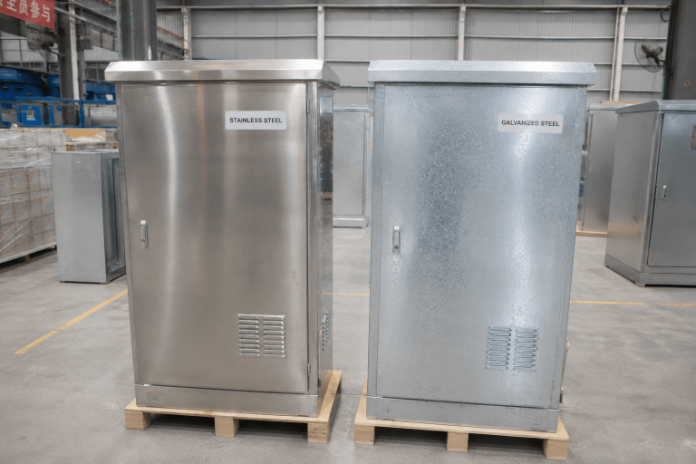
Corrosion Resistance
This comparison is one of the most common questions buyers ask because galvanized steel and stainless steel often compete directly in outdoor projects.
The difference is not simply about which material resists corrosion “better.” The more important issue is how each material behaves after years of environmental exposure.
Galvanized steel depends on an external protective zinc layer. Stainless steel contains corrosion resistance within the alloy structure itself.
In moderate outdoor environments, galvanized steel can perform well for many years. In aggressive environments involving salt, chemicals, or constant humidity, stainless steel usually maintains integrity much longer.
This becomes critical when enclosure sealing performance affects sensitive automation systems or operational uptime.
Cost and Lifecycle Value
The purchase price difference between galvanized steel and stainless steel is often substantial, which is why procurement teams frequently prefer galvanized steel initially.
However, life cycle economics often tell a different story.
When evaluating enclosure value, buyers should consider the following:
Cost Factor | Long-Term Impact |
|---|---|
Corrosion maintenance | Increased labor cost |
Repainting or coating repair | Additional downtime |
Premature enclosure replacement | Higher capital expense |
Water ingress after corrosion | Equipment failure risk |
Outdoor maintenance access | Service difficulty |
In projects involving remote locations, production-critical automation systems, or difficult maintenance access, lifecycle cost often outweighs initial purchase savings.
This is one reason experienced industrial operators frequently standardize stainless steel for outdoor automation infrastructure despite higher upfront pricing.
Which One to Choose
For standard outdoor applications with moderate exposure and manageable maintenance access, galvanized steel often remains a practical and economical choice.
For corrosive, coastal, or high-humidity environments where long-term reliability matters more than upfront cost, stainless steel generally provides stronger operational value over time.
The better material is usually the one that minimizes long-term operational risk rather than simply reducing purchase cost.
Why NEMA and IP Ratings Matter
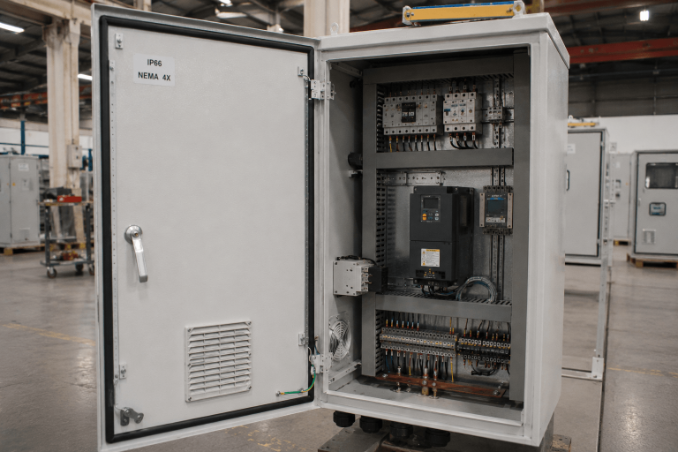
Protection Rating Comes First
Many buyers begin enclosure discussions by focusing on material selection before clearly defining environmental protection requirements.
In practice, the enclosure rating should usually be determined first because it defines what the cabinet must survive operationally.
IP ratings focus primarily on ingress protection against solids and water. NEMA ratings also consider environmental factors such as corrosion, ice formation, and outdoor exposure.
This distinction matters because the enclosure material must support the protection rating consistently over years of real-world use rather than only during initial installation.
According to NEMA enclosure standards, environmental conditions should always be evaluated together with enclosure type and intended operating environment.
NEMA vs IP in Real Projects
Rating System | Main Focus |
|---|---|
IP Rating | Protection against dust and water ingress |
NEMA Rating | Broader environmental conditions, including corrosion |
In many industrial projects, both standards are referenced because ingress protection alone does not fully describe long-term environmental risk.
A cabinet exposed to coastal salt spray may technically satisfy water-ingress requirements while still suffering corrosion-related degradation over time.
This is why enclosure specification requires both environmental understanding and operational context.
Related Article:
How Ratings Affect Material Selection
As environmental requirements become more demanding, enclosure material options usually narrow quickly.
Environment | Common Material Direction |
|---|---|
Standard outdoor exposure | Galvanized steel |
Washdown environments | Stainless steel |
Coastal exposure | Stainless steel 316 |
Chemical exposure | FRP/Fiberglass |
Lightweight infrastructure | Aluminum |
The rating defines the protection target. The material determines whether the enclosure can maintain that protection over its service life.
What Else Affects Outdoor Cabinet Performance
UV Exposure and Surface Finish
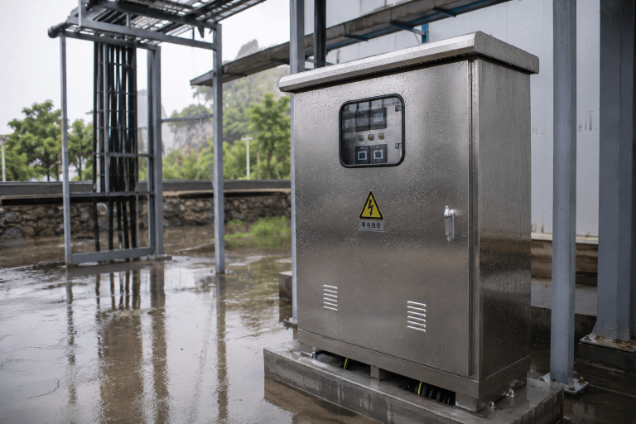
Outdoor electrical cabinets installed under direct sunlight experience constant UV exposure, which gradually affects coatings, plastics, surface finishes, and sealing materials.
This becomes especially important in the following:
- Rooftop installations
- Solar infrastructure
- Open industrial yards
- Desert environments
- Transportation infrastructure
UV-related degradation is often underestimated during procurement because the damage develops gradually rather than immediately.
Over time, however, UV exposure can weaken protective coatings and increase maintenance requirements significantly.
Heat Dissipation and Ventilation
As modern electrical cabinets contain more PLC systems, drives, communication devices, and power electronics, thermal management has become a much larger operational concern.
Outdoor cabinets exposed to direct sunlight can experience a substantial internal temperature rise, especially in warmer climates.
This affects:
- PLC reliability
- Drive lifespan
- Communication stability
- Power supply performance
Enclosure material influences thermal behavior, but ventilation strategy is equally important.
In some projects, buyers focus heavily on corrosion resistance while underestimating thermal management requirements that eventually affect automation reliability more directly.
We explored this operational relationship between control systems, environmental exposure, and startup stability further in our article about why control panel startup problems happen more often than most buyers expect, especially in projects where environmental conditions contribute to commissioning and operational instability.
Grounding and Safety
Metallic enclosures require proper grounding and bonding to maintain electrical safety and fault protection.
Nonmetallic enclosures avoid conductivity but introduce different engineering considerations involving
- Structural rigidity
- Fire behavior
- Mechanical impact
- Long-term durability
This is one reason enclosure material selection should be integrated into the overall electrical system design process rather than treated as a standalone purchasing decision.
How to Choose the Right Material
Start With the Environment
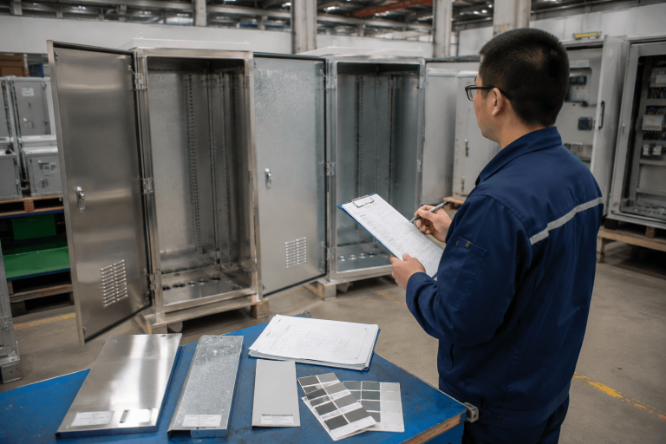
The most reliable enclosure decisions begin with environmental assessment rather than supplier pricing.
Questions buyers should evaluate include:
- Is the site coastal or inland?
- Will airborne chemicals or salt exposure exist?
- How severe is direct sunlight exposure?
- Is maintenance access difficult?
- Does the cabinet protect critical automation systems?
- How expensive would downtime become if enclosure failure occurs?
These operational questions usually narrow material selection much faster than marketing brochures.
Match the Material to the Use Case
Use Case | Common Material Choice |
|---|---|
Standard outdoor installations | Galvanized steel |
Corrosive or humid environments | Stainless steel |
Lightweight outdoor systems | Aluminum |
Severe chemical exposure | FRP/Fiberglass |
Small low-demand applications | Plastic/Polycarbonate |
The goal is not to choose the “best” material universally. The goal is to select the material that creates the lowest operational risk for the actual environment.
Consider Total Cost, Not Just Purchase Price
The lowest-cost enclosure at purchase can become the most expensive enclosure over its operational life if corrosion, overheating, UV degradation, or maintenance issues appear repeatedly.
For buyers responsible for long-term facility reliability, the more useful question is usually the following:
Which enclosure reduces operational risk and maintenance burden over the next ten years?
That perspective changes enclosure decisions substantially.
FAQ
What is the best material for outdoor electrical cabinets?
The best material depends on environmental exposure, maintenance expectations, and the importance of the equipment inside the enclosure. Stainless steel is often preferred for corrosive environments, galvanized steel works well for general outdoor applications, and FRP or plastic materials may be suitable for specialized conditions.
Is stainless steel better than galvanized steel for outdoor enclosures?
In corrosive or coastal environments, stainless steel usually provides stronger long-term reliability because its corrosion resistance exists throughout the material itself rather than relying only on a protective coating. Galvanized steel can still perform well in less aggressive outdoor conditions where maintenance access is manageable.
Are plastic enclosures good for outdoor use?
Plastic enclosures can work effectively for certain outdoor applications, especially smaller systems or communication equipment. However, UV resistance, long-term weather exposure, and structural durability should be evaluated carefully because lower-quality plastics may degrade significantly over time.
What matters more, the material or the IP/NEMA rating?
Both are important, but the protection rating should generally be defined first because it reflects the environmental requirements of the installation. The enclosure material should then be selected to maintain that protection reliably over the expected service life.
Which material is best for coastal environments?
Stainless steel 316 is commonly preferred for coastal and salt-spray environments because it provides stronger resistance to chloride corrosion. FRP can also perform well in certain highly corrosive applications where long-term corrosion resistance matters more than metallic strength.
Does aluminum work for outdoor electrical cabinets?
Yes, aluminum can work well in projects where weight reduction matters, such as rooftop or pole-mounted installations. However, buyers should still evaluate corrosion exposure, mechanical strength, and environmental compatibility carefully before selection.
Related Products: