Jul 6, 2026Case Studies
Integrating HVAC Automation Control Panels into Modern BMS
Integrating HVAC Automation Control Panels into Modern BMS: A Practical Engineering Guide Many commercial buildings still waste large amounts of energy because HVAC equipment operates as isolated sys
Integrating HVAC Automation Control Panels into Modern BMS: A Practical Engineering Guide
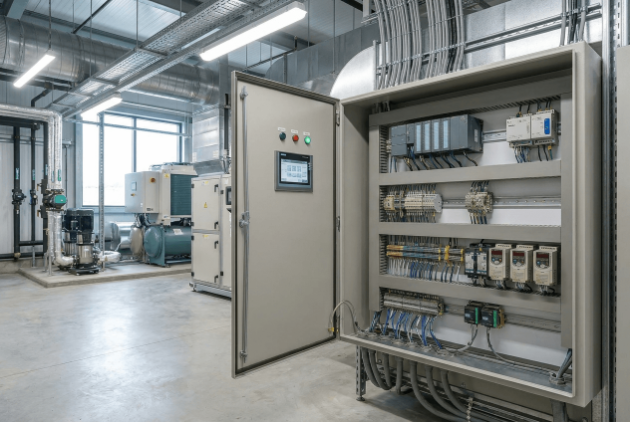
Many commercial buildings still waste large amounts of energy because HVAC equipment operates as isolated systems. I often see chillers, AHUs, and VAV boxes running without coordinated control logic or centralized optimization.
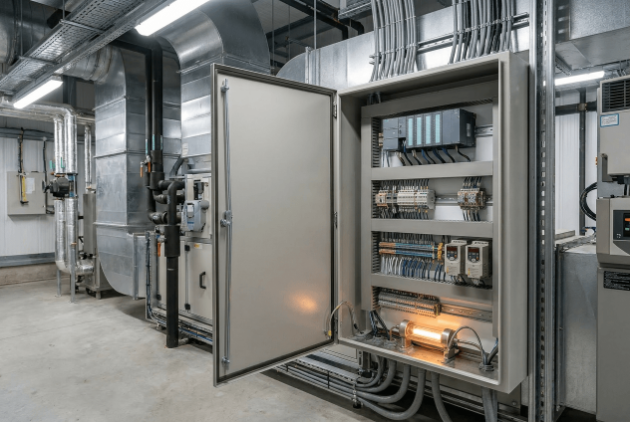
Modern HVAC automation control panels[¹] improve energy efficiency[²], indoor air quality[⁷], and operational reliability by integrating VFDs[³], intelligent controllers[⁴], and open communication protocols such as BACnet[⁵] and Modbus[⁶] into a unified building management system (BMS)[⁸].
In real projects, HVAC control panels are no longer simple motor starter cabinets. They have become the operational core of smart buildings. They collect sensor data, execute control sequences, manage energy consumption, and communicate with the BMS in real time. Poor panel design now affects not only comfort but also energy cost, maintenance efficiency, and green building compliance.
Why Legacy HVAC Control Panels Fail in Modern Buildings
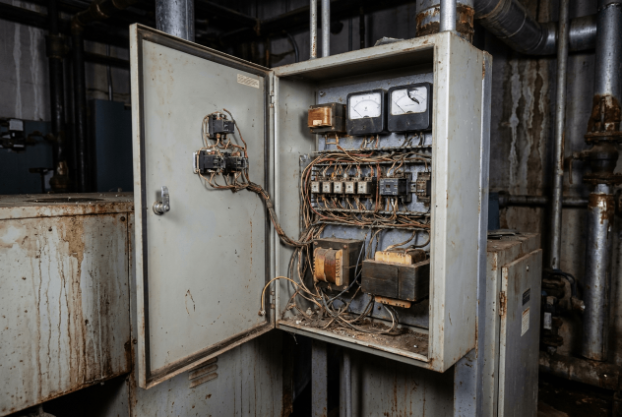
Most older HVAC systems were designed before smart building integration became common. The equipment itself may still function properly, but the control architecture often creates major operational inefficiencies.
The biggest problem in older HVAC control systems is not mechanical failure. It is the inability to coordinate equipment through modern automation and communication protocols.
Common Problems in Existing HVAC Systems
Problem | Typical Cause | Operational Impact |
|---|---|---|
Simultaneous heating and cooling | Poor control logic | Energy waste |
Constant-speed fan operation | No VFD integration | Excessive electricity usage |
Poor indoor air quality | Fixed ventilation settings | Occupant discomfort |
Equipment short cycling | Improper PID tuning | Reduced equipment lifespan |
BMS communication failure | Proprietary protocols | Limited monitoring capability |
I recently worked on a retrofit project in a commercial office building where the chilled water pumps operated continuously at 100% speed regardless of cooling demand. The building automation system could monitor alarms, but it could not dynamically adjust pump speed because the legacy control panel lacked proper VFD integration and BACnet communication.
After upgrading the HVAC automation panel with BACnet IP-compatible controllers and differential pressure-based VFD control, the facility reduced pumping energy consumption by nearly 28%.
According to the U.S. Department of Energy[⁹], HVAC systems[¹0] typically account for 35–40% of total commercial building energy consumption. Poor control strategies[¹1] significantly increase operating costs.[¹2]
Why Open Communication Protocols Matter in HVAC Automation
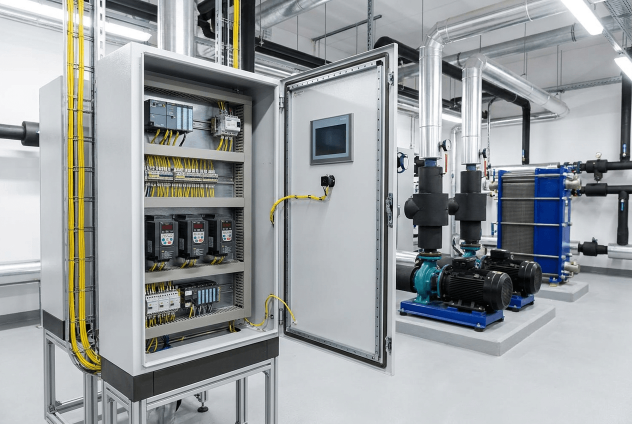
Many HVAC integration problems originate from incompatible communication protocols.
Open HVAC communication protocols such as BACnet and Modbus allow chillers, AHUs, VAV systems, and BMS platforms to exchange operational data in real time.
Without protocol compatibility, building operators lose centralized visibility and advanced optimization capabilities.
Why is BACnet essential for HVAC panels?
BACnet allows HVAC equipment from different manufacturers to communicate within a single building management system. This eliminates isolated control islands and enables centralized alarming, scheduling, trending, and energy optimization.
BACnet has become the dominant protocol in commercial HVAC automation because it supports interoperability between:
- Chillers
- Air Handling Units
- VAV controllers
- Lighting systems
- Energy meters
- Fire alarm interfaces
ASHRAE developed BACnet specifically for building automation systems under ASHRAE Standard 135.
Source:
ASHRAE Standard 135 — BACnet: A Data Communication Protocol for Building Automation and Control Networks
BACnet MS/TP vs BACnet IP
One of the most common mistakes I see during HVAC panel procurement is selecting the wrong BACnet architecture.
BACnet Communication Comparison
Protocol | Physical Layer | Typical Use | Main Advantage |
|---|---|---|---|
BACnet MS/TP | RS-485 | Field devices | Lower cost |
BACnet IP | Ethernet | System-level integration | Faster communication |
Modbus RTU | RS-485 | Legacy HVAC equipment | Wide compatibility |
Modbus TCP | Ethernet | Industrial integration | Easy network expansion |
Practical recommendation
I usually recommend:
- BACnet MS/TP for VAV boxes and distributed field devices
- BACnet IP for supervisory HVAC panels and BMS integration
- Modbus TCP for industrial HVAC equipment and energy meters
This hybrid architecture balances installation cost and scalability.
DDC vs. PLC in HVAC Automation: Which One Should You Choose?
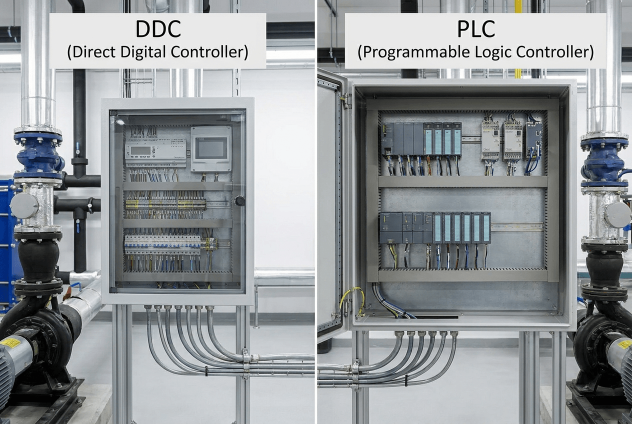
Many engineers automatically assume DDC controllers are always the correct solution for HVAC systems. That is not always true.
DDC controllers work well for standard commercial HVAC applications, while PLC systems provide stronger reliability and flexibility for industrial or mission-critical HVAC environments.
When DDC controllers are the better choice
DDC (Direct Digital Control) systems dominate commercial buildings because they are optimized for standard HVAC applications.
Typical DDC applications include the following:
- VAV control
- Fan coil units
- Rooftop units
- Small AHUs
- Office buildings
Advantages of DDC systems
Advantage | Why It Matters |
|---|---|
Native BACnet support | Easy BMS integration |
Lower installation cost | Reduced project budget |
Prebuilt HVAC functions | Faster commissioning |
Graphical programming | Easier facility maintenance |
When PLC systems outperform DDC controllers
PLC systems become the better solution when HVAC automation requires:
- High reliability
- Complex interlocks
- Industrial integration
- Harsh environments
- High-speed control
Typical PLC-based HVAC applications
Facility Type | Why PLC is Preferred |
|---|---|
Pharmaceutical cleanrooms | Strict environmental stability |
Data centers | Mission-critical cooling |
Semiconductor facilities | High process sensitivity |
Industrial process cooling | Complex equipment sequencing |
Explosion-proof HVAC | Safety integration |
I worked on a pharmaceutical HVAC project where the cleanroom pressure cascade required extremely stable PID loop tuning and redundant control logic. The facility originally attempted to use standard DDC controllers, but unstable response times created room pressure fluctuations during door openings.
After migrating the critical AHU control logic to PLC-based automation, room pressure stability improved significantly.
How VFD Integration Reduces HVAC Energy Consumption
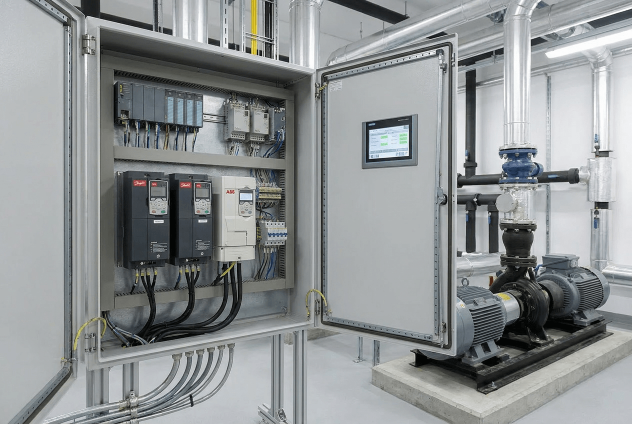
Variable Frequency Drives (VFDs) are one of the most important components in modern HVAC automation.
VFD-controlled HVAC systems reduce energy consumption by matching motor speed to actual system demand instead of operating continuously at full speed.
Why constant-speed HVAC systems waste energy
Many legacy HVAC systems still operate pumps and fans at fixed speeds.
This creates several problems:
- Excessive electricity consumption
- Unstable airflow
- Hydraulic shock
- Equipment wear
- Poor pressure control
According to the affinity laws for centrifugal fans and pumps:
- Flow is proportional to speed.
- Pressure is proportional to speed squared.
- Power consumption is proportional to speed cubed
This means even small speed reductions create major energy savings.
Example
Reducing fan speed by 20% can reduce energy consumption by nearly 50%.
Source:
ASHRAE HVAC Systems and Equipment Handbook
Typical HVAC applications for VFDs
Equipment | Control Strategy | Main Benefit |
|---|---|---|
AHU supply fans | Static pressure control | Reduced fan energy |
Chilled water pumps | Differential pressure reset | Lower pumping cost |
Cooling tower fans | Condenser optimization | Improved chiller efficiency |
Exhaust systems | CO₂-based ventilation | Better IAQ control |
Why PID loop tuning matters in VFD applications
Poor PID tuning is one of the biggest hidden causes of HVAC inefficiency.
Symptoms of poor PID tuning
Symptom | Root Cause |
|---|---|
Oscillating fan speed | Excessive proportional gain |
Slow temperature response | Weak integral tuning |
Hunting chilled water valves | Incorrect loop setup |
Pressure instability | Poor sensor placement |
I often see contractors leave default PID values unchanged during commissioning. The system technically works, but energy consumption remains unnecessarily high because control loops constantly overshoot their targets.
Smart HVAC Control Strategies That Solve Real Operational Problems

Good HVAC automation should solve operational problems, not simply collect data.
Modern HVAC control strategies dynamically adjust airflow, chilled water production, and ventilation rates according to real building conditions.
Scenario A: CO₂-Based Demand-Controlled Ventilation
Many buildings ventilate spaces based on fixed airflow settings regardless of occupancy.
This wastes large amounts of conditioned air.
How demand-controlled ventilation works
CO₂ sensors continuously monitor occupancy levels.
The HVAC controller adjusts:
- Outdoor air dampers
- Fan speed
- Ventilation airflow
based on real occupancy demand.
Typical DCV sequence
CO₂ Level | Ventilation Response |
|---|---|
<600 ppm | Minimum outdoor air |
600–900 ppm | Moderate ventilation |
>1000 ppm | Maximum fresh air intake |
ASHRAE Standard 62.1 provides ventilation guidelines for maintaining acceptable indoor air quality.
Source:
ASHRAE Standard 62.1 — Ventilation for Acceptable Indoor Air Quality
Scenario B: Chiller Plant Optimization
Chiller plants are often the largest energy consumers in commercial buildings.
Poor sequencing logic creates the following:
- Excessive compressor cycling
- Low chiller efficiency
- High pumping energy
- Unstable chilled water temperatures
Effective chiller optimization strategies
Strategy | Operational Benefit |
|---|---|
Variable primary flow | Reduced pump energy |
Automatic chiller rotation | Balanced equipment runtime |
Condenser water reset | Improved COP efficiency |
Load-based staging | Reduced unnecessary operation |
I worked on a hospital retrofit project where chillers were manually staged by operators. During partial-load conditions, too many chillers remained online, which reduced operating efficiency.
After implementing automated load-based staging logic inside the HVAC PLC panel, the facility significantly reduced nighttime energy consumption.
Scenario C: Economizer Cycle Optimization
Economizer cycles are often poorly implemented or disabled completely.
A properly configured economizer cycle uses cool outdoor air to reduce mechanical cooling demand during favorable weather conditions.
Common economizer problems
Problem | Cause |
|---|---|
Excessive humidity | Poor enthalpy control |
Simultaneous heating/cooling | Bad sequence logic |
Damper hunting | Incorrect PID tuning |
Poor IAQ | Faulty sensor calibration |
Many economizer failures happen because outdoor air sensors drift out of calibration over time.
I recommend annual sensor verification as part of preventive maintenance.
What Engineers Should Specify to HVAC Panel Builders
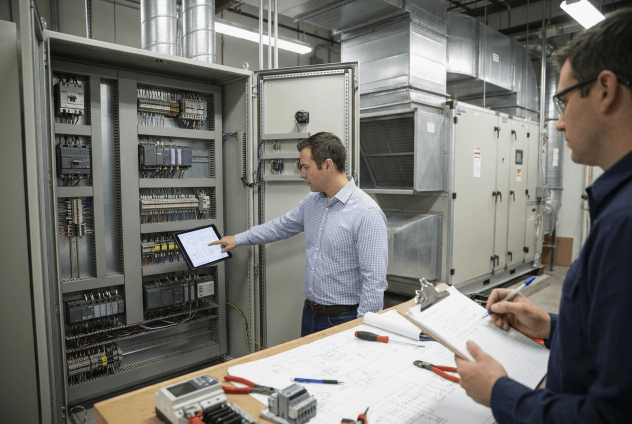
Many HVAC integration problems begin during procurement because specifications are incomplete.
Clear communication, testing, and expansion requirements are essential when specifying HVAC automation control panels.
Communication requirements to specify
Always define:
- BACnet IP compatibility
- BACnet MS/TP support
- Modbus TCP integration
- BMS interoperability
- Remote access capability
Never assume protocol compatibility.
Why Factory Acceptance Testing (FAT) matters
Factory acceptance testing verifies the following:
- I/O operation
- Alarm sequences
- Communication stability
- VFD control
- Power recovery behavior
Recommended FAT checklist
Test Item | Verification Goal |
|---|---|
BACnet communication | BMS interoperability |
Sensor simulation | Control logic validation |
VFD operation | Stable motor control |
Alarm testing | Correct sequence execution |
Power failure simulation | Safe restart behavior |
Skipping FAT often creates expensive commissioning delays onsite.
Recommended enclosure ratings
Installation Environment | Recommended Rating |
|---|---|
Indoor mechanical room | NEMA 12 / IP54 |
Rooftop HVAC system | NEMA 3R |
High-moisture environment | NEMA 4 |
Corrosive industrial area | NEMA 4X stainless steel |
Unlike water treatment control panels that prioritize corrosion resistance, HVAC control panels often prioritize communication integration and multi-system interoperability.
Conclusion
Modern HVAC automation control panels improve energy efficiency, indoor air quality, and operational reliability by combining intelligent control logic, VFD optimization, open communication protocols, and standards-based integration with modern building management systems.