Jul 19, 2026Case Studies
Why Power-Up Wasn't Enough: First Integration of a TRIOL AK06-UD VSD for an ESP System
The project experience on the first integration of a TRIOL AK06-UD VSD for an ESP System, please check the details and hope it is helpful for you.
Why Power-Up Wasn't Enough: First Integration of a TRIOL AK06-UD VSD for an ESP System
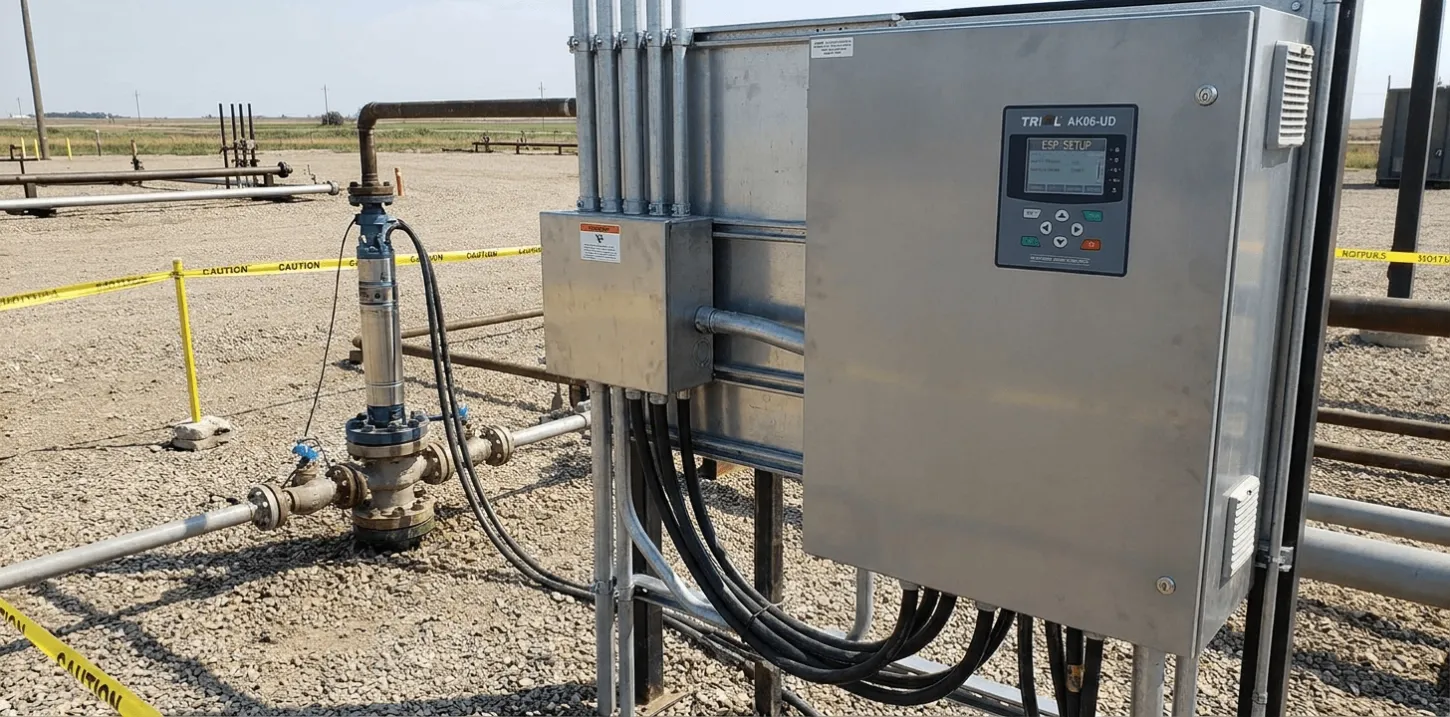
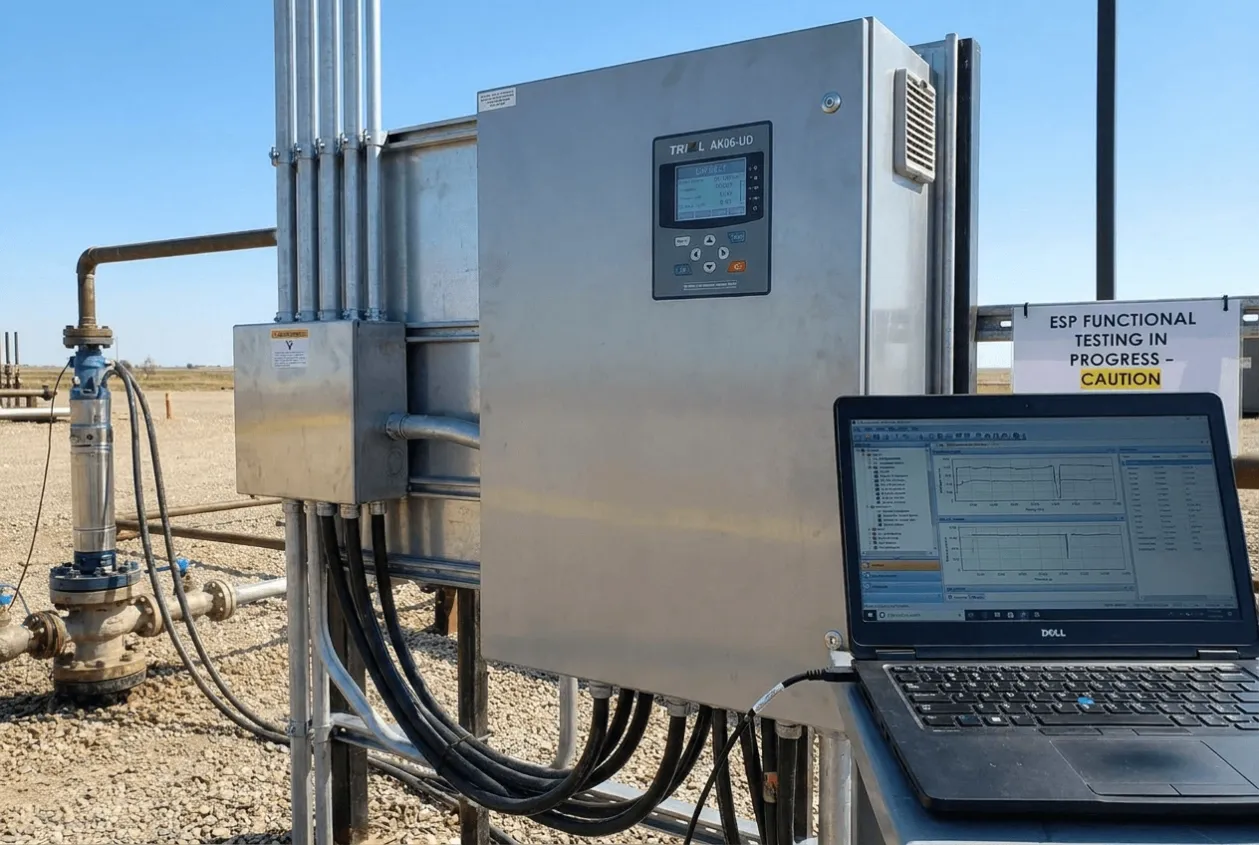
The most critical moment in this project was not when the variable speed drive (VSD)[¹] powered up. It was when the controller had to prove that it could understand the drive, command it correctly, and operate with the ESP (Electric Submersible Pump) system[²] without hesitation. This case documents the first integration and functional testing of a TRIOL AK06-UD VSD with an 18-pulse input transformer[³], UMKA-07 controller, and DHE Phoenix Contact[⁴] XT 175 ESP system.
Project Snapshot
Item | Description |
|---|---|
Industry | Oil & Gas Production |
Application | ESP variable speed drive integration and testing |
Project Type | New VSD platform integration and functional test |
Location | North Africa oil production environment |
Products | TRIOL AK06-UD VSD, 18-pulse input transformer, UMKA-07 controller, DHE Phoenix XT 175 ESP system |
Services | Hardware integration, communication testing, functional verification, startup readiness review |
Result | Successful hardware integration, stable controller communication, and verified connection with the ESP system |
Project Overview
This project involved the first integration and functional testing of a new variable speed drive (VSD)[⁵] platform for an electric submersible pump (ESP)[⁶] application. The system included a TRIOL AK06-UD variable speed drive with an 18-pulse input transformer[⁷], a UMKA-07 controller, and a DHE Phoenix XT 175 ESP system.
The project was completed in July 2025 as part of a production environment where ESP reliability and operating flexibility mattered. In ESP work, a drive is never just a drive. It sits between the power system, the controller, and the downhole equipment that the production team depends on. If the integration is weak, the problem will not stay inside the panel. It will appear during startup, in alarms, in communication faults, or in delayed production decisions.
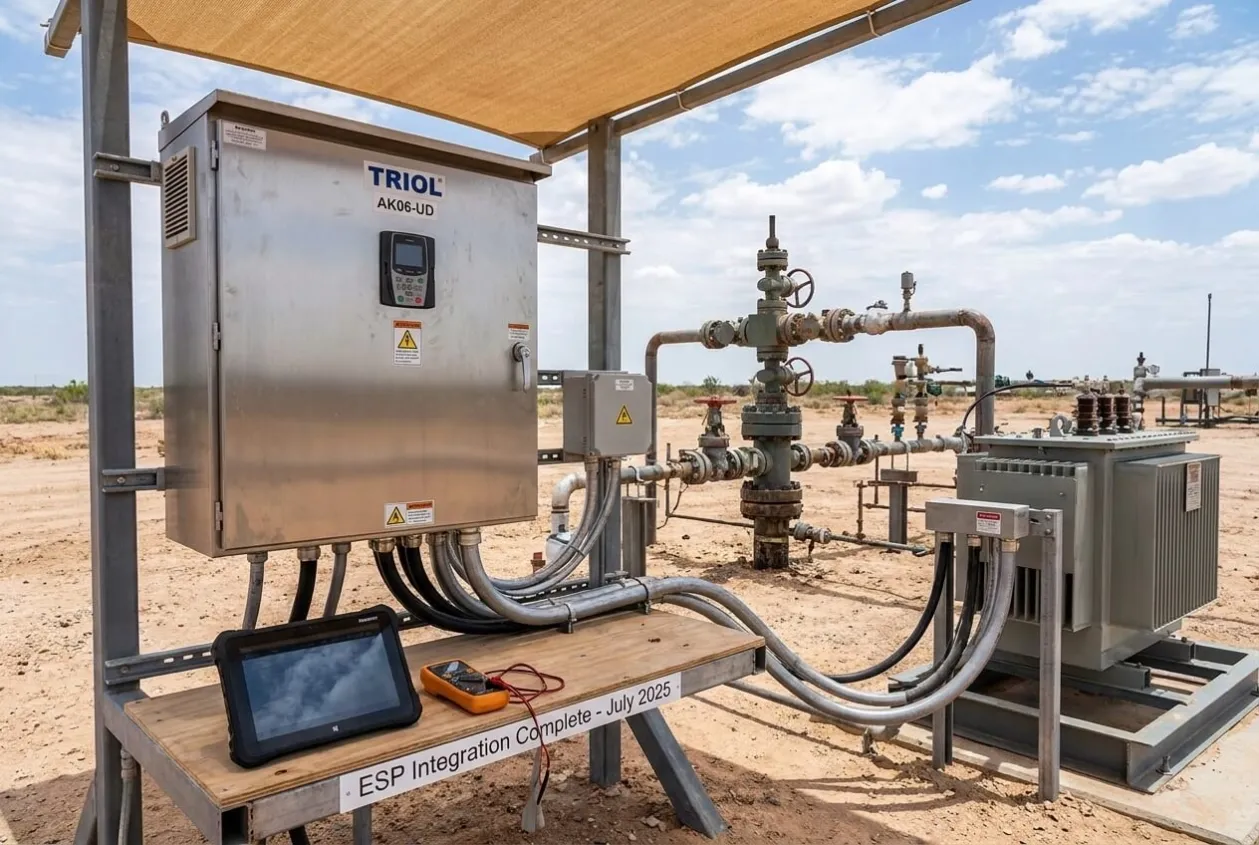
The unusual part of this project was that the main risk was not hardware assembly. The cabinet could be wired correctly, the transformer could be connected, and the VSD could power up, but the system would still not be ready if the controller could not communicate clearly with the drive. Reliable industrial drive integration[⁸] requires both correct hardware installation and validated communication between all system components.
That was the real pressure behind the test.
For a first integration, there is no comfort from repetition. Every response matters. Every signal must be understood. Every alarm must mean something useful. The core message of this project is simple: a new ESP VSD platform is not proven when it powers up; it is proven when the VSD, controller, and ESP system behave as one operating package.
Customer Challenge
From the customer’s side, the challenge was not only to introduce a new VSD type. The real challenge was to introduce it without creating uncertainty for ESP operation.
The production team needed better flexibility and a reliable VSD platform, but they also needed confidence before depending on it. ESP systems operate in difficult conditions, and when a startup goes badly, the cost is not limited to a few hours of electrical troubleshooting. It can affect production planning, field crew coordination, equipment confidence, and future decisions about whether the same platform should be used again.
This was the first use of this VSD type in the application, so the team could not rely on old habits. Nobody could say, “We have done this many times before.” The first test had to create that experience.
The customer needed the integration to confirm several things:
- The TRIOL AK06-UD VSD hardware could be integrated correctly.
- The 18-pulse input transformer configuration could be connected and reviewed as part of the drive package.
- The UMKA-07 controller could communicate stably with the VSD.
- The controller could send commands and receive meaningful feedback.
- The DHE Phoenix XT 175 ESP system could connect and operate through the integrated package.
- The test results could become a reference for future deployments.
- Any confusing signal, alarm, or operating behavior could be identified before field reliance.
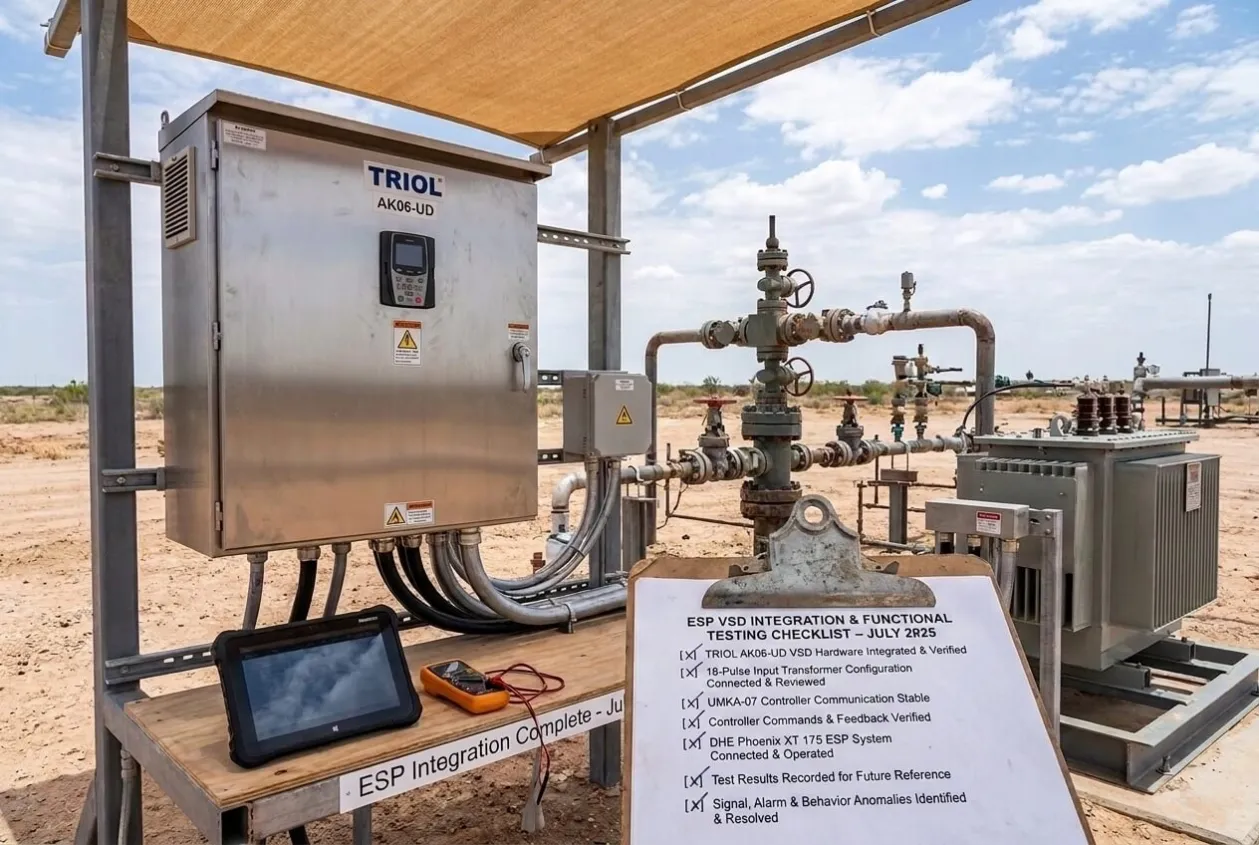
The most painful risk was communication uncertainty.
A VSD fault is usually visible. A power wiring issue usually gives a clear symptom. Communication issues are different. They can look small at first. A status bit does not update. A command is accepted late. A fault appears on the drive but not clearly at the controller. A run signal does not mean what the operator thinks it means. These are the details that slow commissioning and damage confidence.
If this project had been treated as only a power-up test, the team might have missed the most important question: when the operator uses the controller, does the whole ESP package respond in a way that can be trusted?
That question guided the commissioning work.
Engineering Review
The engineering review focused on the real integration boundary between the VSD, controller, and ESP system.
The TRIOL AK06-UD VSD was equipped with an 18-pulse input transformer. For ESP applications, this matters because the drive does not operate in isolation. It connects to a production power system where harmonics, transformer configuration, phase relationship, grounding, and protection behavior must be reviewed carefully. The 18-pulse arrangement can help improve input harmonic performance compared with simpler drive input configurations, but that benefit depends on correct installation and verification.
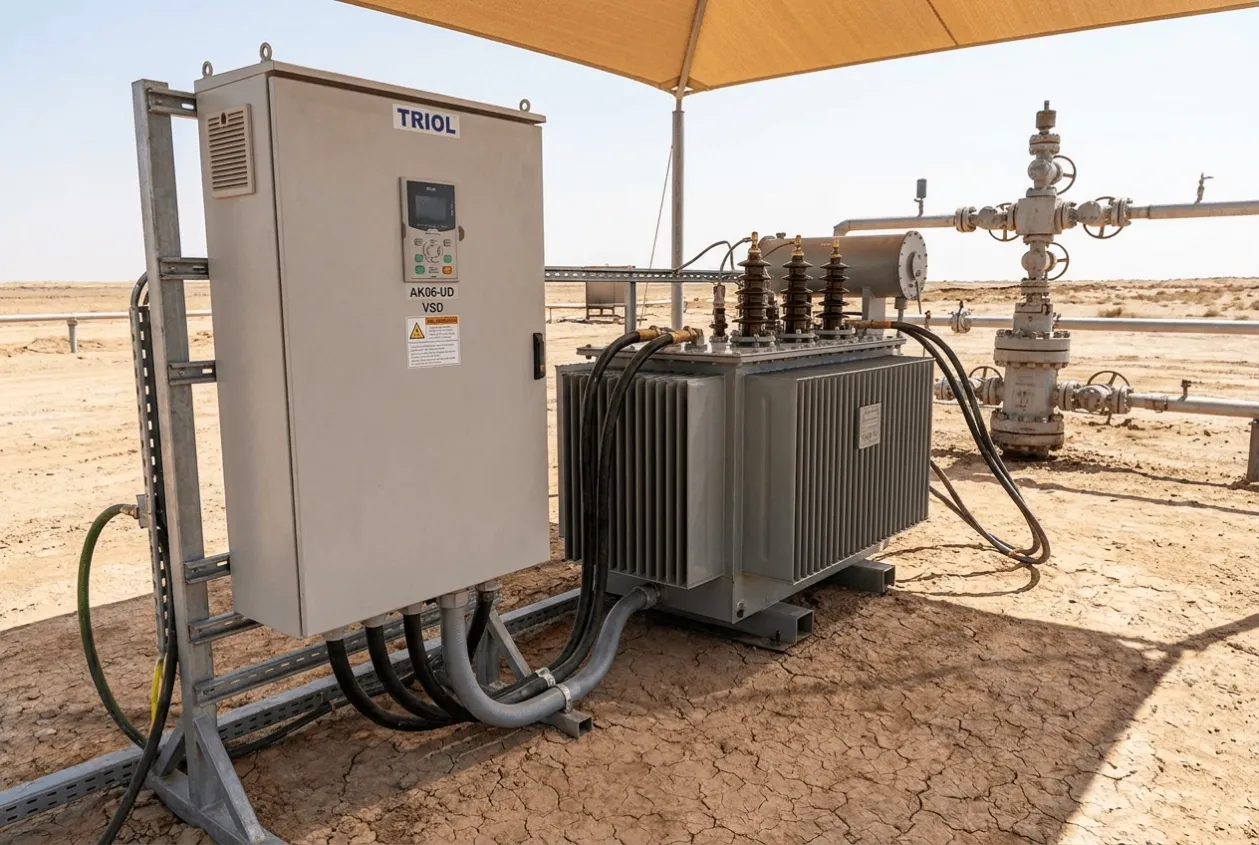
The second review area was the UMKA-07 controller interface. This became the center of the work because the controller is what the operator sees and trusts. It is not enough for the controller to establish a connection. The controller must exchange the right commands, show the right status, display meaningful alarms, and support the correct operating sequence.
The third review area was the DHE Phoenix XT 175 ESP connection. The VSD and controller had to operate with the ESP system as one functional package. ESP control requires more than speed command output. The team had to think about startup sequence, operating limits, fault response, restart logic, protection behavior, and what the operator would see during each stage.
A simplified engineering review table is shown below:
Review Item | Engineering Question | Risk if Ignored |
|---|---|---|
VSD hardware integration | Are power and control interfaces connected correctly? | Failed startup or unsafe energization |
18-pulse transformer | Are input connections, phase relationships, and grounding verified? | Poor power quality or abnormal drive behavior |
Controller communication | Does the UMKA-07 communicate stably with the VSD? | Lost commands or unreliable monitoring |
Signal mapping | Are commands, feedback, alarms, and parameters correctly assigned? | Operator confusion or wrong troubleshooting |
ESP connection | Does the VSD package operate correctly with the DHE Phoenix XT 175 system? | Incomplete integration |
Startup sequence | Are energization and command steps clearly defined? | Commissioning delay |
Fault response | Are alarms and drive faults visible to the controller? | Slow diagnosis during operation |
Parameter limits | Are frequency and protection limits reviewed for ESP operation? | Equipment stress or unstable operation |
Documentation | Are test findings recorded for future deployments? | Repeated mistakes in later projects |
The most important engineering shift was to stop looking at the VSD as a standalone cabinet.
A standalone variable speed drive (VSD)[⁹] can be energized and checked in the workshop. An ESP VSD package must be understood through the controller and the ESP system. If the controller shows unclear feedback, the operator does not care that the drive is healthy internally. If the alarm management[¹0] mapping is weak, the maintenance team loses time. If the startup sequence is not documented, the next deployment begins with the same uncertainty.
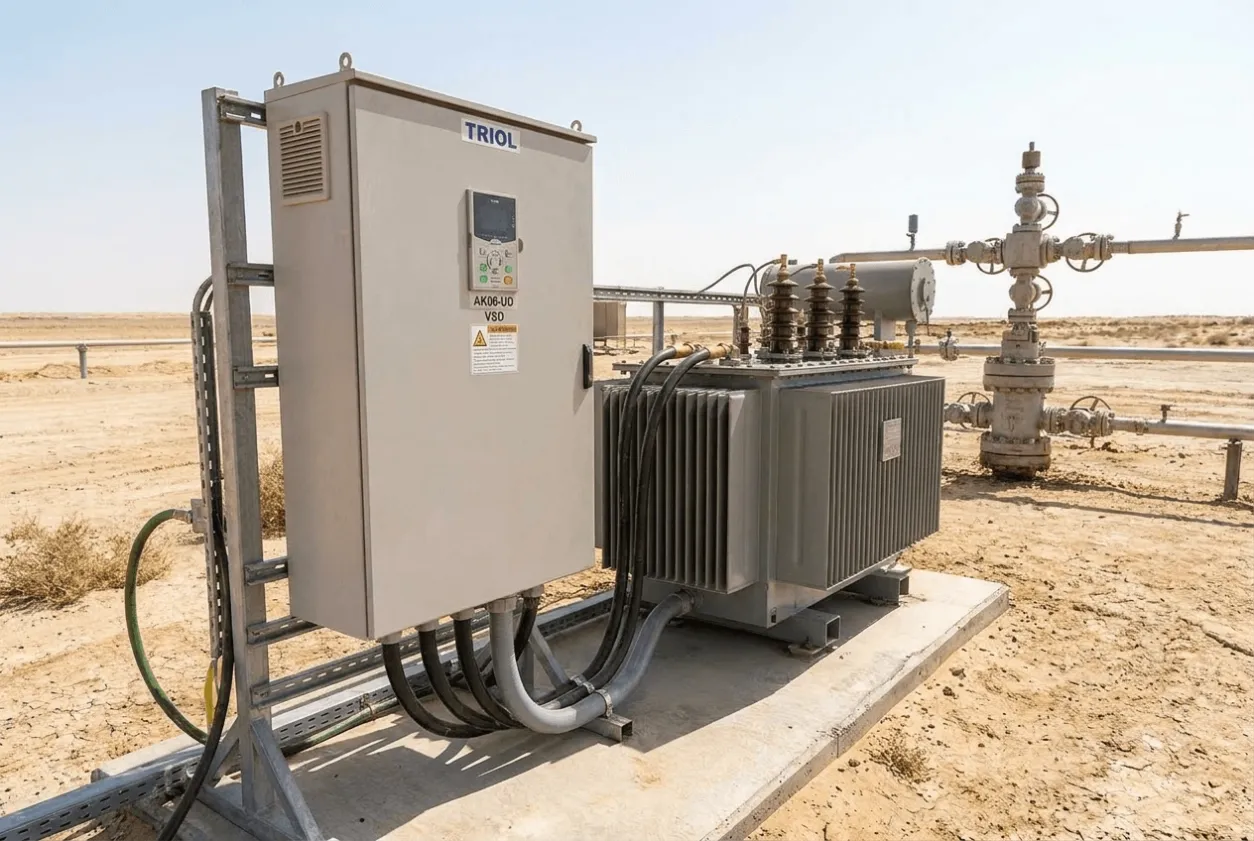
That is why the review focused so heavily on signal meaning. A status signal should not only change state. It should answer a practical question for the operator: Is the drive ready? Is it running? Is it faulted? Is it available to start? Is remote control active? Is the ESP protected? Well-designed human-machine interfaces (HMIs)[¹1] and clearly defined operating states are also a key part of reliable functional safety[¹2].
Those questions decide whether a new integration becomes a working system or just a powered cabinet.
Critical Engineering Decision
The turning point of this project was the decision to make communication and functional behavior the acceptance point, not power-up.
This decision changed the whole test approach.
There was a natural temptation to celebrate early. The hardware was integrated. The drive powered up. The transformer configuration was in place. The controller connection was established. On many projects, that moment creates pressure to move quickly and declare the system almost ready.
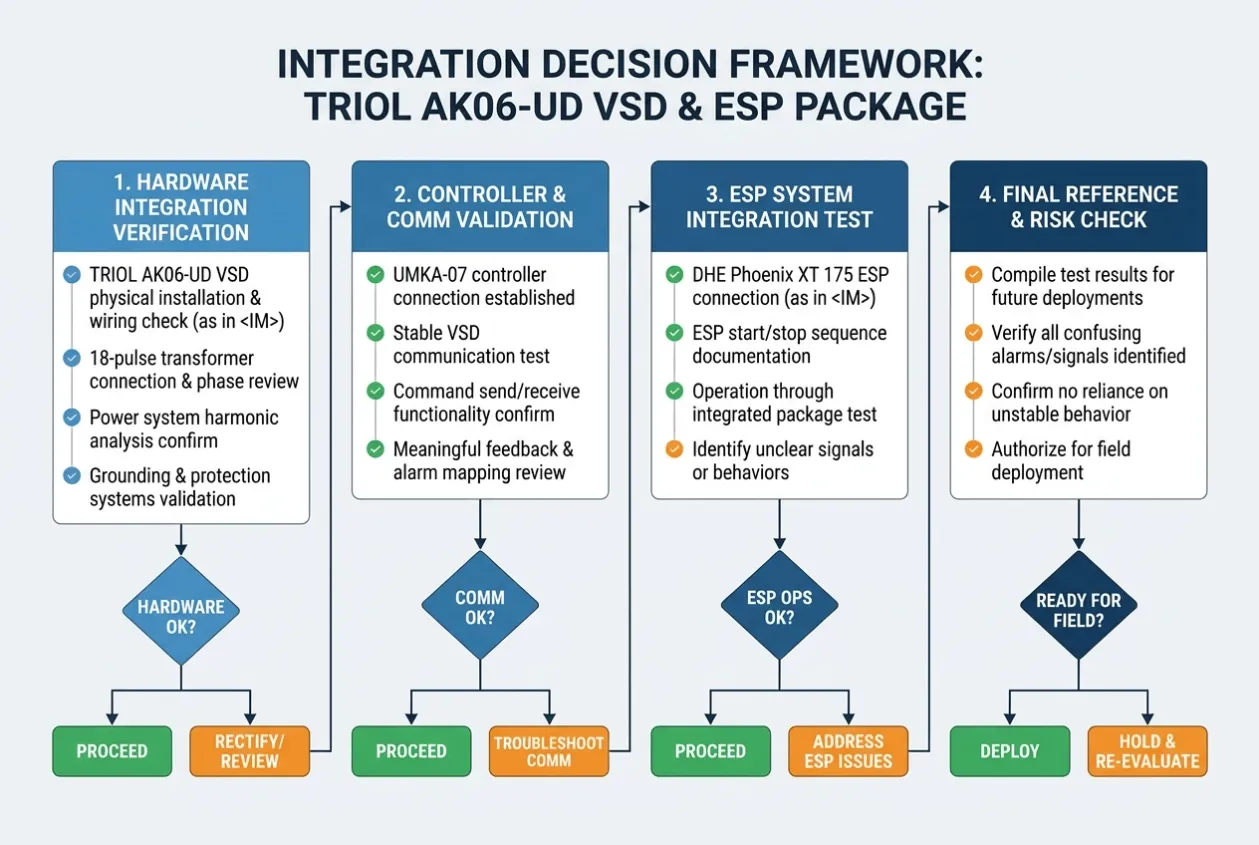
We did not stop there.
For a new ESP VSD platform, power-up is only the first sign of life. It does not prove that the controller understands the drive. It does not prove that fault feedback is useful. It does not prove that the ESP system can be operated with confidence. It only proves that the cabinet can be energized.
There were two possible approaches.
- The first approach was to complete a standard hardware test, confirm that the VSD was energized, check that the controller could see it, and move the system forward. This would have looked efficient, but it would have left too many questions for commissioning.
- The second approach was to test the system the way it would actually be used. That meant verifying communication stability, command response, feedback meaning, alarm behavior, operating sequence, and connection with the DHE Phoenix XT 175 ESP system.
We selected the No. 2 second approach.
This was the decision that truly changed the result. It moved the project from “the VSD is powered” to “the ESP control package is usable.”
That difference matters. A production team does not need a cabinet that only looks ready. They need a system that gives clear information when something goes wrong, responds correctly when a command is issued, and behaves consistently enough to be deployed again.
By making functional behavior the acceptance point, the team avoided the common first-integration mistake of discovering interface problems too late. The test became more demanding, but it gave the project something more valuable than a quick completion: confidence.
Solution Delivered
The delivered solution included successful hardware integration and functional testing of the TRIOL AK06-UD VSD with the UMKA-07 controller and the DHE Phoenix XT 175 ESP system.
The VSD hardware was integrated with the required power and control interfaces. The 18-pulse input transformer formed part of the drive package and was reviewed as part of the overall power configuration. The purpose was not only to connect the equipment but also to prepare it for controlled ESP operation.
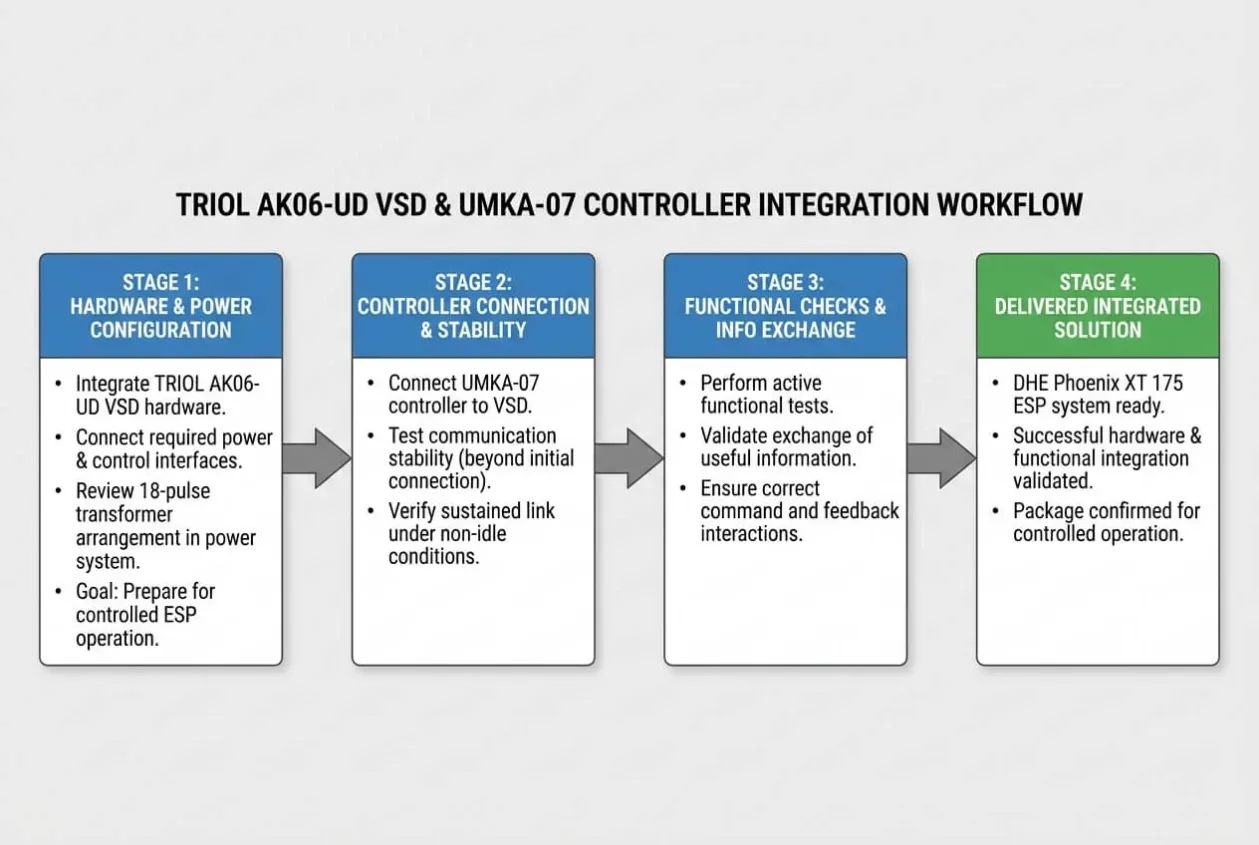
The UMKA-07 controller was connected and tested with the VSD. Communication was checked for stability, not only for initial connection. This was important because a connection that works for a few seconds in an idle condition does not prove that the system is ready for operation. The controller had to exchange useful information with the VSD during functional checks.
The test confirmed that commands, status information, and operating feedback could be handled through the controller interface. The team paid attention to whether the operator would receive information that was clear enough to support startup and troubleshooting.
The DHE Phoenix XT 175 ESP system was then connected and verified as part of the integrated package. This step mattered because the project objective was not to test a VSD on a bench. The objective was to prove that the VSD, controller, and ESP system could operate together.
The final test confirmed three important results:
- Hardware integration was successful.
- Communication between the VSD and UMKA-07 controller was stable.
- Connection and operation with the DHE Phoenix XT 175 ESP system were successful.
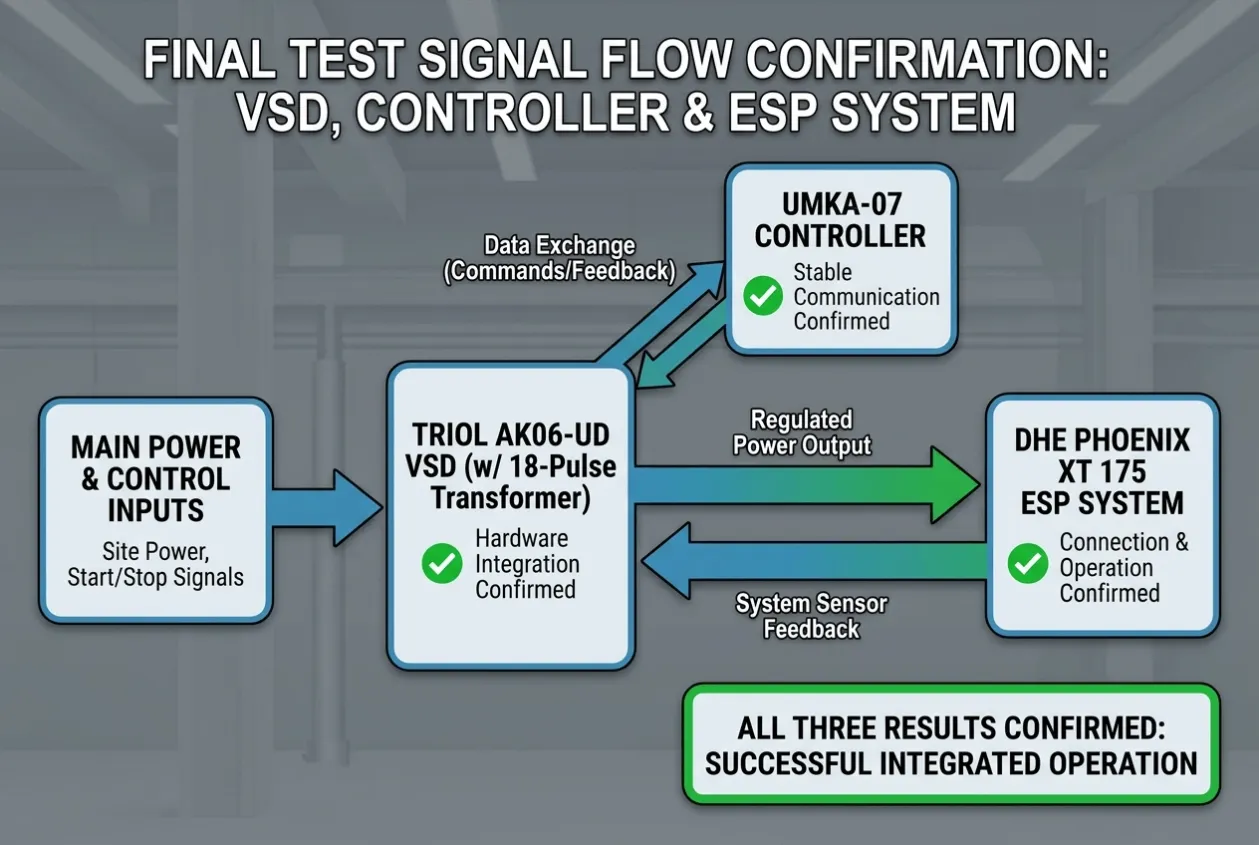
This gave the team a real reference for future deployments. The first integration always carries more uncertainty than the next one. Once the signal mapping, communication behavior, startup sequence, and test steps are understood, future commissioning becomes faster and less stressful.
Before Shipment Verification
Before the integration was considered complete, the system went through verification focused on hardware readiness, communication stability, and functional behavior.
For an ESP VSD system, this stage is where many future problems can be removed. A wiring issue found during integration testing is a correction. A communication issue found during field startup can become a delay, a meeting, and a loss of confidence.
The verification activities included:
Verification Activity | Why It Mattered |
|---|---|
Hardware connection review | Confirmed VSD, transformer, controller, and ESP interfaces were connected correctly |
Power circuit inspection | Reduced risk before energizing the VSD package |
Control wiring check | Confirmed command and feedback paths were connected properly |
Grounding review | Supported safe operation and stable electrical behavior |
Controller communication test | Verified stable communication between UMKA-07 and VSD |
Signal mapping check | Confirmed commands, status, alarms, and feedback were meaningful |
Functional start/stop test | Verified operating behavior through the controller interface |
ESP connection test | Confirmed successful connection with the DHE Phoenix XT 175 system |
Fault and alarm review | Checked whether abnormal conditions could be reported clearly |
Parameter review | Confirmed key operating limits were suitable for test operation |
Documentation update | Captured lessons for future commissioning and deployment |
Final readiness review | Confirmed the integration had moved beyond basic power-up |
The most important check was communication under functional conditions. I do not like to accept a controller connection as proof of integration. A controller may connect but still give unclear information. It may show status without enough meaning. It may receive a fault but not present it in a way that helps the operator.
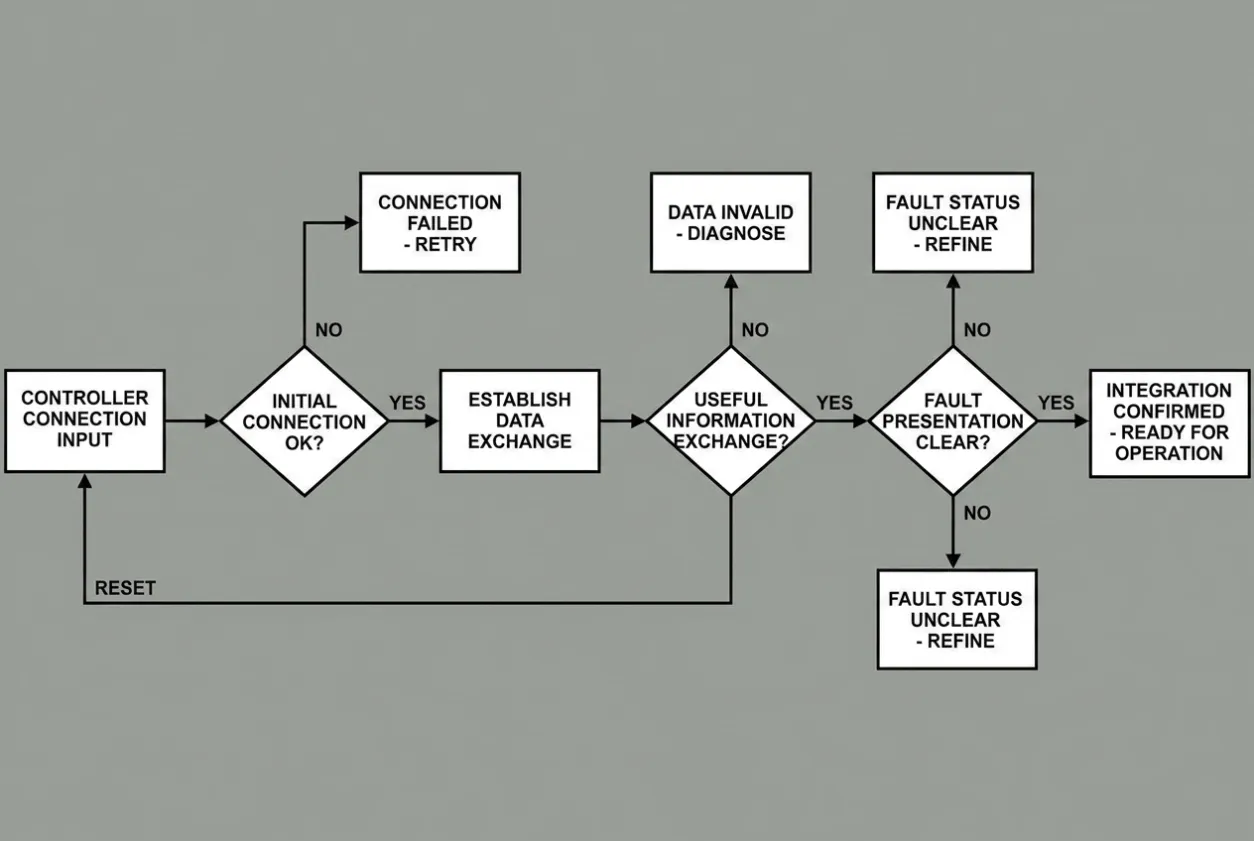
That is why the team checked how signals behaved during real test actions. If a command was issued, the response had to be visible. If the VSD changed state, the controller had to show it correctly. If a fault or alarm condition appeared, the information had to be useful enough for troubleshooting.
Parameter review was also important. ESP applications need operating limits that make sense for the equipment and the production conditions. Frequency limits, ramp behavior, protection values, and restart logic should not be treated as afterthoughts.
By the end of verification, the system had moved beyond basic connection. The VSD and controller were functionally aligned, and the ESP connection had been proven.
Project Results
The integration and functional testing were completed successfully in July 2025.
The result was practical and measurable:
- 1 new VSD type integrated for ESP application.
- 1 TRIOL AK06-UD VSD tested with an 18-pulse input transformer configuration.
- 1 UMKA-07 controller connected and verified.
- 1 DHE Phoenix XT 175 ESP system successfully connected and operated.
- 3 core integration results achieved: hardware integration, stable communication, and ESP system connection.
- 4 key verification areas confirmed: power interface, control interface, communication behavior, and functional operation.
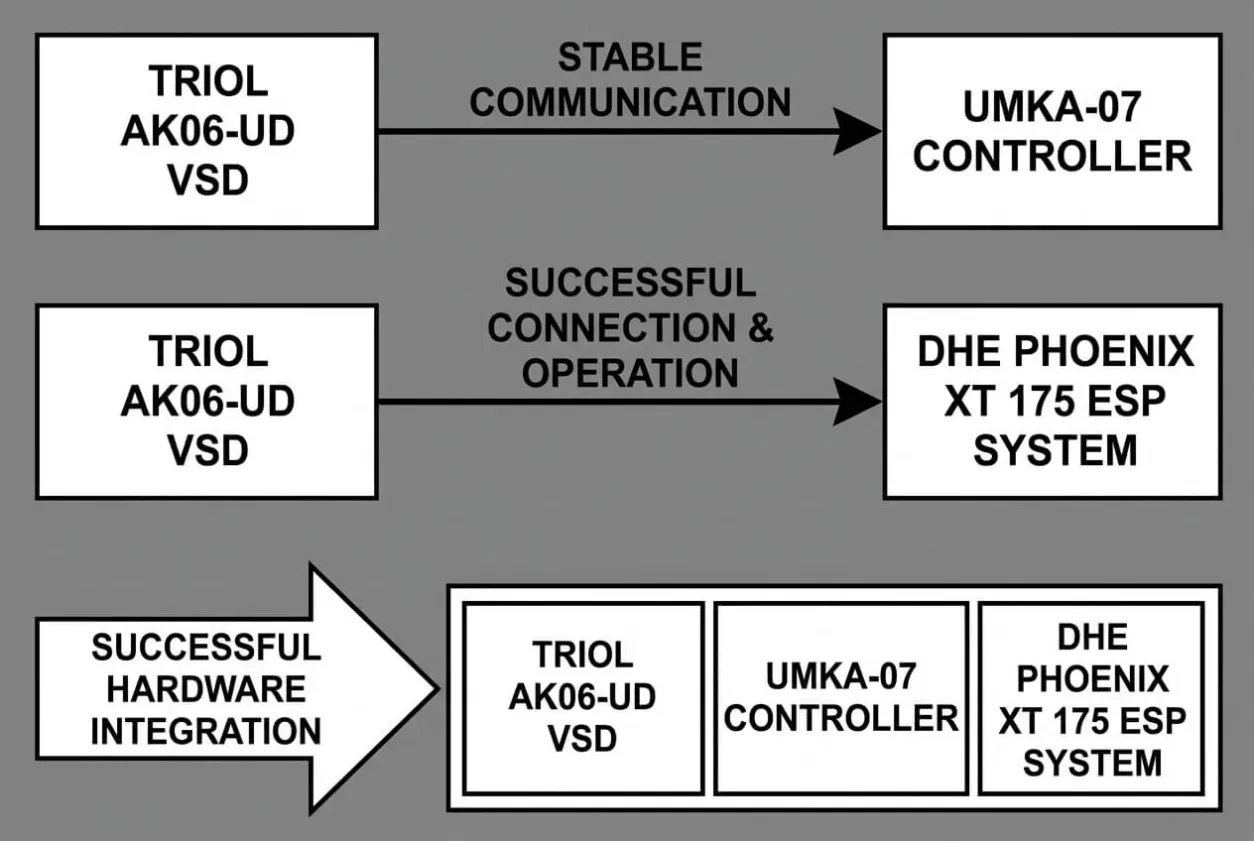
The strongest result was that the project did not stop at energization. The VSD powered up, but more importantly, it communicated stably with the controller and operated with the ESP system as an integrated package.
This matters because the first successful integration becomes a commissioning reference. The next team does not have to start from zero. They can use the tested connection points, verified communication behavior, signal mapping notes, parameter references, and functional test sequence from this project.
That is how commissioning time is reduced in real projects. Not by hoping the next job will be easier, but by documenting what the first job taught.
The customer gained confidence that the new VSD platform could support ESP operation with a stable controller interface. The engineering team gained a clearer deployment path for future installations. The operations team gained a system that was not only powered but also understandable.
For ESP applications, reliability is not created by the VSD alone. It is created when the drive, controller, and ESP system work together in a way that engineers can test and operators can trust.
Engineering Notes from Natalie
The first integration of a new VSD platform always has a different feeling from repeating a known design.
With a familiar package, you already know where to slow down. You know which alarm is normal during startup, which parameter is sensitive, and which signal usually causes confusion. With a new platform, you do not have that comfort. You have to build it through testing.
In this project, the part I watched most closely was communication. Power problems often show themselves clearly. Communication problems can stay quiet until the operator needs the system to explain what is happening.
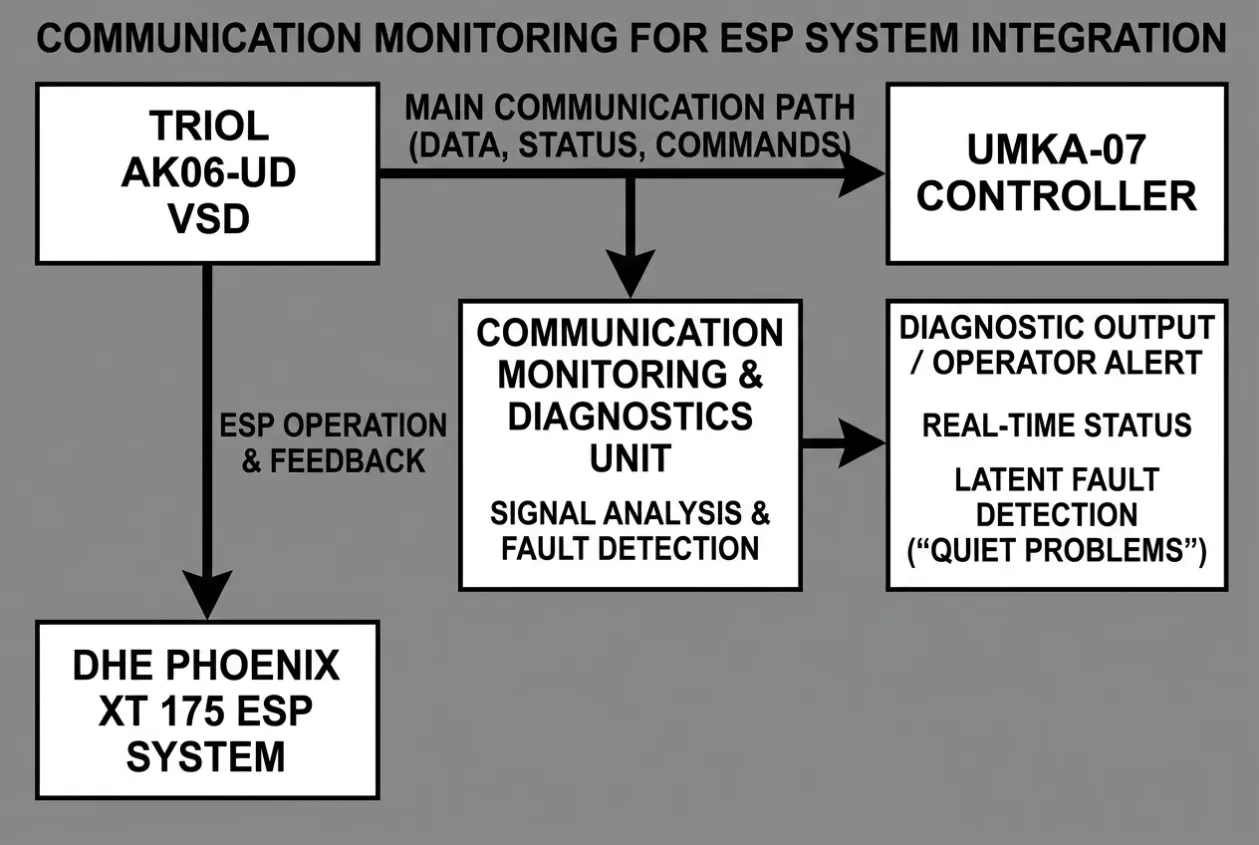
A controller may connect to the VSD, but that does not mean the integration is good. The real test is whether the controller gives the operator the right information at the right moment. Is the drive ready? Is it running? Why did it stop? What fault should the team investigate first?
That is why I do not call a new VSD integration successful just because the cabinet is energized.
For ESP work, success is when the drive, controller, and ESP package behave like one system that people can operate without guessing.
Lessons Learned
1. First integration should be treated as a learning project
The first installation of a new VSD type should generate test records, signal notes, parameter references, and commissioning lessons for future deployments.
2. ESP VSD testing must go beyond power-up
A powered VSD is not the same as an integrated ESP control system. Communication, commands, feedback, alarms, and functional behavior must be verified.
3. Communication stability is a commissioning priority
Stable communication between the VSD and controller determines whether operators can trust the system during startup and operation.
4. Signal mapping must be clear before handover
Commands, ready status, run feedback, fault signals, and alarm information should be checked carefully. Unclear signals slow troubleshooting later.
5. 18-pulse input configurations still need installation discipline
An 18-pulse transformer arrangement can support better harmonic performance, but correct connection, grounding, and phase relationship checks remain essential.
6. Successful integration reduces future commissioning time
Every verified connection point, parameter, and functional test becomes a reference for the next deployment of the same VSD platform.
Key Takeaways
✔ A new ESP VSD platform is not proven by power-up. It is proven by stable communication and functional operation.
✔ The controller, VSD, and ESP system must be tested as one package before field confidence is possible.
✔ First integration records help reduce commissioning time and improve future deployment quality.
Need Similar Support?
If you are preparing an ESP VSD integration, controller upgrade, VSD retrofit, or first-time platform deployment, send us:
✓ VSD Model
✓ Controller Type
✓ ESP System Details
✓ Communication Protocol
✓ Site Power Configuration
We can review the integration points before commissioning, including hardware interfaces, signal mapping, communication behavior, transformer configuration, startup sequence, and the checks that reduce first-deployment risk.
Related Articles: