May 9, 2026Control Panels
What Is an Industrial Control Panel?
What Is an Industrial Control Panel? The “Brain” Behind Modern Industrial Automation Walk into almost any modern factory today and you will find machines moving, pumps running, conveyors operating, an
What Is an Industrial Control Panel?
The “Brain” Behind Modern Industrial Automation
Walk into almost any modern factory today and you will find machines moving, pumps running, conveyors operating, and production lines working continuously with very little human intervention.
But behind all of that automation, there is usually one critical system quietly controlling everything:
The industrial control panel.
Many people outside the automation industry think a control panel is simply a metal cabinet with wires inside. In reality, it is the operational center of an entire industrial process.
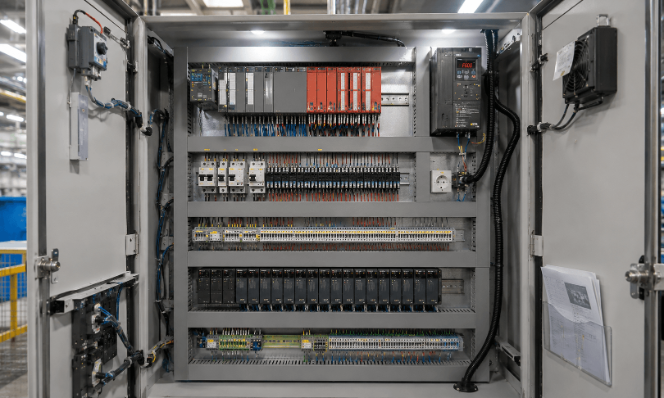
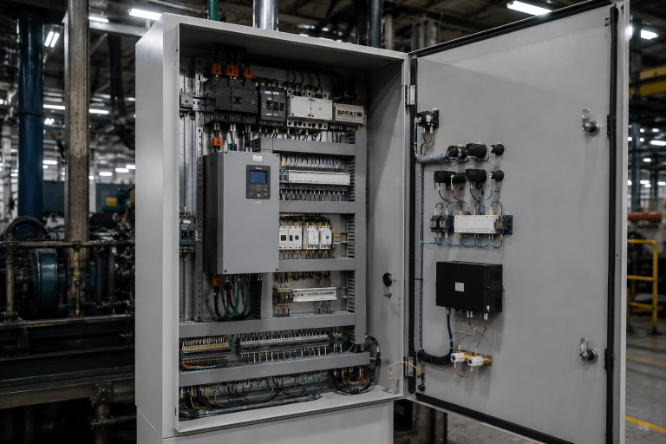
An industrial control panel is an electrical enclosure that contains components used to control, monitor, and automate industrial equipment and processes. It typically includes PLCs, circuit breakers, relays, power supplies, HMIs, and other automation devices that work together to manage industrial operations safely and efficiently.
Without industrial control panels, modern manufacturing and industrial automation would simply not function the way it does today.
Why Industrial Control Panels Matter More Than Ever
Factories today face enormous pressure:
- Higher production demands
- Rising labor costs
- Energy efficiency requirements
- Safety regulations
- Downtime reduction
Industrial automation has become essential for staying competitive.
According to a report by McKinsey & Company, automation technologies could improve manufacturing productivity by up to 30% in some industries.
Industrial control panels are at the center of this transformation because they connect the following:
- Machines
- Sensors
- Motors
- Software
- Operators
- Power systems
into one coordinated control system.
In many ways, the control panel becomes the “brain” of the factory floor.
What Does an Industrial Control Panel Do?
At its core, an industrial control panel manages how industrial equipment operates.
It can:
- Start and stop machines
- Control motors and pumps
- Monitor sensors
- Distribute electrical power
- Protect equipment from overload
- Automate production sequences
- Display system information to operators
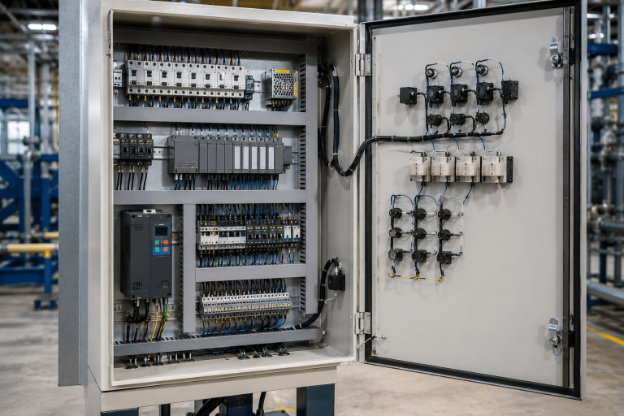
For example, in a water treatment facility, the control panel may automatically do the following:
- Monitor water levels
- Start pumps
- Adjust flow rates
- Trigger alarms
- Shut down equipment during faults
All of this happens in real time.
Without a properly designed control panel, operators would need to manually control every process — which is slower, less accurate, and far more risky.
What Components Are Inside an Industrial Control Panel?
Industrial control panels can vary depending on the application, but most systems contain several key components.
Common Industrial Control Panel Components
Component | Function |
|---|---|
PLC (Programmable Logic Controller) | Controls automation logic |
Circuit Breakers | Protect electrical circuits |
Relays & Contactors | Switch electrical loads |
VFD (Variable Frequency Drive) | Controls motor speed |
Power Supply | Converts and regulates power |
HMI (Human Machine Interface) | Allows operator interaction |
Terminal Blocks | Organize field wiring |
UPS System | Provides backup power |
Sensors & Monitoring Devices | Collect operational data |
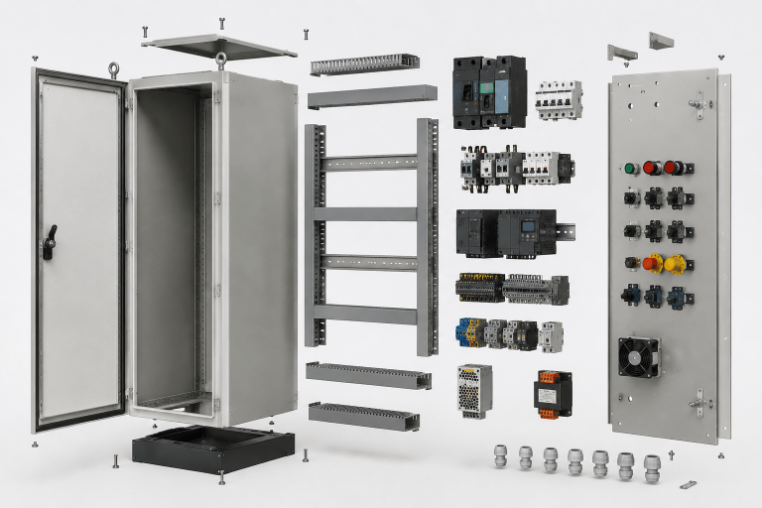
Each component plays a specific role inside the control system.
A well-designed control panel is not just about placing components inside a cabinet. It requires careful planning for the following:
- Heat management
- Wiring organization
- Safety
- Future maintenance
- Environmental protection
The PLC: The Heart of the Control System
One of the most important components inside modern industrial control panels is the PLC.
A PLC works like a small industrial computer.
It receives signals from sensors, processes information, and sends commands to equipment.
For example:
This happens within milliseconds.
According to Rockwell Automation, PLC systems dramatically improve process consistency, reduce manual errors, and increase operational efficiency in industrial environments.
Today, PLC control panels are widely used across nearly every industrial sector.
How Industrial Control Panels Work
Although control panels may look complicated, the basic process is straightforward.
Step 1 — Input Signals
Sensors collect information such as the following:
- Temperature
- Pressure
- Flow
- Position
- Speed
Step 2 — Data Processing
The PLC or control system analyzes the incoming signals based on programmed logic.
Step 3 — Output Actions
The control panel then sends commands to the following:
- Motors
- Pumps
- Valves
- Conveyors
- Alarms
This allows industrial systems to operate automatically and consistently.
Common Types of Industrial Control Panels
Different industries require different types of control systems.
PLC Control Panels
Used for:
- Factory automation
- Packaging systems
- Assembly lines
Motor Control Panels
Used to manage:
- Motors
- Pumps
- Compressors
- Fans
VFD Panels
Used for:
- Motor speed control
- Energy savings
- Process optimization
According to the U.S. Department of Energy, VFD systems can reduce motor energy consumption by as much as 30% in variable-load applications.
Power Distribution Panels
Used to safely distribute electrical power throughout industrial systems.
Custom Automation Panels
Designed specifically for unique industrial applications.
These are common in OEM manufacturing and specialized industrial projects.
Industries That Use Industrial Control Panels
Industrial control panels are everywhere, even if most people never notice them.
They are commonly used in:
Industry | Typical Applications |
|---|---|
Manufacturing | Production lines |
Water Treatment | Pump & filtration systems |
Food Processing | Automated packaging |
Oil & Gas | Monitoring & safety systems |
Renewable Energy | Solar & battery systems |
Mining | Heavy equipment control |
Pharmaceuticals | Cleanroom automation |
As industries become more automated, demand for reliable industrial control systems continues to grow.
According to Grand View Research, the global industrial automation market is expected to exceed hundreds of billions of dollars over the next decade.
Why UL 508A Certification Matters
For buyers in North America, UL 508A certification is extremely important.
UL 508A is a safety standard for industrial control panels published by UL Solutions.
It helps ensure that control panels are
- Properly designed
- Safely wired
- Electrically compliant
- Built according to recognized safety practices
Many industrial projects in the U.S. require UL-certified control panels before installation approval.
According to UL, certified panels help reduce electrical safety risks and improve inspection compliance.
Common Problems in Poorly Designed Control Panels
Unfortunately, not all control panels are built to the same standard.
Poorly designed systems often suffer from:
- Overheating
- Wiring confusion
- Weak ventilation
- Difficult maintenance access
- Inadequate protection ratings
- Electrical noise issues
We have seen factories lose valuable production time simply because a control cabinet did not have proper airflow or enough space for maintenance.
These issues may seem small during manufacturing, but they become very expensive once equipment is installed on-site.
Real-World Example: Downtime Caused by Poor Panel Ventilation
A manufacturing facility in Southeast Asia experienced repeated shutdowns in its packaging line during summer months.
At first, engineers suspected software issues or motor failures.
After investigation, the real problem was much simpler:
- Excessive heat buildup inside the control cabinet
The original enclosure design had limited ventilation, and internal temperatures exceeded safe operating levels for several components.
After redesigning the panel with:
- Improved airflow
- Cooling fans
- Better cable organization
The facility significantly reduced unexpected downtime.
Stories like this are extremely common in industrial automation projects.
How to Choose the Right Industrial Control Panel Manufacturer
Choosing a control panel supplier is not just about price.
A reliable manufacturer should provide the following:
- Engineering support
- Proper documentation
- Quality testing
- UL or CE compliance support
- Clear communication
- Long-term technical assistance
Experienced panel builders also understand:
- System integration
- Environmental protection
- Thermal management
- Future scalability
The best suppliers think beyond assembly. They focus on long-term reliability.
Questions Buyers Should Ask Before Ordering
Before purchasing an industrial control panel, buyers should ask:
- Is the panel designed for the operating environment?
- What certifications are available?
- Is factory testing included?
- How is heat managed inside the enclosure?
- Can the system support future expansion?
- What PLC platform is used?
- Is remote technical support available?
- Are wiring diagrams and documentation included?
These questions can prevent major project problems later.
Final Thoughts
Industrial control panels may not be the most visible part of an industrial system, but they are often the most important.
They control processes, protect equipment, improve efficiency, and keep operations running safely every day.
A well-designed control panel is more than a collection of electrical components inside a cabinet.
It is the foundation of modern industrial automation.
And when designed correctly, it quietly keeps entire factories moving forward — hour after hour, day after day.