Aug 24, 2026Buying Guides
What Certifications Should a Control Cabinet Have?
Which certifications a control cabinet actually needs — CE, UL, NEMA and more — and how to match them to your market and application without over-specifying.
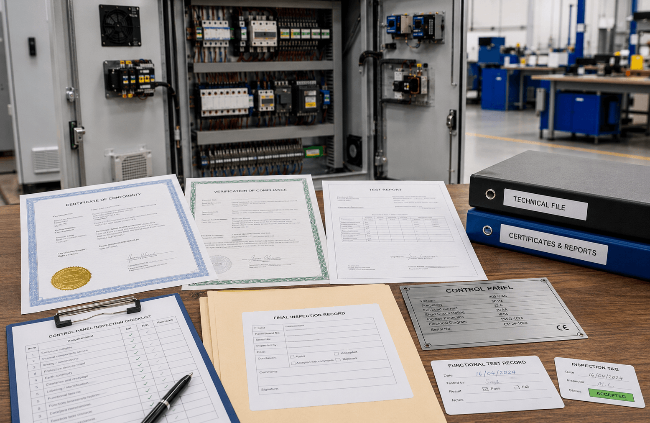
Beyond the Sticker: Why Control Cabinet Certifications Are the "Invisible Floor" of Industrial Safety
Executive Summary: In the world of industrial automation, a control cabinet without the right certification isn't just a technical oversight—it’s a legal and operational ticking time bomb. This guide moves past the paperwork to explore why UL, CE, and SCCR ratings are the true benchmarks of engineering integrity and how they protect your facility from the 11th-hour rejection of a site inspector.
The "clipboard" Moment: Why Certification Hits Hardest During Commissioning
We’ve all seen it: A beautifully wired control cabinet, packed with high-end PLCs and perfectly labeled cables, sitting idle on the factory floor. The project is behind schedule, the client is anxious, and then comes the "clipboard moment." A local electrical inspector or a site safety officer looks for a specific label—UL 508A, CE, or an SCCR rating—and doesn't find it.
Suddenly, that "perfect" cabinet becomes a liability.
In industrial procurement, certifications are often treated as an afterthought—a final box to check. But experienced engineers know that certification is not an administrative task; it is an engineering discipline. It is the difference between a system that is "technically functional" and one that is "legally and operationally safe."
1. UL 508A: The North American "Passport" for Control Panels
If you are shipping equipment to the United States or Canada, UL 508A isn't a suggestion; it’s a requirement for site acceptance.
Many buyers assume that if they use "UL-listed components" (like a Siemens PLC or a Rockwell contactor), the whole cabinet is automatically compliant. This is a dangerous misconception. UL 508A governs how those components are integrated—the spacing, the wire duct fill, the grounding, and the cooling.
Why OSHA Cares:
According to the U.S. Occupational Safety and Health Administration (OSHA), electrical hazards remain a top contributor to industrial workplace injuries. A UL 508A label tells an inspector that the panel was built to mitigate these specific risks (arc flash, fire, and shock).
- The Bottom Line: Without this label, many U.S. jurisdictions will refuse to "red tag" the power-up, stalling your entire production line indefinitely.
- Source: OSHA - Electrical Safety Standards
2. SCCR: The "Silent Math" That Prevents Catastrophic Fire
The Short-Circuit Current Rating (SCCR) is perhaps the most misunderstood part of the UL 508A standard, yet it is arguably the most critical for safety.
SCCR measures the maximum level of short-circuit current that a component or assembly can withstand without catching fire or exploding. In a massive manufacturing plant, the "available fault current" from the grid can be enormous. If your cabinet is rated for 5kA but the facility provides 50kA, a simple short circuit could turn your control panel into a bomb.
The NFPA Warning:
The National Fire Protection Association (NFPA 70 / NEC) requires that the SCCR of a control panel must be greater than the available fault current at the point of installation.
- The Pain Point: Many "budget" cabinets achieve low SCCR ratings by using cheap fuses or undersized components. When the inspector checks the math, the cabinet is rejected—resulting in a costly teardown and rebuild.
- Source: NFPA 70 - National Electrical Code
3. CE Marking: Conformity, Not Just Quality
For the European market, the CE Marking is the "Manufacturer’s Declaration" that the equipment meets all relevant EU health, safety, and environmental directives.
However, don't let the sticker fool you. Unlike UL, which often involves third-party testing, CE is frequently a self-declaration process based on the Low Voltage Directive (2014/35/EU) and the EMC Directive (2014/30/EU).
- The Reality Check: A "CE-marked" cabinet from a low-cost supplier might technically meet the legal minimums but lack the thermal management or wire organization needed for 24/7 industrial stress.
- Expert Advice: Always ask for the "Declaration of Conformity" (DoC). A supplier who can't provide the technical file behind the CE mark is a supplier who is cutting corners on your safety.
4. IEC 61439: The Global Language of Low-Voltage Assemblies
While North America follows UL, much of the rest of the world follows IEC 61439. This standard is the global blueprint for how low-voltage switchgear and control assemblies should behave.
The International Electrotechnical Commission (IEC) standards focus heavily on "design verification." It’s not just about if the door closes; it’s about how the cabinet handles a temperature rise of 30°C over 8 hours of peak load.
- Why it Matters: For multinational OEMs, building to IEC standards ensures that their machine can be sold in Australia, Brazil, or the UAE without a total electrical redesign.
- Source: IEC - 61439-1:2020 Standard
5. IP vs. NEMA: Protecting the "Brain" from the Environment
Finally, we have the environmental ratings. This is where most "mysterious" PLC failures begin.
- IP Ratings (IEC 60529): Focus on dust and water. An IP65 cabinet is "dust-tight" and protected against water jets.
- NEMA Ratings: Go further. They evaluate corrosion resistance, oil mist, and ice. A NEMA 4X enclosure is the "gold standard" for harsh chemical or coastal environments.
The Mistake: Choosing a cabinet based on an IP rating while ignoring the internal dew point. As noted by NEMA, a perfectly sealed cabinet can still fail if it doesn't have the right heaters to prevent internal condensation—a leading cause of "ghost faults" in PLCs.
- Source: NEMA - Enclosure Types Guide
The UniRegal Perspective: Why We Obsess Over Compliance
At UniRegal, we’ve seen the fallout of "unlabeled" engineering. We’ve seen 2,000 on a non-certified enclosure.
We don't view certifications as "paperwork." We view them as the engineering contract we sign with our customers. When we supply a component or a solution, we are verifying that:
- It is traceable: Every module has a pedigree.
- It is Tested: It meets the thermal and electrical stresses of the real world.
- It is Defensible: If an incident occurs, your insurance and your auditors will find a paper trail of compliance.
How to Audit Your Supplier:
Ask them three questions:
- "Can you provide the SCCR calculation for this specific layout?"
- "Does your design account for the thermal derating of the PLC inside this enclosure?"
- "What is the specific UL or IEC standard this build adheres to?"
If they hesitate, they aren't selling you a solution—they are selling you a risk.
Final Thoughts: Peace of Mind in a Label
The most expensive control cabinet is the one you aren't allowed to turn on.
Whether you are an OEM building for export or a plant manager upgrading a legacy line, certifications are your insurance policy against downtime, legal liability, and safety failures. They are the visible proof of invisible quality.Related guides
Need certified enclosures? We help match CE/UL/NEMA ratings to your market and source compliant enclosures from Foshan suppliers. Talk to our team about your project.
Need a technical review of your next control cabinet project?
Contact the UniRegal engineering team. Let’s get your system up and running and fully certified for the long haul.