Aug 27, 2026Case Studies
Control Panel Integration for a Water Treatment Project
Control Panel Integration for a Water Treatment Project — Why Multi-Brand Automation Systems Often Become Difficult to Operate Over Time One of the biggest misconceptions in industrial automation is t
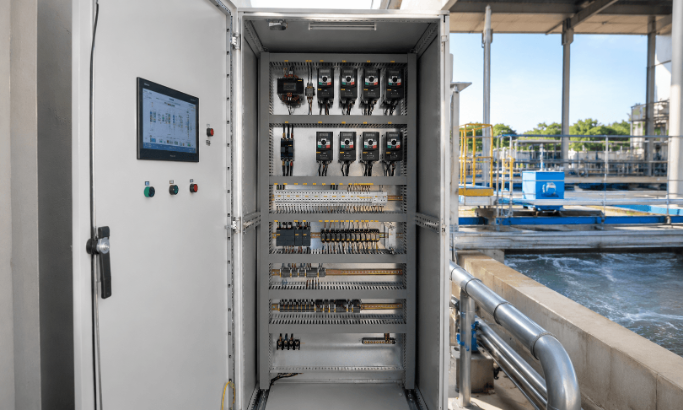
Control Panel Integration for a Water Treatment Project — Why Multi-Brand Automation Systems Often Become Difficult to Operate Over Time
One of the biggest misconceptions in industrial automation is the belief that successful integration simply means getting devices to communicate.
In reality, communication is usually the easy part.
The far more difficult challenge is ensuring that systems built by different vendors, designed at different times, and structured around different engineering assumptions can continue operating together predictably under real process conditions.
This becomes especially critical in water treatment projects.
Because unlike isolated machine automation, water treatment systems are continuous operational environments. Pumps, valves, dosing systems, pressure controls, alarm handling, and remote monitoring infrastructure all interact simultaneously across long operating cycles where stability matters more than speed.
In these environments, integration problems rarely appear as dramatic failures.
More often, they appear as the following:
- inconsistent system behavior,
- unstable process coordination,
- delayed operator response,
- intermittent communication faults,
- or increasing maintenance dependency on a small number of experienced engineers.
At first, the system still appears operational.
Over time, however, the facility becomes progressively harder to troubleshoot, expand, and manage confidently.
This case study explains how we helped a water treatment project address growing integration complexity between multiple PLC and VFD platforms by restructuring the control architecture around operational consistency rather than isolated device functionality.
The Facility Did Not Have a Device Problem—It Had an Architecture Problem
The project involved a water treatment system that had evolved gradually over multiple expansion phases.
Different process sections had been supplied by different vendors over time, resulting in a mixed automation environment containing:
- multiple PLC brands,
- different generations of VFDs,
- inconsistent communication structures,
- and varying HMI development approaches.
From a component-level perspective, the facility appeared technically functional.
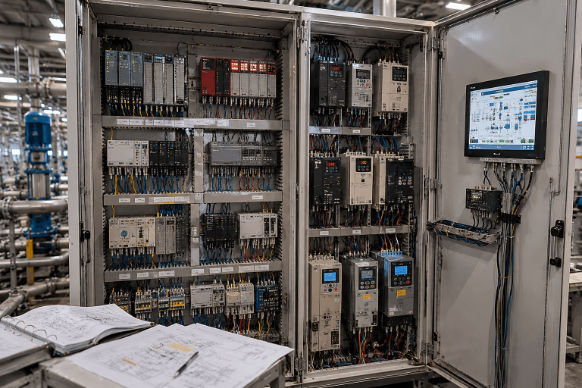
Individual systems operated correctly:
- pumps responded,
- VFDs communicated,
- instrumentation transmitted data,
- and local control logic executed properly.
Yet operationally, the system was becoming increasingly difficult to manage.
Commissioning teams and maintenance engineers repeatedly encountered situations where:
- Alarm behavior varied between subsystems
- operator interfaces displayed inconsistent process states,
- Fault recovery behavior differed across equipment
- and communication interruptions produced unpredictable operational responses.
Importantly, these were not catastrophic failures.
The problem was more structural:
The facility lacked a unified operational logic across the automation architecture.
And in long-running industrial process environments, architectural inconsistency becomes progressively more expensive over time.
Why Water Treatment Systems Become Increasingly Sensitive to Integration Quality
Water treatment automation is often underestimated because the process itself appears relatively stable compared to high-speed manufacturing environments.
But from a controls perspective, water treatment systems contain a unique form of operational sensitivity.
Unlike discrete automation systems where processes occur in defined cycles, water treatment facilities operate as continuously interacting process ecosystems.
Pump sequencing affects:
- pressure stability,
- chemical dosing,
- flow balancing,
- filtration timing,
- reservoir management,
- and sometimes environmental compliance conditions simultaneously.
That means automation behavior cannot be evaluated only at the device level.
The real challenge is how subsystems behave during the following:
- process transitions,
- abnormal operating conditions,
- communication interruptions,
- or partial equipment failures.
And this is precisely where many integration architectures begin showing weaknesses.
Because systems developed independently often contain hidden differences in
- timing assumptions,
- fault-handling priorities,
- alarm logic,
- operational state interpretation,
- and recovery behavior.
These differences may remain invisible during isolated subsystem testing.
They become visible only when the entire facility begins operating dynamically under real process conditions.
The Real Integration Problem Was Not Communication Failure
One of the most important findings during the project review was that communication itself was not the core issue.
In fact, most devices were already exchanging data successfully through existing industrial protocols.
The deeper problem was that the systems interpreted operational conditions differently.
This distinction became critical.
For example, during pump transition sequences:
- One PLC interpreted standby conditions based on pressure stabilization timing
- another prioritized flow confirmation,
- While certain VFD fault states triggered alarm responses differently depending on communication timing.
Technically, the devices were communicating.
Operationally, however, the system lacked behavioral consistency.
This is one of the most common problems in multi-vendor industrial automation projects.
Different automation suppliers often optimize around their own subsystem priorities:
- One focuses on equipment protection,
- Another emphasizes process continuity,
- another structure's alarms around maintenance diagnostics.
Individually, each design decision appears reasonable.
Collectively, however, they create a fragmented operational architecture where the facility no longer behaves predictably as a unified system.
And unpredictability is one of the most expensive forms of operational risk in continuous process industries.
Why Multi-Brand PLC and VFD Integration Becomes More Difficult as Facilities Expand
Many industrial integration problems do not originate from poor engineering.
They originate from gradual system evolution.
As facilities expand over years or decades, automation layers accumulate incrementally:
- additional pump stations,
- new process loops,
- upgraded instrumentation,
- replacement drives,
- remote monitoring systems,
- temporary operational modifications.
Each expansion phase is usually optimized around immediate project requirements rather than long-term architectural consistency.
This creates what many industrial facilities eventually experience:
functional systems with fragmented operational logic.
The challenge becomes especially severe when:
- Multiple PLC platforms coexist,
- communication standards evolve,
- and different engineering teams modify systems over time.
At that point, the automation architecture may still technically function while becoming progressively harder to
- troubleshoot,
- validate,
- upgrade,
- or operate confidently during abnormal conditions.
This project had reached exactly that stage.
The problem was no longer whether the system worked.
The problem was how much engineering interpretation was required to keep it working consistently.
Rebuilding the Control Strategy Around Operational Consistency
Instead of approaching the project as a communication compatibility exercise, we focused on operational coordination across the entire control architecture.
This required shifting the engineering perspective away from isolated device behavior and toward the following:
unified process behavior.
Several areas were restructured accordingly:
- PLC operational state coordination,
- alarm prioritization hierarchy,
- VFD response mapping,
- process interlock logic,
- HMI operational consistency,
- and communication fault handling.
One of the most important improvements involved standardizing how operational states were interpreted across systems.
Previously, similar conditions could generate different
- alarm responses,
- status indicators,
- or sequencing behavior
depending on which subsystem generated the event.
This increased operator uncertainty during troubleshooting because engineers needed to mentally translate process behavior between automation layers.
By standardizing operational logic, the system became far more behaviorally predictable under dynamic operating conditions.
Why HMI Design Quietly Became an Operational Risk Issue
Another important discovery involved the HMI structure.
At first glance, the interfaces appeared functional. Process data was visible, alarms existed, and operators could navigate the system.
However, operationally, the HMI architecture contained several inconsistencies:
- different naming conventions between process areas,
- inconsistent alarm grouping logic,
- varying navigation structures,
- and uneven visibility into communication-related faults.
This became particularly problematic during abnormal operating conditions when operators needed rapid situational clarity.
In industrial process environments, operator confidence depends heavily on:
- information consistency,
- alarm prioritization clarity,
- and the ability to understand system state quickly under pressure.
Poor HMI standardization increases cognitive load during troubleshooting, especially in facilities where multiple operators or maintenance teams interact with the system over time.
We restructured the HMI architecture around the following:
- unified process visualization,
- standardized alarm handling,
- consistent navigation hierarchy,
- and clearer subsystem relationship visibility.
The result was not simply a cleaner interface.
It was improved operational comprehension across the facility.
Stable Communication Required Architectural Discipline
Another important issue involved communication stability between PLC and VFD platforms.
Initially, the project appeared compliant because all devices technically supported the required industrial protocols.
But protocol compatibility alone does not guarantee operational reliability.
Long-term communication stability depends heavily on:
- polling architecture,
- network timing behavior,
- signal prioritization,
- grounding integrity,
- fault recovery logic,
- and synchronization strategy between automation layers.
Several intermittent operational disturbances were eventually traced to differences in how devices handled:
- communication delays,
- transient faults,
- and process state recovery.
These issues rarely appeared during static testing.
They emerged dynamically during:
- simultaneous pump transitions,
- rapid operational changes,
- and communication recovery events.
This is why industrial integration reliability is fundamentally an architectural discipline—not merely a protocol compatibility exercise.
Documentation Became Critical for Long-Term Maintainability
Another issue that surfaced during the review was documentation fragmentation.
As different vendors contributed to the system over time, engineering documentation had gradually lost structural consistency.
This increased dependency on tribal knowledge inside the facility because
- Only certain engineers fully understood subsystem relationships
- Troubleshooting required cross-referencing multiple documentation styles,
- and future modifications became increasingly difficult to validate safely.
One of the long-term risks in industrial automation is not immediate failure.
It is the gradual loss of maintainability as system complexity increases faster than documentation clarity.
To address this, we restructured the following:
- wiring documentation hierarchy,
- terminal mapping logic,
- communication architecture references,
- and I/O organization standards
into a more unified engineering framework.
This reduced operational dependency on individual engineers and improved long-term maintainability across future system expansions.
The result was not just better integration—it was greater operational predictability.
After restructuring the control architecture, the most important improvement was not simply communication stability.
It was operational predictability across the facility.
Operators experienced:
- more consistent process behavior,
- clearer alarm interpretation,
- improved fault response visibility,
- and reduced uncertainty during abnormal operating conditions.
Maintenance teams also benefited because troubleshooting became more systematic rather than heavily dependent on historical knowledge of subsystem differences.
Most importantly, the facility gained an automation structure that was easier to expand and support long-term.
And in continuous process industries like water treatment, long-term maintainability is often far more valuable than short-term commissioning success.
Final Thoughts
One of the biggest misconceptions in industrial automation is assuming integration quality is determined by whether devices can exchange data successfully.
In reality, mature industrial integration is measured by something far more difficult:
whether the entire operational system behaves predictably under real process conditions over time.
In water treatment environments, where systems operate continuously and process stability directly affects operational reliability, integration architecture becomes a long-term operational discipline rather than a one-time commissioning task.
That is why successful control panel integration requires more than technical compatibility.
It requires:
- consistent operational logic,
- unified process behavior,
- maintainable communication architecture,
- and engineering structures capable of remaining understandable years after the original project has been completed.
Because ultimately, the true challenge in industrial automation is rarely getting systems to communicate once.
The real challenge is ensuring they continue operating together reliably as complexity grows over time.