May 9, 2026Control Panels
7 Common Mistakes That Compromise Industrial Reliability
The Long-Term Cost of Poor Enclosure Design: 7 Common Mistakes That Compromise Industrial Reliability Executive Summary: An industrial enclosure is far more than "just a box." It is a controlled envi
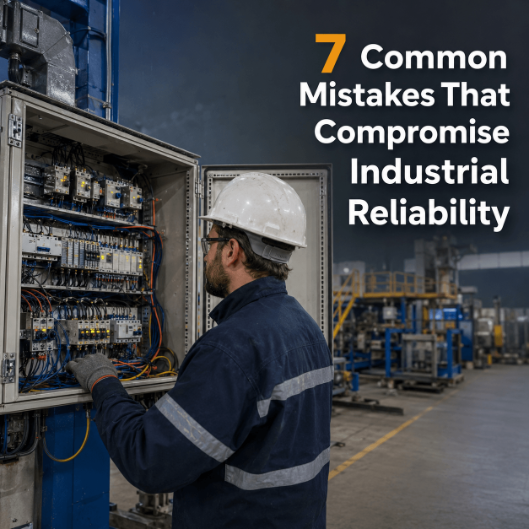
The Long-Term Cost of Poor Enclosure Design: 7 Common Mistakes That Compromise Industrial Reliability
Executive Summary: An industrial enclosure is far more than "just a box." It is a controlled environment for your facility's most critical intelligence. While many enclosure projects appear successful at commissioning, hidden design flaws in thermal management and environmental protection often manifest as systemic failures years later. This article analyzes the critical mistakes that lead to unplanned downtime and how to transition from a procurement mindset to a lifecycle reliability strategy.
The "Silent Guardian" Paradox
In industrial automation, the enclosure is the first line of defense. During the initial installation, everything usually looks perfect: the IP ratings are compliant, the wiring is tidy, and the system powers up without alarms.
However, the real test of an enclosure doesn't happen on Day 1. It happens in Year 3 or Year 5, when seasonal humidity cycles, accumulated thermal stress, and evolving production loads begin to expose early project shortcuts. By then, what started as a "minor oversight" has evolved into an expensive operational bottleneck.
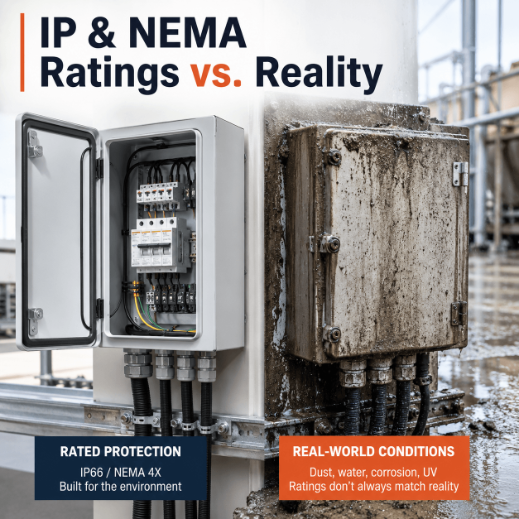
1. The "Checkbox" Compliance Trap: IP & NEMA Ratings vs. Reality
One of the most frequent mistakes is treating IP (Ingress Protection) or NEMA ratings as static, "set-and-forget" checkboxes.
According to the IEC 60529 standard, IP ratings are determined under specific, controlled laboratory conditions. They do not account for the long-term degradation caused by UV exposure, aggressive chemical washdowns, or the vibration-induced fatigue of seals.
- The Risk: A cabinet may be rated IP66 for water jets but fail to protect against "vapor breathing"—where rapid temperature changes suck humid air past seals, leading to internal corrosion.
- Expert Insight: Don't just source for the rating; source for the environment. Coastal or chemical environments require specific material science (e.g., 316L stainless steel vs. 304) that a simple IP rating won't specify.
- Source: IEC Webstore - IEC 60529:2013
2. Underestimating the "Thermal Chain Reaction"
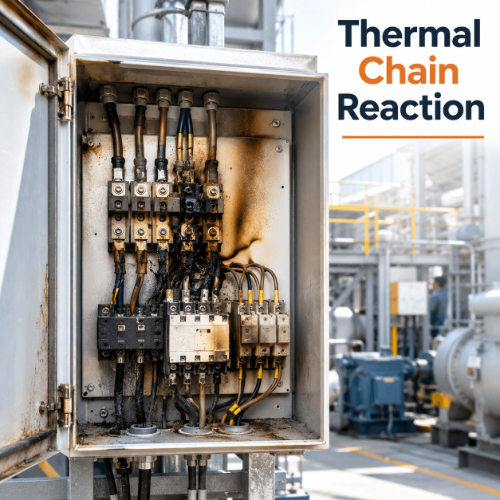
Heat is the #1 killer of industrial electronics. In modern automation, cabinets are becoming more dense with high-performance PLCs, VFDs, and industrial PCs—all of which are heat-intensive.
The assumption that "natural ventilation is enough" is a high-stakes gamble. Schneider Electric research indicates that elevated operating temperatures are a leading cause of premature component aging.
- The Rule of Thumb: Every 10°C rise above the recommended operating temperature can reduce the functional lifespan of a PLC or power supply by as much as 50%.
- The Invisible Failure: Heat-induced failures often appear as "ghost faults"—random communication drops or CPU resets that maintenance teams spend weeks troubleshooting, only to find the root cause was localized "hot spots" inside the cabinet.
3. Designing for the Present, Ignoring the Future (Scalability)
A project optimized solely for the current Bill of Materials (BOM) is a project destined for future failure. As facilities adopt Industry 4.0 and IIoT upgrades, cabinets inevitably need more space for:
- Edge computing gateways
- Additional I/O modules
- Upgraded networking switches
The Consequence: Overcrowded cabinets lead to restricted airflow and "cable nests" that make maintenance nearly impossible. At UniRegal, we recommend a minimum of 20-30% spare internal volume for any new enclosure project to lower the Total Cost of Ownership (TCO).
4. The Ergonomic Overlook: Neglecting the Maintenance Technician
An enclosure that looks sleek in a CAD drawing can be a nightmare on the plant floor. If a technician cannot easily access terminal blocks or replace a fan without dismantling half the system, your Mean Time to Repair (MTTR) will skyrocket.
Poor accessibility increases:
- Human Error Risk: Tight spaces lead to accidental wire disconnections.
- Safety Hazards: Difficulty in reaching isolation switches during emergencies.
- Labor Costs: What should be a 10-minute component swap becomes a 2-hour production halt.
5. The "Internal Weather" Problem: Condensation and Moisture Cycling
Many buyers mistakenly believe that if a cabinet is "sealed," it is safe from moisture. In reality, some of the most destructive moisture is created internally.
When a cabinet cools down at night, the internal air reaches its dew point, and water droplets form directly on sensitive PCB surfaces.
- The Solution: Proper environmental control requires more than just seals; it requires anti-condensation heaters and controlled hygrostats to manage the internal microclimate.
- Case Evidence: We have seen outdoor PLC cabinets in coastal regions fail within 18 months—not from rain, but from internal "sweating" that led to terminal oxidation.
6. The $2.5 Trillion Threat: Misunderstanding Corrosion
Corrosion is often viewed as an aesthetic issue, but it is fundamentally a reliability threat. The AMPP (Association for Materials Protection and Performance) estimates that the global cost of corrosion exceeds $2.5 trillion annually.
In industrial settings, corrosion doesn't just eat the metal; it compromises the following:
- Grounding Integrity: Rusty enclosures lose their electrical bonding, creating safety risks and EMI (Electromagnetic Interference) issues.
- Seal Longevity: Corrosion around door hinges and latches eventually prevents the door from sealing correctly, voiding the IP rating.
7. Procurement vs. Reliability: The Strategic Pivot
The deepest mistake is viewing an enclosure as a CAPEX (Capital Expenditure) item to be minimized, rather than an OPEX (Operational Expenditure) protector.
A "cheap" enclosure might save $1,000 on the initial quote, but if it causes a single hour of unplanned downtime due to overheating or a condensation-induced short circuit, the "savings" are instantly erased.
How Professional Buyers Evaluate Enclosures:
Metric | Procurement Mindset | Reliability Mindset |
|---|---|---|
Selection Criteria | Lowest Initial Cost | Total Cost of Ownership (TCO) |
Protection | Basic IP/NEMA Rating | Environmental Micro-climate Control |
Thermal | Passive Ventilation | Active Thermal Design & Load Analysis |
Future-Proofing | Tightest Fit (Save Space) | 20%+ Expansion Capacity |
Final Thoughts: Protecting the Stability of Your Operation
An enclosure is not just a shell; it is the cradle of your system’s intelligence. When an enclosure fails to manage heat, moisture, or accessibility, it doesn't just damage a component—it destabilizes your entire production schedule.
At UniRegal, we help industrial leaders move beyond the "box" and build systems that thrive in the harsh reality of the plant floor. Whether you are dealing with legacy equipment upgrades or new automation builds, ensuring the integrity of your enclosure is the most cost-effective insurance policy you can buy.
Is your current enclosure strategy creating a future downtime crisis?
Contact us for a comprehensive enclosure audit or to source verified, high-performance spares that stand the test of time.